
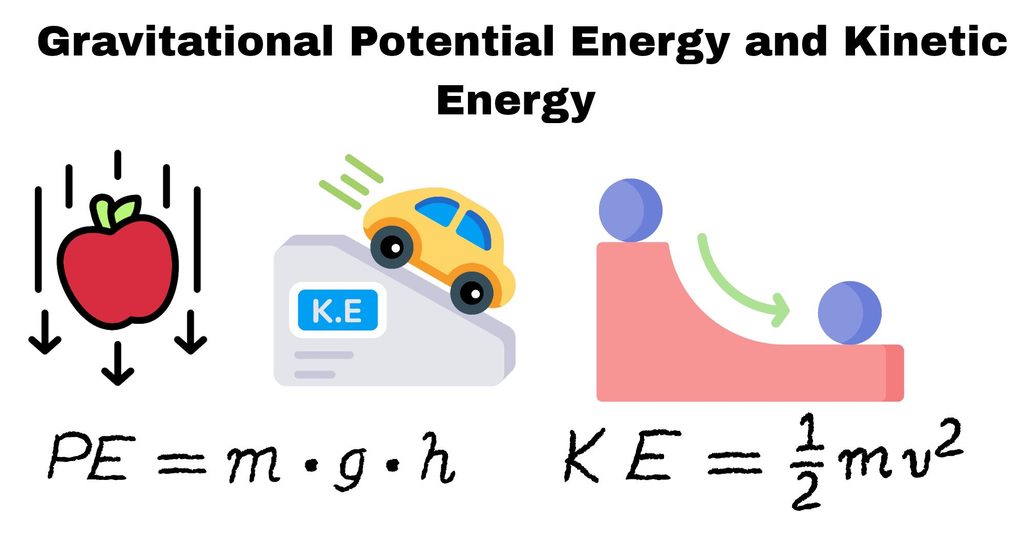
Gravitational potential energy and kinetic energy are very much related terms. The terms come under the same roof of mechanical energy. Their brief knowledge and significances are presented below:
Gravitational Potential Energy
Gravitational potential energy is a special type of potential energy where the position of an object lies at a certain height where gravity is acting. For example, a bucket of water lifted above the ground has gravitational potential energy stored in it. We have to do more work to lift objects at greater height, and since work done and energy are directly related, the same object at greater height will have greater gravitational potential energy than at lower height.
Kinetic Energy
Kinetic energy is the energy of motion, whatever be its type, like horizontal motion, vertical motion, rotational motion, sinusoidal motion, or motion along curved paths. For example, falling water, rolling ball, rotating wheel, moving bus, etc. all have kinetic energy. Even a small object can possess considerable kinetic energy if it moves at a sufficiently high speed.
Relationship Between Potential Energy and Kinetic Energy
Gravitational potential energy and kinetic energy have an inverse relation, as one talks about rest and the other about motion. An object having maximum potential energy cannot possess kinetic energy and vice versa. As soon as potential energy starts decreasing, kinetic energy starts increasing, and when potential energy is zero, kinetic energy becomes maximum. For example, when a stone is thrown upward and falls freely under gravity, its gravitational potential energy decreases while its kinetic energy increases. When the stone initially moves upward, its kinetic energy is gradually converted into gravitational potential energy. These two forms of energy demonstrate how energy continuously changes from one form to another in nature.
Gravitational Potential Energy Formula and Derivation
An object holding its position due to the influence of gravity is said to store gravitational potential energy. As we raise the object upward, we do some work that becomes against gravity. Hence, this work done becomes the energy of its position, i.e., gravitational potential energy.
Derivation of Gravitational Potential Energy
Suppose we have an object on the ground which is lifted against gravity. Let its mass be ‘m’, and it is taken to the height ‘h’. Of course, a gravitational force acts on that object equal to its weight. Therefore,
Weight = Gravitational Force (F) = mg [Equation 1]
(g = Acceleration due to gravity)
When we lift an object up with constant speed, an external force is required that is equal to its weight. Thus,
Applied force = mg [Equation 2]
Now, the work done by this constant external force will be:
Work done = Force × Displacement [Equation 3]
Here, displacement is the height obtained, and if height is h, then:
W = F × h [Equation 4]
Substituting [Equation 1] into [Equation 4], we get,
W = mg × h
W = mgh [Equation 5]
This work done is stored as gravitational potential energy on that object.
Thus, we have the expression for gravitational potential energy as:
GPE = mgh [Equation 6]
The SI unit will also be the same as that of energy, i.e., joule (J).
To derive the SI unit:
From equation (6), we can derive the SI unit of gravitational potential energy as:
GPE = kg × m/s² × m
= kg m²/s²
= Joule (J)
For gravitational potential energy, one joule is defined as the energy stored in an object lifted through a height of one metre by a force of one newton.
Important Considerations
The formula for gravitational potential energy can be applied only for the constant gravitational field strength, i.e., the value of ‘g’ must be approximately constant for the objects near the Earth’s surface.
Also, gravitational potential energy can differ according to the reference level taken.
The change in gravitational potential energy is more important than its absolute value in most practical situations.
If an object moves from an initial height h₁ to a final height h₂, its change in gravitational potential energy is:
ΔGPE = mg(h2 – h1) [Equation 7]
From equation (7), we see that if the object moves upward, the GPE increases and vice versa.
Kinetic Energy Formula and Derivation
Kinetic energy occurs when an object is in motion. A moving object can perform work on another object when it collides with it or interacts with it.
For example, a moving hammer can drive a nail into wood, and flowing water can rotate a turbine’s blades. These examples demonstrate that moving objects possess energy.
Derivation of Kinetic Energy
Suppose an object at rest is moved by a force and performs a displacement. Let its mass be ‘m’, force be ‘F,’ and the displacement be ‘s’. As the object moves, its velocity also increases from 0 to v.
From Newton’s second law of motion,
F = ma [Equation 8]
(a = acceleration produced)
The work done will be:
W = F × s [Equation 9]
Using equation (8) in equation (9), we get,
W = mas [Equation 10]
From the third equation of motion,
v2=u2+2as
Since the object initially starts from rest,
u = 0
Therefore,
v2=2as
Rearranging,
as=v2/2
Substituting this value into the work equation,
W=mv2 /2
W=½ mv2 [Equation 11]
Since this work done is equivalent to the energy of motion, i.e., kinetic energy, equation (11) is the expression for the kinetic energy for an object starting from rest.
KE = ½ mv2 [Equation 12]
The SI unit of kinetic energy is also the same as that of energy, i.e., joule (J).
From equation (12), we can derive its SI unit as:
KE = kg × (m/s)²
= kg m²/s²
= Joule (J)
From equation (12), we can draw the following conclusions:
Kinetic energy depends on
- the mass of an object.
- square of its speed.
Things to consider:
- A resting object has zero kinetic energy relative to the chosen reference frame.
- Kinetic energy is either zero or positive.
- If the velocity of an object doubles, its kinetic energy becomes four times greater.
- If the mass of an object doubles, its kinetic energy also doubles (keeping velocity constant).
Note that, although velocity is a vector quantity, its square gives its magnitude, which makes the kinetic energy a scalar quantity.
Factors Affecting Gravitational Potential Energy and Kinetic Energy
Both energies- gravitational potential energy and kinetic energy are affected by certain factors; some may be common, and some are different physical quantities, which are given below:
Factors Affecting Gravitational Potential Energy
From equation (6), we see that GPE depends on the object’s mass, height, and the acceleration due to gravity.
-Mass of the Object
From equation (6), we see the relation,
GPE ∝ m for constant height and g.
Hence, increasing mass can obviously increase the GPE.
-Height of the Object
Again, from equation (6), we find,
GPE ∝ h for constant mass and g.
This means that an object placed at a greater height from the reference level will have more gravitational potential energy than the same object placed at a lower height from the same level.
-Acceleration Due to Gravity
Also, from equation (6)
GPE ∝ g, for a constant value of mass and the height from the reference level.
Thus, for the same mass and height, an object will have more gravitational potential energy in a region where gravitational acceleration is greater.
Factors Affecting Kinetic Energy
According to the formula of kinetic energy, the following two factors affect it.
-Mass of the Object
From equation (12), we find that,
KE ∝ m
Therefore, at constant speed, increasing mass can get more kinetic energy.
-Velocity of the Object
Also, from equation (12),
KE ∝ v²
This means that keeping mass constant, even a small increase in velocity can produce a significant increase in the kinetic energy; for example, if velocity doubles, kinetic energy becomes four times greater, if it triples, kinetic energy becomes nine times greater, and so on. This relationship is very important for the safety purposes of moving vehicles because the kinetic energy of a moving vehicle increases rapidly with speed.
Energy Transfers Between Potential and Kinetic Energy
Energy always gets transferred from one object to another or is transformed from one form into another. Gravitational potential energy and kinetic energy are also transferred, and this can be commonly observed in everyday life.
Conversion of Potential Energy into Kinetic Energy
Checking on a stone held at a certain height above the ground, initially, the stone is at rest, and hence the energy it holds is the gravitational potential energy.
Now, let’s release the stone and see it falling. As it falls under gravity and its height decreases, the GPE also decreases, which makes increase in its kinetic energy due to the increased motion.
Therefore, just before reaching the ground, the stone will have maximum kinetic energy and minimum gravitational potential energy relative to the ground. Hence, a complete transfer of gravitational potential energy to kinetic energy can be observed.
Conversion of Kinetic Energy into Potential Energy
To demonstrate this, let’s throw a ball vertically upward.
Initially, the ball will be at its maximum kinetic energy at the point of projection. As it moves upward, its velocity decreases due to the gravitational force trying to pull it downward. At the same time, since the work is being done against the force, gravitational potential energy rises, and kinetic energy decreases.
At the maximum height, the ball finally comes to rest, and hence kinetic energy becomes zero, while its gravitational potential energy is maximum relative to the projection point. Once reaching the maximum height, it starts falling, and the kinetic energy starts to increase.
Energy Changes During the Motion of a Falling Object
If an object is falling with its mass m from the height H (consider no air resistance),
At the initial position,
- Height = H
- Velocity = 0
- Potential energy = mgH
- Kinetic energy = 0
After the object falls a distance x,
Remaining height to travel = H − x
Therefore, potential energy becomes
PE=mg(H-x)
Using the equation of motion:
v2=2gx
Kinetic energy:
KE=½ mv2
KE=½ m(2gx)
KE=mgx
At this position, total mechanical energy is:
ME=PE+KE
ME=mg(H-x)+mgx
ME = mgH
Hence, the total mechanical energy is not affected when considering no resisting forces.
Conservation of Mechanical Energy
Mechanical energy always means two forms of energy: potential energy and kinetic energy. Their combination means the total mechanical energy. So, the conservation principle of mechanical energy states that the total mechanical energy for a system is always constant given that the non-conservative forces are absent on that system.
Therefore,
ME=KE+PE [Equation 13]
For an object moving only under the influence of gravity, its total mechanical energy is given by:
KE+GPE=Constant [Equation 14]
Or,
KE₁+GPE₁=KE₂ +GPE₂
Where,
- KE₁ = Initial kinetic energy
- GPE₁ = Initial gravitational potential energy
- KE₂ = Final kinetic energy
- GPE₂ = Final gravitational potential energy
Conditions for Conservation of Mechanical Energy
- Only conservative forces, such as gravitational force or elastic spring force, should be acting on the system.
- Non-conservative forces, such as friction and air resistance, should be absent or negligible.
- The system should have consistent conditions, with the same reference level for potential energy.
- The total mechanical energy must remain unaffected.
However, reality is affected by resisting factors. Hence, some mechanical energy always gets wasted into other forms like heat energy, sound energy, etc.
Solved Problems on Gravitational Potential Energy and Kinetic Energy
Some of the solved problems are given below to understand their formula and calculations better.
Problem 1:
Find the gravitational potential energy of a 5 kg object, 10 m high from the ground (g = 9.8 m/s²).
Solution:
Given,
Mass, m = 5 kg
Height, h = 10 m
Value of g = 9.8 m/s²
We know that,
GPE = mgh
Putting all the given values,
GPE = 5 × 9.8 × 10
GPE = 490 J
Hence, the GPE of the object is 490 J.
Problem 2:
To find the kinetic energy of a car of mass 1000 kg moving with a constant velocity of 20 m/s:
Solution:
Given,
Mass, m = 1000 kg
Velocity, v = 20 m/s
We have,
KE=½ mv2
Putting all the given values,
KE=½ x 1000 x 202
KE=500 x 400
KE = 200000 J
Hence, the kinetic energy of the car is 200000 J or 200 kJ.
Problem 3:
To find the height of an object of mass 2 kg and GPE 196 J (g = 9.8 m/s²)
Solution:
Given,
Mass, m = 2 kg
Gravitational potential energy = 196 J
Value of g = 9.8 m/s²
We have,
GPE = mgh
Rearranging,
h=GPE/mg
Substituting the values,
h=196 / 2×9.8
h=196/19.6
h = 10 m
Hence, the height is 10 m.
Problem 4:
To find the velocity of a moving ball having mass 4 kg and kinetic energy 200 J:
Solution:
Given,
Mass, m = 4 kg
Kinetic energy = 200 J
We know that,
KE=½ mv2
Rearranging,
v2=2KE/m
v = √2KE/m
Substituting the values,
v=√2×200/4
v=√100
v = 10 m/s
Hence, the ball is moving with a velocity of 10 m/s.
Problem 5:
To find the velocity of a falling ball just before reaching the ground, with mass 2 kg and dropped from 20 metre height (g = 9.8 m/s²):
Solution:
Given,
Mass, m = 2 kg
Initial height, h = 20 m
Initial velocity, u = 0
Value of g = 9.8 m/s²
Using the conservation principle,
Initial mechanical energy = Final mechanical energy
Initially, the stone is at rest. Therefore,
Initial kinetic energy = 0
Initial potential energy = mgh
At the ground, potential energy = 0.
Therefore,
mgh=½ mv2
Cancelling m from both sides,
gh=½v2
v2 = 2gh
Substituting the values,
v2=2×9.8×20
v2=392
v=√392
v ≈ 19.8 m/s
Answer: The velocity of the stone just before reaching the ground is approximately 19.8 m/s.
Problem 6:
Find the total mechanical energy of a 3 kg ball moving 4 m/s above a height of 5 m. (g = 9.8 m/s²):
Solution:
Given,
Mass, m = 3 kg
Velocity, v = 4 m/s
Height, h = 5 m
Value of g = 9.8 m/s²
Using conservation of mechanical energy, M.E. = K.E. + GPE
First, calculate kinetic energy.
KE=½ mv2
KE=½ x 3 x 42
KE = 24 J
Now, calculate gravitational potential energy.
GPE = mgh
GPE = 3 × 9.8 × 5
GPE = 147 J
Therefore,
ME = 24 + 147
ME = 171 J
Answer: The total mechanical energy of the ball is 171 J.
Applications of Potential and Kinetic Energy
Some major applications of potential and kinetic energy are given below:
Hydroelectricity
While generating hydroelectricity, the power stations store water in dams at a certain height and hence use the gravitational potential energy of water. Now, on releasing water, it flows with a certain velocity through pipes and acquires kinetic energy. Now the turbines rotate, and the generators convert this mechanical energy into electrical energy. Hence, in the whole process, there is the conversion of potential energy, kinetic energy, and thus gained mechanical energy into electrical energy.
Roller Coasters
As the roller coaster initiates, it moves with a certain velocity and reaches the top of a hill. At the top, it remains at the gravitational potential energy and then gradually falls freely with the kinetic energy. Hence, there is a continuous chain of conversion between potential and kinetic energy. However, some mechanical energy is wasted in the form of heat and sound produced by the roller coaster due to friction and air resistance. Also, some external energy input is needed to lift the cars to their initial height.
Pendulum Motion
When displaced from the mean position, a simple pendulum reaches the extreme position with maximum gravitational potential energy, then oscillates under gravity towards the mean position with increasing kinetic energy and decreased potential energy. The same process keeps on going until it finally comes to rest.
Falling Objects
Objects falling freely under gravity are the best examples to show the conversion of gravitational potential energy into kinetic energy. For example, projectiles, raindrops, falling leaves, etc.
Sports and Physical Activities
Many sports like basketball, football, volleyball, etc., involve the motion of a ball under gravity and hence, we clearly see the inter-conversion between kinetic and potential energies.
Cranes and Lifting Machines
The activity of lifting heavy objects to a certain height also involves gravitational potential energy, whether it is done manually or by heavy lifting machines like cranes. The work is done against gravity, and on lowering the objects, this potential energy is converted to kinetic energy.
Transportation and Vehicle Safety
Kinetic energy is maintained carefully for vehicles and transportation because even a small increase in velocity can tremendously increase the motion and hence the kinetic energy. This can make the vehicle uncontrolled or difficult to keep in track. The braking systems are therefore introduced to make the vehicles stop using friction. Friction helps to convert this mechanical energy into thermal energy and reduce the mechanical energy.
Conclusion
The total mechanical energy comes from both potential energy and kinetic energy, and gravitational potential energy is also one special kind of potential energy that accounts for gravity. However, these two energies work together to result in the total mechanical energy. Gravitational potential energy comes when an object is worked against gravity and kept at a certain height, whereas kinetic energy always refers to motion energy.
The expressions for gravitational potential energy and kinetic energy are respectively:
GPE = mgh and KE = ½mv².
From their expressions, we can conclude that gravitational potential energy requires mass, height, and the value of acceleration due to gravity, whereas kinetic energy requires mass and velocity only for the calculation.
As they are forms of mechanical energy, the total mechanical energy is said to be conserved if they interchange their forms but keep the total energy the same as before. However, in reality, we may get some loss in mechanical energy due to the action of non-conservative forces on the body.
These concepts are seen casually in our lives, such as moving vehicles, sports, modern technologies like hydroelectric power generation, etc. Hence, they are simple but very strong foundations of mechanics. To sum up, they help to understand basic to complex motions easily.
References
- Urone, P. P., Hinrichs, R., & Beceiro-Novo, S. (2012). Gravitational Potential Energy. ISP209: The Mystery of the Physical World.
- Wu, J., & Maltese, A. (2022). 5.1 Work, Kinetic, and Potential Energy. STEM for Educators.
- Kuehn, K. (2015). Kinetic and Potential Energy. In A Student’s Guide Through the Great Physics Texts: Volume III: Electricity, Magnetism and Light (pp. 113-122). Cham: Springer International Publishing.
- https://thisvsthat.io/gravitational-potential-energy-vs-kinetic-energy
- https://www.bbc.co.uk/bitesize/articles/zvrxb7h#zqmwvj6
- https://biologyinsights.com/how-are-kinetic-energy-and-gravitational-energy-related/
- https://www.miniphysics.com/secondary/g3-science/physics/energy/kinetic-and-gravitational-potential-energy
