
Energy conservation is all about the behavior of energy when any physical changes occur in objects. In physics, energy conservation is a fundamental law that says: energy is always conserved, whatever may be its form. We experience energy in different forms like mechanical energy, thermal energy, chemical energy, electrical energy, light energy, and sound energy. All these forms can be converted into one another, and hence energy changes its form.
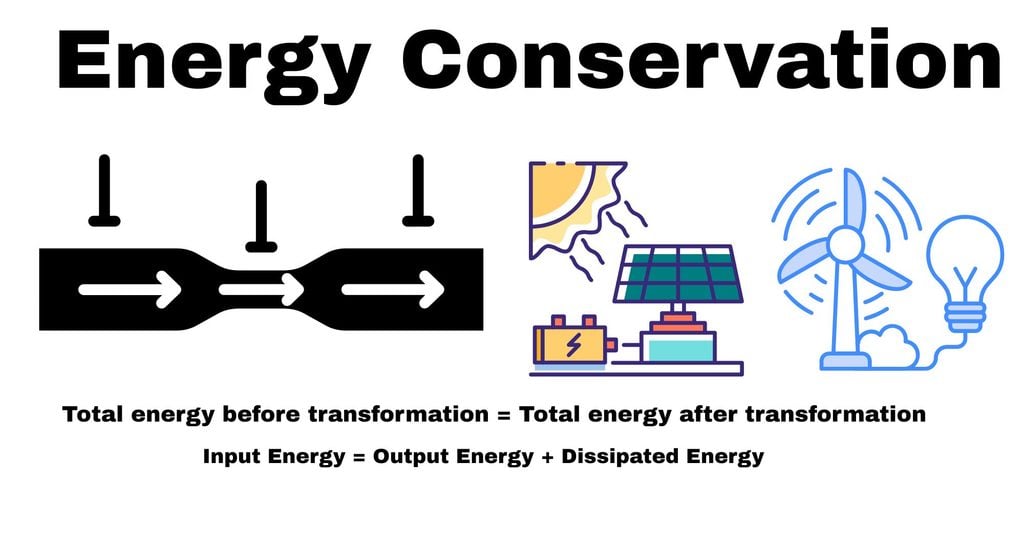
Energy conservation occurs naturally and is frequent everywhere in daily life. Hence, to understand nature and also energy-based technologies, it is very important to understand this principle. Engineers build different designs, machines, power plants, vehicles, and renewable energy systems on the basis of energy conservation. Scientists use it to analyze the motion of objects and the operation of several systems.
In environmental terms, energy conservation means saving energy, which is a different term than the law in physics. Hence, this difference must be recognized by the students and used as per the context of their study.
Work Done and the Work-Energy Principle
Work and energy are the same physical quantities as they have the same units. In physics, work is done when a force makes an object move, causing a displacement. Applying a force without producing displacement does not result in mechanical work.
For a constant force and displacement occurring in the same direction, work done is given by:
W = Fs [Equation 1]
where:
- W = work done
- F = applied force
- s = displacement of the object
Work has the SI unit joule (J). One joule of work is done when a force of one newton produces one metre of displacement, and this displacement is in the direction of the force.
If a force acts at an angle θ to the displacement, the work done is:
W = Fs cos θ [Equation 2]
From equation (2), we see that the work done becomes zero if the component of force and the displacement are perpendicular to each other. Hence, they must be parallel to each other to have work done. Also, when the force acts in the same direction as the displacement, the work done is positive and vice versa.
For example, if a person is pushing a box forward, the box will move forward, and the applied force is said to be doing positive work. However, friction can oppose this motion and can result in negative work. The net work is the sum of the work done by all forces acting on the box.
Kinetic Energy
Kinetic energy is the moving energy because it is associated with the motion of an object and given by:
KE = ½mv² [Equation 3]
where:
- KE = kinetic energy
- m = mass of the object
- v = speed of the object
Energy and work done have the same units.
From equation (3), we can see that kinetic energy has a direct relation to the mass and the square of speed. Therefore, if an object moves twice as fast as another object of the same mass, it will have four times as much kinetic energy.
The Work-Energy Principle
The work-energy principle is a relation showing the work done related to the change in kinetic energy.
Mathematically,
Wₙₑₜ = ΔKE [Equation 4]
Therefore,
Wₙₑₜ = KE₂ − KE₁
or,
Wₙₑₜ = ½mv² − ½mu² [Equation 5]
(u = initial speed, v = final speed)
Hence, this principle is very important to describe the motion, work done, and energy. When the net work done on an object is found to be positive, we can say the kinetic energy of the object or a system increases, and vice versa. For the net work obtained to be zero, we say the kinetic energy has remained constant.
The work-energy principle is very useful in analyzing motion because it relates forces, displacement, and speed. This does not always require the calculation of acceleration and time.
Principle of Conservation of Energy
The principle of conservation of energy states that the total energy of an isolated system remains constant. Energy may be converted from one form into another, but it cannot be created or destroyed.
Mathematically,
Total energy before transformation = Total energy after transformation
If a system is dealing only with change in mechanical energy, i.e., only kinetic energy and potential energy, the principle is given as:
KE₁ + PE₁ = KE₂ + PE₂ [Equation 6]
This equation holds for systems having mechanical energy conserved. It means that the energy is purely mechanical and there is no transfer of energy into other forms like thermal energy, friction, or air resistance.
Conservation of Mechanical Energy
Mechanical energy is the total energy, i.e.
Mechanical energy = Kinetic energy + Potential energy
(Kinetic energy = Energy of motion, Potential energy = Energy of position)
Therefore,
ME = KE + PE
For an object moving under gravity near Earth’s surface,
PE = mgh [Equation 7]
where:
- m = mass of the object
- g = acceleration due to gravity
- h = height of fall
An object falling freely has maximum gravitational potential energy at its initial point and zero kinetic energy. But the potential energy gradually decreases as soon as it starts falling, giving gradually increasing kinetic energy. Thus, the energy is transferred, and hence the total mechanical energy becomes constant.
For a ball falling from a certain height, just before reaching the ground, its potential energy relative to the ground is approximately zero, while its kinetic energy is maximum.
The transformation can be represented as:
Gravitational potential energy → Kinetic energy
When the air resistance is negligible or ignored, we can find the total mechanical energy as constant throughout the fall.
Energy Transfers and Dissipation
Energy transfer is a process of energy passing from one system to another, and this transformation occurs when energy changes its form. Energy is always changing its form in practice while performing mechanical work, heating, electrical processes, radiation, etc. For example, when we hit a ball, the mechanical energy is transferred from our hand to the ball. Also, we receive energy from sunlight through electromagnetic radiation. However, the received energy may not always be in a useful form. The surroundings consume some energy in many real processes, and hence the energy is lost. This process is called energy dissipation.
Energy Dissipation Due to Friction
Friction is a main cause of energy dissipation. When two surfaces slide against each other, some mechanical energy is transformed into thermal energy.
The energy is not destroyed. Instead, it is transferred into forms that are less easily converted back into the original mechanical motion.
A bouncing ball on the ground undergoes energy loss during each bounce. Some energy is transferred into sound, while some becomes thermal energy and deformation of the ball and ground. As a result, the ball reaches a smaller height after each bounce.
Dissipation Due to Air Resistance
Air tries to block the motion of the object passing through it, and hence some energy is dissipated. It plays a vital role for objects travelling through air and objects in motion.
Useful and Dissipated Energy
In practical devices, the input energy comes out as useful energy output and dissipated or transferred energy.
For example, an electric motor is supplied with electrical energy and gives out mechanical energy. However, some input energy is also transferred as heat due to electrical resistance and friction, and as sound.
A simplified energy balance is:
Input energy = Useful energy output + Dissipated energy
The causes of energy dissipation can somehow be reduced by using techniques like lubricating agents, high-quality internal materials, proper insulation to control heat transfer, etc. But energy dissipation cannot be fully controlled; we can just reduce it.
Efficiency and Its Formula
Efficiency is a technique to measure the performance of any machine or physical system in terms of energy or work done or power. It is either expressed as a fraction or a percentage
No practical machine is perfectly efficient because some input energy is usually transferred into unwanted forms, such as heat and sound.
The efficiency of a machine can be calculated as:
Efficiency = (Useful energy output / Total energy input) × 100% [Equation 8]
Or,
Efficiency = (Useful work output / Total work input) × 100% [Equation 8a]
Or,
Efficiency = (Useful power output / Total power input) × 100% [Equation 8b]
Efficiency is often measured to perform a comparison between machines and physical systems. This helps to improve the efficiency of those systems by keeping the energy losses minimum. However, the efficiency of a practical machine can be lost because of practical conditions like friction, vibrations, resistance, etc. Thus, we cannot expect a 100% output from a machine or a practical system.
For example, efforts to reduce friction, like using lubricating agents in the parts of engines, can improve the performance of vehicles and transport systems.
Measuring efficiency is very important in power generation. Before power generation, the efficiency of the available energy of the water flow is calculated.
One cannot depend only on efficiency alone for a particular purpose. Other factors like cost, reliability, safety, environmental impact, etc. are also considered equally before using a particular machine.
Power in Physics: Definition, Formula, and Units
Power is a mathematical measure of the work done and gives the rate at which the work or energy transfer is done. Hence, it concentrates on the speed of transferring energy by a machine, person, or any physical system.
For example, two machines may perform the same amount of work but in different time periods. The machine that performs the work in less time has greater average power.
Formula for Power
Average power is given by:
P = W / t [Equation 9]
where:
- P = average power
- W = work done
- t = time taken
Since work is a transfer of energy, power can also be expressed as:
P = E / t [Equation 10]
where E is the energy transferred during the time interval.
The SI unit given to power is the watt (W), and one watt of power is defined as one joule of energy transferred per second.
1 W = 1 J/s
Larger units like kilowatt (kW) and megawatt (MW) are also used in practical applications.
Average Power and Instantaneous Power
Both are mathematical measures; however, average power takes the total work done and divides by the total time taken, and instantaneous power takes any instant of time and measures the energy transfer at that particular time.
Average power = Total work done / Total time taken
Instantaneous power = dW/dt [Equation 11]
where dW represents a very small amount of work done during a very short time interval dt.
Instantaneous power is especially used when force or velocity are changing continuously.
Importance of Power
The power calculation is important in many applications.
- In transport, the power of an engine is calculated to measure the ability of that engine to transfer energy to move a vehicle.
- In electrical systems, the power of an electrical device means the rate at which that device consumes or transfers electrical energy.
- In sports, power means the ability of a player to perform mechanical work.
Many of us are still confused between energy and power. Thus, we must be clear in concept that energy means the capacity, and power means the rate of doing work.
For a device operating at constant power,
E = Pt [Equation 12]
where E is the energy transferred, P is the power, and t is the operating time.
This relationship is widely used to calculate electrical energy consumption and the energy requirements of machines.
Power Equations: P = W/t and P = Fv
Power can be calculated in different ways depending on the information available. Two particularly useful equations in mechanics are P = W/t and P = Fv.
Power Equation: P = W/t
The equation
P = W / t
is used to calculate average power when the work done and the time taken are known.
For example, if a machine performs 6,000 J of work in 20 s, its average power is:
P = W / t
P = 6,000 / 20
P = 300 W
Therefore, the average power of the machine is 300 W.
This equation is useful for comparing machines that perform the same task in different periods. If two machines perform the same amount of work, the machine that takes less time has greater average power.
Applications of P = Fv
This equation is useful for calculating the power required to move vehicles, lift loads, and operate machines.
For example, we can calculate the power delivered by the engine to the wheels by using this equation if the vehicle is moving at a constant speed on a level road. For this, the driving force provided by the engine and the speed of the vehicle must be known.
The equation can also be used for lifting machines working at a constant speed.
Another formula for power is given by:
P = Fv [Equation 13]
Equation (13) is the case when mass is being lifted vertically at speed v.
Since F = mg,
P = mgv [Equation 14]
From the above equation, we see that power is directly related to the speed and the mass of the object being lifted.
Relationship Between Power, Force, and Velocity
From the equation P = Fv, we see that the power depends on both force and velocity when they act in the same direction.
A large force does not always mean that the power is greater. If the object still holds its rest position, the velocity will be zero, and hence the power becomes zero.
Similarly, if the action of a small force makes an object move with greater velocity, the power can be very high.
This idea is used while analyzing engines, motors, cranes, elevators, and other mechanical systems.
Solved Problems on Energy Conservation, Efficiency, and Power
Problem 1
Suppose a ball of mass 2 kg is falling from a height of 10 m. Calculate its initial gravitational potential energy and its speed before hitting the ground. Consider air resistance to be negligible and use the value of g as 10 m/s².
Solution:
Given:
Mass, m = 2 kg
Height, h = 10 m
Acceleration due to gravity, g = 10 m/s²
Initial speed, u = 0 m/s
Now,
PE = mgh
PE = 2 × 10 × 10
PE = 200 J
Hence, the gravitational potential energy is 200 J.
Again,
Since the ball is at rest initially, its kinetic energy is zero.
Total initial mechanical energy = 200 J
Before hitting the ground, the ball is in motion, and hence the potential energy is approximately zero, and the kinetic energy is 200 J.
KE = ½mv²
200 = ½ × 2 × v²
200 = v²
v = √200
v ≈ 14.1 m/s
Hence, the initial potential energy is 200 J, and the speed just before reaching the ground is approximately 14.1 m/s.
Problem 2
Suppose a 5 kg object initially moving at 2 m/s is allowed to accelerate; the speed becomes 6 m/s. What is the net work done on the object?
Solution:
Given:
Mass, m = 5 kg
Initial speed, u = 2 m/s
Final speed, v = 6 m/s
According to the work-energy principle,
W = ΔKE
W = ½mv² − ½mu²
Substituting the values,
W = ½ × 5 × 6² − ½ × 5 × 2²
W = 2.5 × 36 − 2.5 × 4
W = 90 − 10
W = 80 J
Hence, we found 80 J of work done.
Problem 3
A machine has the input energy 2,000 J but the output energy only 1,500 J. What is the efficiency of that machine, and what amount of energy is dissipated into other forms?
Solution:
Given:
Input energy = 2,000 J
Useful output energy = 1,500 J
For efficiency,
Efficiency = (Output energy / Input energy) × 100%
= (1,500 / 2,000) × 100%
= 75%
Now the remaining energy will be:
Dissipated energy = Input energy − Useful output energy
Dissipated energy = 2,000 − 1,500
Dissipated energy = 500 J
Hence, the efficiency of the machine is 75%, and 500 J of energy is dissipated into other forms.
Problem 4
Suppose, in 30 seconds, a motor can perform 12,000 J of work. What is its average power?
Solution:
Given:
Work done, W = 12,000 J
Time, t = 30 s
Using the formula,
P = W / t
P = 12,000 / 30
P = 400 W
Hence, the average power of the motor is 400 W.
Problem 5
A car moves at a constant speed of 15 m/s while its engine provides a driving force of 800 N. Calculate the power delivered by the driving force.
Solution:
Given:
Driving force, F = 800 N
Velocity, v = 15 m/s
Using the formula,
P = Fv
P = 800 × 15
P = 12,000 W
P = 12 kW
Hence, 12 kW of power is delivered.
Conclusion
Energy conservation explains how energy behaves in physical systems. Every valid physical law is under this principle. The work-energy principle shows how beautifully work done and mechanical energy are related. Hence, with its help of it we can analyze motion directly. The conservation of mechanical energy gives us a wonderful exchange occurring between the kinetic and potential energies. For this, we neglect some non-conservative effects like friction, air resistance, etc.
In real-world systems, the input energy is never the same as the expected output energy and gets dissipated. However, this energy is not destroyed. However, it becomes less useful for performing certain tasks. Efficiency measures this energy loss as a fraction and compares the input energy to the output obtained. This can help to improve our machines for performing any tasks.
Power also gives an important measurement of the rate of work done. The equations P = W/t and P = Fv are frequently used in designing motors, machines, or any operating systems.
To sum up, the concepts of energy conservation are a crucial part of classical mechanics. They can explain everyday phenomena, solve numerical problems in academics, and help technology to upgrade by designing efficient machines and energy systems.
References
- Jeggo, T. (2023). Work, energy, and power. Southern African Journal of Anaesthesia and Analgesia, 29(6), 122-124.
- Kleppner, D., & Kolenkow, R. (2014). An introduction to mechanics. Cambridge University Press.
- Goldstein, H. (2011). Classical mechanics. Pearson Education India.
- https://physicsfundamentals.org/blog/conservation-of-energy
- https://sciencenotes.org/law-of-conservation-of-energy/
- https://en.wikipedia.org/wiki/Conservation_of_energy
- https://modern-physics.org/conservation-of-energy/
