Energy is the unseen property that keeps on flowing as the function of everything in existence. The nature, ecosystem, and whole universe holds due to the energy. Physics defines energy as the work or power to do work. All our everyday activities, machines, all matters, etc., are ultimately concerned with energy. The process of cooking, heating, motion, rest, physical interactions, and bonding all are all examples of energy. In reality, without energy, no physical process could occur.
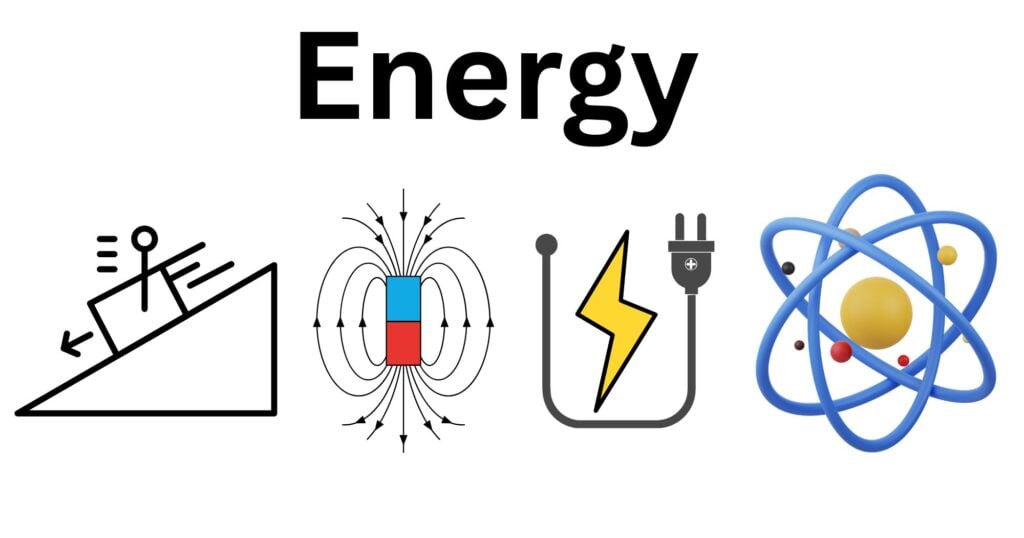
The conservation law of energy has governed the universe. The energy takes many forms and keeps roaming around the universe. All we experience is the energy transformation from one form to another, but not the destruction of energy. The study of energy has always remained a major topic of interest in physics. The developing technologies are also the product of research on energy. In other realms like engineering, chemistry, environmental science, and recent trends, energy plays a crucial role in the study.
What Is Energy? Definition, Units, and Basic Concepts
Energy is the cause of change for anything like motion, heat, light, sound, etc. Energy may be in stored form or in motion, but is always conserved. For example, a body in motion and a body at rest possess energy. All solid, liquid, or gaseous molecules are held together by energy. The stuff we eat, the bulb we light, or the mobile we use, everything contains energy.
Physics categorizes energy as a scalar quantity. It has no specified direction but has a certain magnitude.
SI Unit of Energy
The well-known unit of energy is the joule (J) which is the SI unit.
One joule is defined as the amount of energy required to move an object through one meter by a force of one Newton.
1 Joule = 1 Newton×1 meter
Some other units of energy are
- Calorie (cal) – common in heat and thermodynamics, and also in nutrition
- Kilowatt-hour (kWh) – used in electrical energy consumption
- Electron volt (eV) – used in atomic and nuclear physics
Basic Concepts of Energy
- Energy can exist in different forms:
There are various forms of energy, such as mechanical, thermal, electrical, chemical, nuclear, sound, and light energy. All have their equal significance and use. Also, all forms of energy can be interchanged for perfect use.
- Energy can be stored:
Objects may store energy for future use. For example, a stretched rubber stores energy to return to its original position after removing the stretching force.
- Energy Can Be Transferred
Energy flows from one system to another. This is the cycle of nature. For example, the kinetic energy of turbines and motors can create electrical energy.
- Energy Can Be Transformed
Energy can be transformed from one form to another. An electric bulb changes electrical energy into light and heat energy.
- Energy Is Conserved
The total energy of a closed system is constant. The energy is never created or destroyed. Energy either changes form or gets transferred.
Forms and Types of Energy (Kinetic, Potential, and Other Forms)
Energy appears in several forms. The various energy types are described below:
Kinetic Energy
Kinetic energy is the energy of motion. Every moving object or molecule possesses kinetic energy.
For example:
- Moving cars
- Flying birds
- Flowing rivers
- Rotating fans
Kinetic energy is mathematically expressed as:
KE = 1/2mv2 [Equation 1]
Where:
- KE = kinetic energy
- m = mass
- v = velocity
This equation shows that kinetic energy depends upon mass and velocity of the object. Also, from [Equation 1], we can say that the energy increases rapidly with velocity.
-Examples of Kinetic Energy
- A fast-moving train has greater kinetic energy than a bicycle.
- A bullet possesses very high kinetic energy because its speed is very large.
Potential Energy
Potential energy is the energy possessed by an object due to its position, shape, or condition.
-Gravitational Potential Energy
An object thrown upwards from the ground is supposed to have the gravitational potential energy.
PE = mgh [Equation 2]
Where:
- m = mass
- g = acceleration due to gravity
- h = height
Examples:
- Water stored in dams
- A book kept on a shelf
- A hanging fruit
-Elastic Potential Energy
Elastic potential energy is stored in stretched or compressed objects such as springs and rubber bands.
Examples:
- Bow and arrow
- Compressed spring
- Slingshot
Thermal Energy
Thermal energy is the energy associated with the motion of atoms and molecules inside a particle. For example, boiling water, fire, steam engines, etc.
Chemical Energy
Chemical energy is stored in molecular compounds and chemical bonds. For example, food, polymers like plastics, fuel, batteries, etc.
Stored chemical energy is released when a chemical reaction occurs.
Electrical Energy
Electrical energy is the energy obtained due to the movement of electric charges. For example, fans, mobile phones, computers, nuclear power plants, etc.
Light or Radiant Energy
Light energy is carried by electromagnetic waves.
The Sun is the primary natural source of light energy on Earth.
Examples:
- Sunlight
- Lasers
- Electric bulbs
Sound Energy
Sound energy is produced by vibrating objects and travels through a medium in the form of waves.
Examples:
- Musical instruments
- Loudspeakers
- Human voice
Nuclear Energy
Nuclear energy is stored in the nucleus of atoms.
It is released during nuclear reactions such as fission and fusion.
Examples:
- Nuclear power plants
- The Sun and stars
Nuclear energy can produce enormous amounts of power.
Mechanical Energy and Its Components
Mechanical energy related to the energy of an object or a system during rest or motion. Mechanical energy is in two forms, i.e., kinetic and potential energy. The sum of both forms gives the mechanical energy of the system, which is called the total energy of the system.
ME = KE + PE [Equation 3]
Mechanical energy is common in any physical phenomenon, like sports, vehicles, molecules, etc.
Components of Mechanical Energy
-Kinetic Energy Component
This component arises from motion.
Examples:
- Rolling ball
- Moving train
- Rotating wheel
-Potential Energy Component
This component arises from position or configuration.
Examples:
- Water stored in dams
- Raised hammer
- Stretched spring
Conservation of Mechanical Energy
In the absence of external factors, the total mechanical energy of a system remains constant.
For example, when a ball is thrown upward
- At the highest point, potential energy is maximum.
- At the lowest point, kinetic energy is maximum.
- Total mechanical energy remains constant.
A similar case occurs in the motion of a pendulum.
Importance of Mechanical Energy
Mechanical energy is important in:
- Transportation systems
- Machines and engines
- Hydroelectric plants
- Sports activities
- Industrial machinery
It forms the basis of classical mechanics and engineering applications.
Law of Conservation of Energy
The whole of physics is grounded on one law, i.e., the law of conservation of energy. The law states about the existence and transformation of energy. It says that energy has no point of creation or destruction. It always exists in nature in various forms and keeps transferring or transforming.
The total energy of a closed or isolated system is always constant. Energy conservation is held by all fields of physics, like thermodynamics, electricity and magnetism, nuclear physics, particle physics, quantum mechanics, solid state physics, etc. Any theory not within this principle is considered invalid.
Although the forms of energy can be different, the total energy of the system will be the same.
Mathematical Representation
Einitial=Efinal [Equation 4]
This means the total energy before transformation equals the total energy after transformation.
Examples
-Falling object
As an object falls:
- Potential energy decreases
- Kinetic energy increases
However, the total mechanical energy of the ball remains the same at all points.
–Pendulum Motion
A pendulum keeps moving to and fro when displaced from the mean position. Thus, it experiences continuous change in its kinetic energy and potential energy at each position. This makes the motion of a pendulum possible.
-Hydroelectric Power Plant
The water dams store potential energy. When the water is released from the dams at certain heights, it gains kinetic energy. This rotates the turbines and produces electricity.
Importance of the Law
- It explains natural phenomena.
- It forms the basis of engineering and technology.
- It helps in designing machines and energy systems.
- It supports scientific calculations and predictions.
Transformation and Transfer of Energy
Transformation and transfer of energy are two natural processes occurring frequently. There are two different processes of nature, which are described below:
Energy Transformation
Energy transformation means the changing of energy from one form to another.
Examples:
| Process | Transformation |
| Electric bulb | Electrical → Light + Heat |
| Generator | Mechanical → Electrical |
| Battery | Chemical → Electrical |
| Car engine | Chemical → Mechanical + Heat |
| Solar panel | Solar → Electrical |
| Photosynthesis | Light → Chemical |
Energy Transfer
Energy transfer means the movement of energy from one object or system to another.
Methods of Energy Transfer
–Conduction
Heat transfer through direct contact.
Example:
- Metal spoon in hot tea
–Convection
Heat transfer through the movement of fluids.
Example:
- Boiling water
–Radiation
Heat transfer through electromagnetic waves.
Example:
- Sun heating Earth
Importance of Energy Transformation
Energy transformation enables:
- Operation of machines
- Electricity generation
- Transportation
- Communication systems
- Industrial production
In simple words, a nature cannot function without the transformation of energy.
Work, Power, and Energy Relationship
Work, power, and energy are closely related concepts in physics.
Work
Work is done when a force causes displacement.
W = Fd [Equation 5]
Where:
- W = work
- F = force
- d = displacement
The SI unit of work is the joule.
-Relationship Between Work and Energy
Work transfers energy from one object to another.
For example:
- Lifting an object increases its potential energy.
- Pushing a cart increases its kinetic energy.
Thus:
Work done on an object equals the change in its energy.
Power
Power is the rate of doing work.
P = Wt [Equation 6]
Where:
- P = power
- W = work
- t = time
The SI unit of power is the watt (W).
One watt equals one joule per second.
-Relationship Among Work, Power, and Energy
- Energy provides the capacity to do work.
- Work transfers energy.
- Power measures how quickly work is done.
For example:
- Two machines may perform equal work.
- The machine doing it faster has greater power.
Practical Examples
-Electric Motor
Electrical energy converts into mechanical work.
-Human Body
Food provides chemical energy used for muscular work.
-Power Plants
Power plants convert energy sources into electrical power.
Sources of Energy (Renewable and Non-Renewable)
Energy is obtained from two main sources: renewable and non-renewable energy sources. They are termed on the basis of their availability in nature.
Renewable Sources of Energy
Renewable energy sources are sources that can be used repeatedly and are found abundantly in nature. Their availability is not limited and is naturally replenished.
-Solar Energy
Energy obtained from the Sun.
Applications:
- Solar panels
- Solar cookers
- Solar water heaters
Advantages:
- Abundant
- Pollution-free
Limitations:
- Depends on sunlight availability
-Wind Energy
Energy obtained from moving air.
Wind turbines convert wind energy into electricity.
Advantages:
- Clean energy
- Renewable
Limitations:
- Requires windy areas
-Hydroelectric Energy
Energy obtained from flowing water.
Dams are used to generate hydroelectricity.
Advantages:
- Reliable
- Low pollution
Limitations:
- Expensive dam construction
- Environmental impacts
-Biomass Energy
Energy obtained from plant and animal materials.
Examples:
- Firewood
- Agricultural waste
- Biogas
-Geothermal Energy
Energy is obtained from heat inside Earth.
Used to generate electricity.
Non-Renewable Sources of Energy
Non-renewable sources have a limited existence and take a long process (millions of years) to form.
-Coal
Widely used fossil fuel for electricity generation and industry.
Problems:
- Air pollution
- Carbon emissions
-Petroleum
Used in vehicles and industries.
Products include:
- Petrol
- Diesel
- Kerosene
-Natural Gas
Cleaner than coal and petroleum, but still produces greenhouse gases.
-Nuclear Fuels
Examples:
- Uranium
- Plutonium
Used in nuclear power plants.
Advantages:
- Very high energy output
Limitations:
- Radioactive waste
- Risk of accidents
Applications of Energy in Everyday Life
Energy is essential in nearly every human activity.
-Domestic Uses
Energy is used for:
- Cooking
- Heating
- Lighting
- Refrigeration
- Entertainment devices
-Transportation
Vehicles use energy for movement.
Examples:
- Cars
- Buses
- Trains
- Aircraft
–Industrial Applications
Industries require energy for:
- Operating machines
- Manufacturing products
- Heating and cooling
-Agriculture
Energy is used in:
- Irrigation pumps
- Tractors
- Harvesting machines
-Communication and Technology
Modern communication systems depend on electrical energy.
Examples:
- Mobile phones
- Internet
- Television
- Computers
-Medical Applications
Hospitals use energy for:
- Medical equipment
- X-ray machines
- MRI scanners
- Lighting and ventilation
-Education
Energy powers:
- Computers
- Smart classrooms
- Laboratory equipment
Advantages of Energy Utilization
The proper use of energy has transformed human civilization.
-Improved Standard of Living
Energy enables comfortable living through modern appliances and transportation.
Limitations and Challenges in Energy Use
The use of energy also faces lots of challenges for nature. Some of the limitations and challenges are described below
Pollution
Excessive use of non-renewable energy has substantially increased the pollution of the planet. Pollution in air, water, soli or sound is the result of high use of energy.
Global Warming and Climate Change
Pollution, as a result, gives rise to greenhouse gases. They have adverse effects on the climate, like global warming, melting of glaciers, unexpected weather, etc.
Resource Depletion
Non-renewable resources are limited. Nature can run out of them because of their excessive dependence.
High Costs
Technologies depending on renewable sources are costly and require high-maintenance. For example, solar farms, Wind turbines, and hydroelectric dams are all very expensive to afford.
Energy Inequality
Many regions are still untouchable from technologies like electricity and modern energy systems.
Nuclear Hazards
Nuclear energy involves risks such as:
- Radiation leaks
- Waste disposal problems
Energy Wastage
Inefficient use of energy leads to unnecessary consumption and economic loss.
Examples include:
- Leaving lights on unnecessarily
- Inefficient machines
- Fuel wastage
-Solutions to Energy Challenges
Possible solutions include:
- Energy conservation
- Development of renewable energy
- Efficient technologies
- Public awareness
- Sustainable energy policies
Conclusion
Energy is the fundamental thing for survival. It is also the key term to hold the universe and natural phenomena. It is responsible for any kind of changes and exists in many forms. Every form is equally important, and one form is interlinked with the other. Energy cannot be completely exhausted, but keeps being transformed or transferred. The law of conservation of energy is found everywhere, and for any physical process, this law is always conserved. No law is valid if it is violated.
Energy is also seen as an important topic for food and nutrition, economics, biology, environment, engineering, etc. The terms work and power are significantly related to energy and are the basis for many physical principles. Humans and their modern technologies are also strongly relying on energy and its principles.
The energy sources, viz., renewable and non-renewable sources, are very important as they produce energy. The sun is a renewable energy source that is the source of energy for nature. Non-renewable sources are limited, and hence their conservation is the demand of today’s environment.
We know the use of energy is a basic need of nature. However, the evolving technologies and the population are showing negative effects on nature with the random use of energy. This is harmful to the whole ecosystem and ecotone. This must be considered as the great challenge for humans. Nature cannot be controlled. Therefore, any advancements should be made under controlled and limited action. Otherwise, the consequences are huge to bear for the planet.
References
- National Research Council, Policy, Global Affairs, Board on Science, Economic Policy, Division on Engineering, … & Benefits of Energy Production. (2010). Hidden costs of energy: unpriced consequences of energy production and use. National Academies Press.
- Omer, A. M. (2008). Energy, environment and sustainable development. Renewable and sustainable energy reviews, 12(9), 2265-2300.
- Jaffe, R. L., & Taylor, W. (2018). The physics of energy. Cambridge University Press.
- Kapitza, P. L. (1976). Energy and physics. Soviet Physics Uspekhi, 19(2), 169-173.
- https://en.wikipedia.org/wiki/Energy
- https://www.britannica.com/science/energy
- https://sciencenotes.org/energy-definition-examples/
