
Introduction and Definition of Thermonuclear Fusion
When nuclei are freed from an atom and made to combine, a reaction takes place called thermonuclear fusion. Here, the word ‘thermo’ means heat, and ‘nuclear’ means the nucleus. The reaction also takes place at extreme temperatures. As it releases a very large amount of energy, it is the most powerful energy-releasing process.
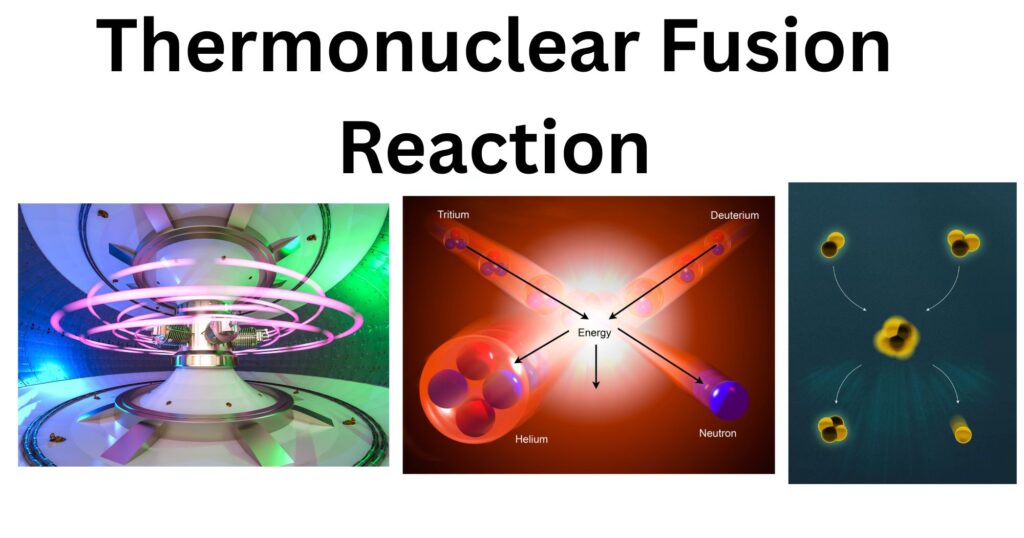
This reaction is considered to occur in the celestial bodies like the sun and stars. There occurs a continuous combination of hydrogen nuclei to form helium. Thus, the reaction releases tremendous heat and light energy. This energy reaches the Earth and other space as the main source of energy.
It is the most fascinating topic for scientists and researchers today. It has the potential to give eternal energy to humans. This energy is also a clean and safe energy for use. However, the extreme conditions for the reaction are extremely difficult to attain. Also, the reaction is uncontrollable and can be unbearable for Earth. If possible, this can be a good source of energy production in the future.
Principle of Thermonuclear Fusion
As defined, the thermonuclear fusion principle is the combination of light nuclei at extremely high temperatures and pressure. Two nuclei normally cannot react as they repel (they are positively charged) and do not come closer to each other. This is called Coulomb’s repulsion in electrostatics. This force of repulsion must be overcome to make the thermonuclear fusion possible. This can happen in such conditions where extremely high temperature and pressure can bring two nuclei closer.
At very high temperature (i.e., 108 K), the nuclei are at very high speeds and can overcome the repulsion between them. Now, they are capable of coming closer and combining. This gives a heavier nucleus.
A common thermonuclear fusion reaction is:
1H2 + 1H3 → 2He4 + 0n1+ 17.6 MeV [Equation 1]
In this reaction:
- Deuterium and tritium are isotopes of hydrogen.
- They combine to form helium.
- A neutron is released.
- A large amount of energy is produced.
The released energy comes from a small loss of mass during the reaction. According to Einstein’s mass–energy relation:
E=mc2 [Equation 2]
Mechanism of Thermonuclear Fusion and Plasma Formation
The mechanism of thermonuclear fusion involves several physical processes. The first step is heating the fusion fuel to an extremely high temperature.
Heating of Fuel
Usually, deuterium and tritium are the fuels for the fusion reaction. They are the isotopes of hydrogen. They are heated to very high temperatures (above ten million degrees Celsius).
At those temperatures, atoms become unstable, and the electrons separate from the nuclei.
Formation of Plasma
When the electrons are removed from atoms, a plasma state is obtained. Plasma contains:
- Positively charged ions
- Free electrons
Plasma is also called one of the states of matter.
Plasma is the most abundant state in nature. It is found in celestial objects like stars, lightning, and the Sun.
Collision of Nuclei
Inside plasma, nuclei are found to be moving at high speeds in random directions. This movement causes collisions between nuclei.
If the collision energy is high enough, the nuclei overcome the repulsive force between them and finally combine.
Release of Energy
During fusion, some mass is converted into energy. The released energy appears mainly as:
- Heat energy
- Kinetic energy of particles
- Radiation
This energy can later be converted into electricity.
Plasma Instability
The major problem in fusion reactions is the instability of plasma. As it is extremely hot, it is difficult to control and confine. The magnetic disturbances also make it more unstable. With more study and research, technologies are being developed to solve this problem.
Conditions for Thermonuclear Fusion
Extremely High Temperature
It requires a very high temperature for a fusion reaction to occur.
T≈107−108K
This range of temperature is much higher than the temperature at the center of the Sun.
High Pressure or High Density
The nuclei must come close enough. This requires very high pressures, creating a greater density of nuclei.
In stars, gravitational force gives the pressure to combine hydrogen nuclei.
In fusion reactors, scientists try to maintain high pressure by using magnetic or laser-based methods.
Confinement Time
The hot plasma must not escape and remain for a longer time to make the reaction possible.
This requirement is explained by the Lawson criterion, which states that successful fusion depends on:
- Plasma temperature
- Particle density
- Confinement time
If plasma escapes quickly, the reaction doesn’t occur.
Importance of Confinement:
This confinement method is very challenging. Scientists use special confinement methods, such as:
- Magnetic confinement
- Inertial confinement
These methods prevent plasma from touching the reactor walls.
Types of Thermonuclear Fusion (Controlled and Uncontrolled Fusion)
Thermonuclear fusion can be classified into two main types.
Controlled Thermonuclear Fusion
Controlled fusion occurs under carefully managed conditions. Scientists attempt to regulate the fusion process to produce useful energy safely.
Controlled fusion is mainly used in:
- Experimental reactors
- Scientific research
- Future power generation
Examples include:
- Tokamak reactors
- Stellarators
- Laser fusion devices
Controlled fusion aims to produce continuous and stable energy output.
Uncontrolled Thermonuclear Fusion
Uncontrolled fusion occurs suddenly and releases massive energy in a very short time.
The best-known example is the hydrogen bomb.
In a hydrogen bomb:
- A fission explosion first creates an extremely high temperature.
- Fusion reactions then occur rapidly.
- Enormous destructive energy is released.
Uncontrolled fusion is not used for peaceful energy production.
Difference Between Controlled and Uncontrolled Fusion
| Controlled Fusion | Uncontrolled Fusion |
| Carefully regulated | Cannot be controlled |
| Used for energy research | Used in weapons |
| Gradual energy release | Sudden energy release |
| Safe laboratory conditions | Extremely destructive |
Nuclear Fusion Reactions in Stars
Stars are natural thermonuclear fusion reactors. The Sun continuously produces energy through nuclear fusion.
Conditions Inside the Sun
The center of the Sun has:
- Extremely high temperature
- Very high pressure
- Dense hydrogen plasma
These conditions allow hydrogen nuclei to fuse continuously.
Proton–Proton Chain Reaction
The main fusion process in the Sun is called the proton–proton chain reaction.
Overall reaction:
41H1→ 2He4 + 2e+ +2ν + energy [Equation 3]
In this process:
- Hydrogen nuclei combine.
- Intermediate particles are formed.
- Helium nuclei are produced.
- Large amounts of energy are released.
Energy Production in the Sun
The Sun converts millions of tons of hydrogen into helium every second.
This fusion energy produces:
- Sunlight
- Heat
- Solar radiation
Without thermonuclear fusion, life on Earth would not exist.
Fusion in Other Stars
The size and temperature of various stars are unique. Thus, each of them has different fusion reactions.
Large stars can fuse:
- Helium
- Carbon
- Oxygen
- Heavier elements
Most of the chemical elements of the universe form due to the fusion reactions in stars.
Common Fusion Reactions (Deuterium–Tritium and Deuterium–Deuterium)
Deuterium–Tritium (D–T) Fusion
This is the most important fusion reaction for current research.
Reaction:
1H2 + 1H3 → 2He4 + n +17.6 MeV [Equation 4]
Advantages:
- High energy production
- Easier to achieve than other fusion reactions
- Lower required temperature
Disadvantages:
- Produces high-energy neutrons
- Tritium is radioactive
Deuterium–Deuterium (D–D) Fusion
Reaction:
1H2 + 1H2 → 2He3 + n +energy [Equation 5]
Advantages:
- Deuterium is abundant in seawater
- No need for tritium fuel
Disadvantages:
- Requires a much higher temperature
- Lower reaction probability
Deuterium–Helium-3 Fusion
Another advanced fusion reaction is:
1H2 + 2He3 → 2He4 + p + 18.3 MeV [Equation 5]
This reaction produces fewer neutrons and hence is safer. However, helium-3 is rare and expensive.
Methods of Achieving Controlled Thermonuclear Fusion
The two main methods are:
Magnetic Confinement Fusion
Magnetic confinement uses strong magnetic fields to confine plasma.
Since plasma contains charged particles, magnetic fields can control its motion.
-Tokamak
The tokamak is the most widely used magnetic confinement device.
Features:
- Doughnut-shaped chamber
- Powerful superconducting magnets
- Circular plasma motion
Tokamaks are used in many international fusion projects.
-Stellarator
A stellarator is another magnetic confinement system with twisted magnetic coils.
Advantages:
- Better plasma stability
- Continuous operation possible
Disadvantages:
- Complex design
Inertial Confinement Fusion
In inertial confinement fusion, tiny fuel pellets are compressed using high-energy lasers or ion beams.
Process:
- Laser beams strike the fuel pellet.
- Outer material explodes outward.
- Inward pressure compresses the fuel.
- Fusion occurs for a very short time.
This method is mainly used in advanced laboratory experiments.
Comparison of the Two Methods
| Magnetic Confinement | Inertial Confinement |
| Uses magnetic fields | Uses lasers |
| Continuous plasma confinement | Short pulse reactions |
| Tokamak and stellarator | Laser fusion systems |
| Large reactor chambers | Tiny fuel pellets |
Energy Production and Applications of Thermonuclear Fusion
Fusion releases enormous energy from a very small amount of fuel.
Energy Production
The energy produced in fusion mainly appears as kinetic energy of particles and heat.
This heat can be used to:
- Produce steam
- Rotate turbines
- Generate electricity
Applications of Thermonuclear Fusion
- Generation of Electricity
Power plants supplied by fusion reactions can provide large amounts of electricity.
- Space Propulsion
Fusion engines may help spacecraft travel faster in deep space missions.
- Scientific Research
Research in various fields like plasma physics, nuclear physics, and particle physics can be done with the understanding of thermonuclear fusion reactions.
- Industrial Applications
Industries requiring very high temperatures can also benefit from fusion reactions
- Hydrogen Production
Hydrogen fuel can also be produced for transport systems.
Advantages of Thermonuclear Fusion as an Energy Source
Enormous Energy Output
Fusion produces huge amounts of energy from very light nuclei.
Abundant Fuel Supply
Deuterium is easily obtained in seawater, which is abundant in nature. Similarly, lithium can produce tritium.
These isotopes can supply fuel for millions of years.
Low Environmental Pollution
Fusion does not release:
- Smoke
- Carbon dioxide
- Sulfur gases
Therefore, it can reduce global warming.
Safer Than Fission
Fusion does not involve dangerous chain reactions.
If reactor conditions fail, the reaction naturally stops.
Less Radioactive Waste
Fusion produces much less long-term radioactive waste than nuclear fission.
High Energy Efficiency
Fusion fuel contains much more energy per unit mass than fossil fuels.
Limitations and Challenges in Thermonuclear Fusion Technology
The various challenges and limitations faced in thermonuclear fusion technology are given below:
Extremely High Temperature Requirement
It requires a temperature above millions of degrees, which is extremely difficult.
Plasma Control Problems
Plasma is unstable and difficult to confine.
Expensive Technology
Fusion reactors require:
- Advanced magnets
- Powerful lasers
- Complex cooling systems
This makes research very costly.
Material Damage
High-energy neutrons can severely damage reactor materials after exposure. Thus, stronger materials are being developed to use in reactor walls.
Energy Balance Problem
The energy released is greater than the absorbed energy during the fractions. This is a challenging situation to achieve a net positive energy.
Tritium Availability
Tritium fuel is radioactive and difficult to produce in large amounts.
Long Development Time
Fusion reactors are difficult to run ordinarily in all regions.
Thermonuclear Fusion vs Nuclear Fission
The differences between fusion and fission reactions are given below:
| Thermonuclear Fusion | Nuclear Fission |
| Combines light nuclei | Splits heavy nuclei |
| Uses hydrogen isotopes | Uses uranium or plutonium |
| Requires extremely high temperature | Occurs at a lower temperature |
| Produces less radioactive waste | Produces more radioactive waste |
| No uncontrolled chain reaction | Chain reactions possible |
| Energy source of stars | Used in present nuclear power plants |
| Cleaner energy source | More pollution risk |
Fusion is considered a far better, safer, and cleaner source of energy than fission.
Future Prospects of Fusion Energy and Reactor Development (ITER and Beyond)
The fusion reaction is under the developing project, thinking of it as an unlimited source of energy. The huge international project is ITER.
ITER Project
ITER is being built in France with cooperation from many countries.
Goals of ITER:
- Demonstrate large-scale fusion
- Produce more energy than consumed
- Test fusion reactor technology
- Improve plasma control systems
ITER uses a large tokamak reactor.
Other Fusion Projects
Many countries are conducting fusion research, including:
- United States
- China
- Japan
- South Korea
- European countries
Private companies are also investing in fusion technology.
Future Commercial Reactors
Some future scientific suspects are:
- Supply clean electricity
- Reduce the use of fossil fuels
- Greatly reduce greenhouse gas emissions
- Provide sustainable energy
Fusion Beyond Earth
Fusion can also be the power source of spacecraft and space stations in the future.
Besides having unlimited challenges on the way, progress is being made in fusion science and engineering.
Conclusion
The thermonuclear fusion process is the result of the combination of light nuclei. Although the involvement is of light nuclei, the energy released after the reaction is too much. This occurs naturally in heavenly bodies. It is their prime source of heat and light energy in stars and the sun. It is also the source of energy for the Earth, as the Earth obtains all energy from the sun.
This reaction is very challenging to do artificially till today. It has very extreme requirements like high temperatures and pressure. During fusion, plasma is formed. The nuclei taking part in the reaction collide with very high energy, such that they can overcome electrostatic repulsion. Research is improving day by day to conduct controlled fusion reactions. Researchers use magnetic confinement and inertial confinement methods to perform them.
Thermonuclear fusion is also considered an energy source for the future. Thus, the produced energy is very huge and also shows up with low pollution, and is safer. However, the challenges like plasma instability, extremely high temperatures, material damage, and high cost are always on top.
Projects like ITER are still building hopes for artificial fusion reactions. In the future, it may become one of the significant technologies of humankind.
References
- Shafranov, V. D., Bondarenko, B. D., Goncharov, G. A., Lavrent’ev, O. A., & Sakharov, A. D. (2001). On the history of the research into controlled thermonuclear fusion. Physics-Uspekhi, 44(8), 835-843.
- Petrescu, R. V., Aversa, R., Kozaitis, S., Apicella, A., & Petrescu, F. I. (2017). Some basic reactions in nuclear fusion. American Journal of Engineering and Applied Sciences, 10(3).
- Blandinskii, V. Y., Davidenko, V. D., Zinchenko, A. S., Moryakov, A. V., Rodionova, E. V., Chukbar, B. K., & Tsibul’skii, V. F. (2020). Energy outlook for thermonuclear fusion. Atomic Energy, 128(1), 41-44.
- Bobin, J. L. (2014). Controlled thermonuclear fusion. World Scientific Publishing Company.
- Samm, U. (2003). Controlled thermonuclear fusion at the beginning of a new era. Contemporary Physics, 44(3), 203-217.
- Joachain, D. E. (Ed.). (2013). Atomic and molecular physics of controlled thermonuclear fusion. Springer Science & Business Media.
- https://en.wikipedia.org/wiki/Nuclear_fusion
- https://www.britannica.com/science/thermonuclear-reaction
