What Are SI Units?
SI Units are an important part of the measurement of physical quantities. Measurement is the foundation of physics. So, to make the measurement system easily understood by everyone, a common standard system was built, called the SI system. The SI unit is the short form of the International System of Units. It makes communication in terms of measurement convenient and simple.
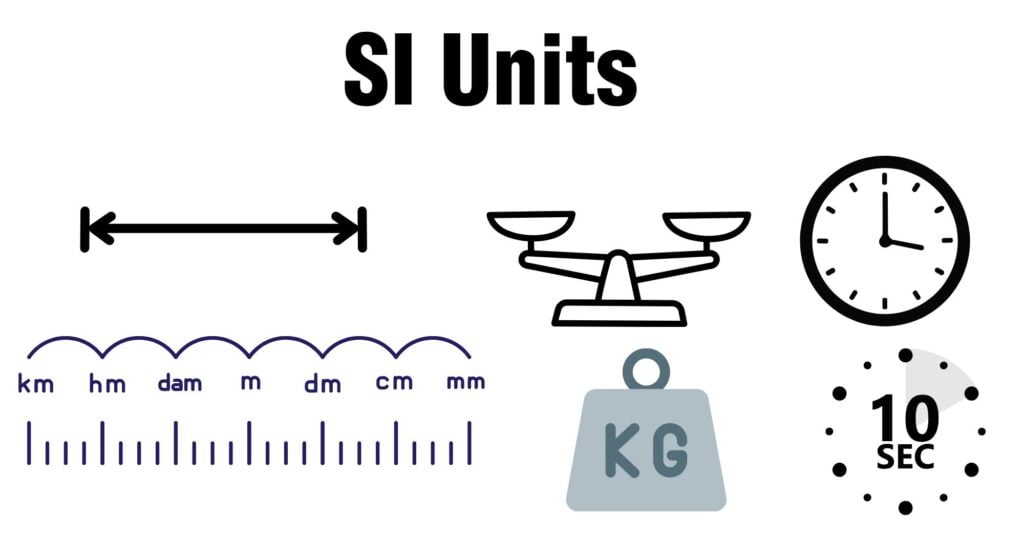
SI system is based on the metric system and is common in all fields. The SI system is also easier for conversion, establishing relations with other units. Hence, it is suitable for all calculations and measurements. It includes seven fundamental quantities, which are called SI base quantities. Other higher calculations are done, and units are given according to these quantities.
SI system is consistent in all terms. It needs no additional numerical conversion. It only requires the mathematical relation of units. The abbreviated units are preferred over the longer names. It makes simple or complex measurements appear convenient. Hence, it is clear, coherent, and also makes comparison easier.
SI Base Quantities and Base Units
As mentioned above, the SI system has seven base quantities. These quantities are the foundations of the SI system and are independent of any other quantities for measurement. The units of such quantities are called the base units.
The seven SI base quantities and their units are as follows:
| SI Base Quantity | SI Base Unit | Symbol |
| Length | metre | m |
| Mass | kilogram | kg |
| Time | second | s |
| Electric current | ampere | A |
| Thermodynamic temperature | kelvin | K |
| Amount of substance | mole | mol |
| Luminous intensity | candela | cd |
Length — metre (m)
Length is the measure of distance between two points. Its SI unit is metre, and usually denoted by m. The SI unit can be converted into millimeters or inches for smaller lengths and into kilometers for longer lengths.
Mass — kilogram (kg)
Mass means the measurement of matter contained in an object. Its SI unit is the kilogram, and usually denoted by kg. It is also converted to milligrams for smaller masses and tonnes for larger masses (tonne is not an SI unit).
Time — second (s)
Time is the measurement of the duration between events. Its unit is the second and denoted by s. This can also be converted into milliseconds or microseconds for very small time periods and minutes or hours for longer periods.
Electric Current — ampere (A)
Electric current is the electric charge that flows through a conductor. Its SI unit is the ampere, represented by A. In electricity, other measurements are also done for voltage, resistance, power, etc.
Thermodynamic Temperature — kelvin (K)
Temperature measures how hot or cold a body is. Its SI unit is the kelvin and is denoted by K. Other units like Celsius and Fahrenheit are also popular for temperature. However, Kelvin is the standard unit provided.
Amount of Substance — mole (mol)
The mole is the SI unit for the amount of substance. It is widely used in chemistry and molecular physics. It helps to study the particles in a microscopic view.
Luminous Intensity — candela (cd)
Luminous intensity measures the strength of light emitted by a source in a particular direction. Its SI unit is candela and denoted by cd.
All these units form a strong base of the SI system.
SI Derived Units
Not every physical quantity requires its own independent base unit. Many quantities can be obtained by combining the seven base quantities mathematically, which are called derived units.
For example, speed or velocity is calculated using:
Velocity = Distance / Time
Since distance is measured in metres and time is measured in seconds, the SI unit of velocity is metre per second (m/s).
Similarly, acceleration is the change in velocity per unit time:
Acceleration = Velocity / Time
Therefore, the unit of acceleration is m/s².
Derived units are extremely important in physics because most physical quantities used in practical calculations are derived quantities.
Some SI derived units are given special names like:
| Physical Quantity | SI Derived Unit | Symbol |
| Frequency | hertz | Hz |
| Force | newton | N |
| Pressure | pascal | Pa |
| Energy | joule | J |
| Power | watt | W |
| Electric charge | coulomb | C |
| Electric potential difference | volt | V |
| Electrical resistance | ohm | Ω |
| Capacitance | farad | F |
| Magnetic flux | weber | Wb |
| Magnetic flux density | tesla | T |
| Inductance | henry | H |
| Luminous flux | lumen | lm |
| Illuminance | lux | lx |
Force — newton (N)
Force is calculated from Newton’s second law:
F = ma (m is mass and a is acceleration.)
Therefore:
1 N = 1 kg·m/s²
The newton is used to measure forces such as gravitational force, friction, tension, and applied force.
Energy — joule (J)
Energy is commonly calculated as work done:
W = Fd
As the SI unit for force is newton and that of distance is metre:
1 J = 1 N·m
Thus:
1 J = 1 kg·m²/s²
The joule is used to measure mechanical, thermal, electrical, and many other forms of energy.
Power — watt (W)
Power describes the rate at which work is done, or energy is transferred:
P = W/t
Therefore:
1 W = 1 J/s
The use of watt is common for electrical appliances. In daily life, it is used frequently to denote the power of bulbs, lamps, etc.
Pressure — pascal (Pa)
Pressure is force acting per unit area:
P = F/A
Therefore:
1 Pa = 1 N/m²
Substituting the SI unit of force:
1 Pa = 1 kg/(m·s²)
Pressure is important in fluid mechanics, meteorology, engineering, and many other areas.
Expressing Derived Units in Terms of Base Units
The derived units can be broken down into the seven base units. This is done through dimensional analysis and checking the validity of physical equations.
Consider velocity:
Velocity = Distance / Time
Therefore:
SI unit of velocity = m/s
Acceleration is:
Acceleration = Velocity / Time
Thus:
SI unit of acceleration = m/s²
Now consider force:
Force = Mass × Acceleration
The unit of mass is kg, while acceleration has the unit m/s².
Therefore:
Force = kg × m/s²
or:
1 N = 1 kg·m·s⁻²
Similarly, the unit of energy can be derived from the unit of force:
Energy = Force × Distance
Therefore:
J = N × m
Since:
N = kg·m·s⁻²
we get:
J = kg·m²·s⁻²
The unit of power is:
Power = Energy / Time
Therefore:
W = kg·m²·s⁻³
Pressure is:
Pressure = Force / Area
Since area has the unit m²:
Pa = N/m²
Therefore:
Pa = kg·m⁻¹·s⁻²
These relationships help solve physics problems. They allow us to compare different quantities and check our equations.
For example, if an equation shows a relation of energy as mass multiplied by velocity, the units on the two sides would be:
Left side:
kg·m²/s²
Right side:
kg·m/s
The units are different, showing that the proposed equation cannot represent energy correctly.
Thus, expressing derived units in terms of base units provides a powerful method for checking physical equations.
SI Prefixes and Unit Conversions
Physical quantities encountered in science can vary enormously in size. For example, distances in nuclear physics are very small, while in astronomy the distance between celestial bodies is extremely large. Writing all these values using the same unit can look complex.
SI prefixes solve this problem by representing powers of ten.
Some commonly used SI prefixes are:
| Prefix | Symbol | Factor |
| kilo | k | 10³ |
| hecto | h | 10² |
| deka | da | 10¹ |
| deci | d | 10⁻¹ |
| centi | c | 10⁻² |
| milli | m | 10⁻³ |
| micro | μ | 10⁻⁶ |
| nano | n | 10⁻⁹ |
| pico | p | 10⁻¹² |
| mega | M | 10⁶ |
| giga | G | 10⁹ |
| tera | T | 10¹² |
Prefixes make measurements easier to read. For example, instead of writing 0.000001 metre, we can write 1 micrometre.
Converting Between Units
Unit conversion involves changing the numerical value while keeping the physical quantity unchanged.
For example:
5 km = 5 × 1,000 m = 5,000 m
Similarly:
3,000 m = 3 km
Care must be taken with squared and cubed units. For example:
1 m = 100 cm
but:
1 m² = 10,000 cm²
because the conversion factor must also be squared.
Likewise:
1 m³ = 1,000,000 cm³
because the linear conversion factor is cubed.
Correct unit conversion is essential for avoiding errors in scientific calculations.
Homogeneity of Physical Equations
An important principle associated with SI units and dimensional analysis is the principle of homogeneity. It states that for a physical equation to be valid, it must have the same dimensions, and hence, the same units, on both sides of the equation.
For example, consider the equation:
v = u + at
The dimensions of velocity v are:
[v] = LT⁻¹
The dimensions of initial velocity u are also:
[u] = LT⁻¹
Acceleration has dimensions:
[a] = LT⁻²
Time has dimensions:
[t] = T
Therefore:
[at] = LT⁻² × T = LT⁻¹
Since the two terms on the RHS, i.e., u and at, have the same dimensions, it is the same as that of the LHS, or v. Thus, the equation is valid.
The principle of homogeneity should also apply during addition and subtraction. Quantities with the same dimensions can only be added or subtracted.
For example:
5 m + 2 m = 7 m
is meaningful.
However:
5 m + 2 s
is not physically meaningful because length and time are different physical quantities.
Hence, the principle of homogeneity can be used to test the validity of any equation.
For example, consider:
s = ut + ½at²
The first term has dimensions:
[ut] = LT⁻¹ × T = L
For the second term:
[at²] = LT⁻² × T² = L
Therefore, both terms represent length, and the equation is dimensionally homogeneous.
Dimensional analysis cannot prove that every numerical constant in an equation is correct, but it can identify many possible errors. It is therefore a valuable tool in physics.
Applications of SI Units
SI units are mostly used in science and technology. Some common applications of SI units are as follows:
Physics
Physics is based on measurement. Hence, the maximum use of units is made here. There are also other systems for measurement, but to give a standard specification, SI units are used.
Engineering
Engineers frequently keep measuring distances, temperatures, electrical power, etc., which is done in the SI system. Buildings, constructions, industrial works, etc, all require measurement, and a standard system is used for this.
Chemistry
In chemistry, mole, kelvin, kilogram, metre, and other SI units are used generally. The frequent measurement of concentration, energy, temperature, amount of substance, etc. are expressed in SI units.
Medicine
SI units are also important in medicine and healthcare. Measurements such as body temperature, mass, blood pressure, and laboratory quantities are commonly expressed using metric and SI-related units.
Astronomy
Astronomical measurements involve extremely large distances and quantities. SI units provide a consistent foundation, although astronomers also use specialized units such as astronomical units and parsecs for convenience.
Everyday Technology
From the masses of groceries we measure to the electrical appliances we use, all are expressed in common units called SI units. We often use terms like kg, metre, watt, etc. in our everyday lives.
International Trade and Communication
To make trade and communication simple and easily recognised across all countries, the units of the product qualities must be in common units. Hence, SI units are used internationally to specify the details.
Common SI Units and Prefixes
The SI units must be correctly used by every student and professional. Some commonly used and important basic SI units are given below:
| Quantity | Unit | Symbol |
| Length | metre | m |
| Mass | kilogram | kg |
| Time | second | s |
| Temperature | kelvin | K |
| Electric current | ampere | A |
| Amount of substance | mole | mol |
| Frequency | hertz | Hz |
| Force | newton | N |
| Energy | joule | J |
| Power | watt | W |
| Pressure | pascal | Pa |
| Electric charge | coulomb | C |
| Voltage | volt | V |
| Resistance | ohm | Ω |
Some common prefixes that must be known for measurements are given below:
Kilo (k): 1 km = 1,000 m.
Mega (M): 1 MW = 1,000,000 W.
Giga (G): 1 GHz = 1,000,000,000 Hz.
Milli (m): 1 mm = 0.001 m.
Micro (μ): 1 μm = 0.000001 m.
Nano (n): 1 nm = 0.000000001 m.
The symbols of prefixes must be written carefully. For instance, m represents milli-, while M represents mega-. Changing the capitalization can therefore change the meaning by a very large factor.
All these prefixes are also the SI units. Correct use of unit symbols is another important part of scientific communication. Also, the unit symbols are always written in singular form. For example, when the mass is greater, we always write 5 kg, 10 kg, and not kgs.
Conclusion
The International System of Units (SI) is a universal code of conduct for measurement. It makes communication consistent worldwide. It is also the foundation of measurement and the whole of science and technology. SI base quantities are the seven independent quantities on the basis of which other complex formulas are built, and measurements are done.
SI prefixes are developed to make larger or smaller values appear simple to understand. Prefixes such as kilo, mega, giga, milli, micro, and nano represent powers of ten. They also simplify unit conversion and scientific notation.
The SI system also helps in dimensional analysis. It gives rise to the principle of homogeneity. By examining the units and dimensions on both sides of a physical equation, scientists and students can identify many possible errors. Dimensional consistency of any equation is mandatory.
The applications of SI units are across all fields like engineering, chemistry, medicine, astronomy, manufacturing, technology, etc. A standardized system of measurement allows scientists and engineers around the world to work together using the same measurement language.
The correct use of symbols and prefixes is important to solve a problem correctly. This understanding of SI units will provide good measurement and hence good research. In conclusion, SI units provide consistency, accuracy, clarity, and universality in scientific measurement.
References
- International Bureau of Weights and Measures, Newell, D. B., & Tiesinga, E. (2019). The international system of units (SI) (pp. 1-138). Physical Measurement Laboratory National Institute of Standards and Technology.
- Thompson, A., & Taylor, B. N. (2008). Use of the international system of units (si). NIST special publication, 81, 1.
- Lehmann, H. P., & Conn, R. B. (1979). SI units. CRC Critical Reviews in Clinical Laboratory Sciences, 10(2), 147-170.
- Markowitz, W. M. (1973). SI, the international system of units. Geophysical surveys, 1(2), 217-241.
- https://en.wikipedia.org/wiki/International_System_of_Units
- https://www.britannica.com/science/International-System-of-Units
- https://sciencenotes.org/si-base-units/
