
The equations of motion are mathematical concepts used to predict and analyze motion. Motion is a part of daily life. So, to analyze motion, physicists have developed certain mathematical relationships. They are the fundamental concepts of physics. The same equations rule the motion of a ball, a moving car, and the motion of planets. This concept is also an important part of engineering, geography, construction, design, sports, etc.
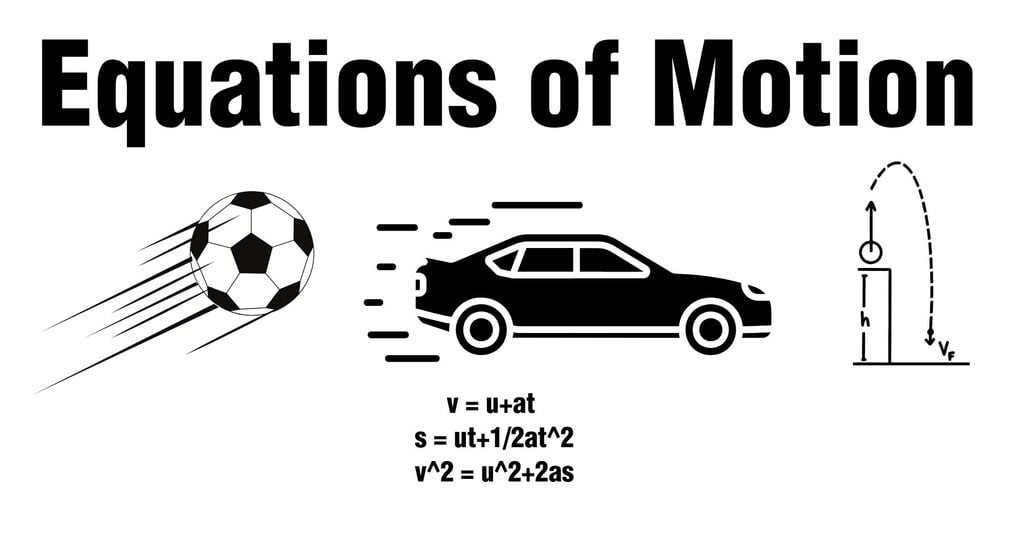
There are various aspects of motion like position, distance travelled, velocity, acceleration, etc. These things keep changing with time. Therefore, the equations of motion help to study the motion of objects either moving constantly, changing with time, or at any instant of time. This further helps to calculate the final displacement of the objects or their final velocity.
The equations of motion form an important part of kinematics. They are widely used in practical situations like sports, transportation, engineering, astronomy, etc.
The three commonly used equations of motion with constant acceleration are:
v = u+at [Equation 1]
s = ut+1/2at2 [Equation 2]
and
v2 = u2+2as [Equation 3]
where:
- u = initial velocity
- v = final velocity
- a = constant acceleration
- t = time
- s = displacement
For example, if a car moves with a uniform initial velocity of 5 m/s and uniform acceleration of 2 m/s2 for 4 seconds, its final velocity can be calculated as:
v = u+at
v = 5+(2)(4)=13 m/s
Thus, the equations of motion provide a convenient mathematical method for analyzing changing motion.
Distance, Displacement, Speed, Velocity, and Acceleration
There are various physical quantities used to describe motion. The important quantities are described below:
Distance
Distance is the length of the path covered by an object and is a scalar quantity with the SI unit, metre (m). For example, if a person moves 5 m east and then 3 m west, his total distance covered will be:
5+3 = 8 m
Displacement
Displacement keeps track of the change in position of an object from its starting point to its final point. It is a vector quantity and also has the SI unit metre (m)
In the same above example, now the calculation for displacement will look for the direction. For the person walking 5 m east and then 3 m west, the displacement will be:
5−3 = 2 m east
Therefore, distance and displacement vastly differ from each other.
Speed
Speed is the rate at which an object is moving a certain distance and is measured in the SI unit metre per second (m/s). It is given by:
Speed = Distance/Time
For example, if a person runs 100 m in 20 s, his speed will be:
Speed = 100/20 = 5 m/s
Velocity
Velocity is the rate at which the displacement changes with time. It is also measured in the SI unit metre per second (m/s), but is a vector quantity.
Velocity = Displacement/Time
However, if an object moves in a straight line with constant velocity, its speed and velocity can be the same.
Acceleration
The change in velocity with time gives acceleration.
a = Δv/Δt
If an object’s velocity changes from u to v during time t, then:
a = v−u/t
Acceleration is measured in m/s2
An object accelerates whenever its velocity changes. This can happen because its speed changes, its direction changes, or both.
Motion Graphs and Their Interpretation
Graphs provide a visual way to understand motion. The most important graphs in elementary kinematics are position-time, velocity-time, and acceleration-time graphs.
Position-Time Graph
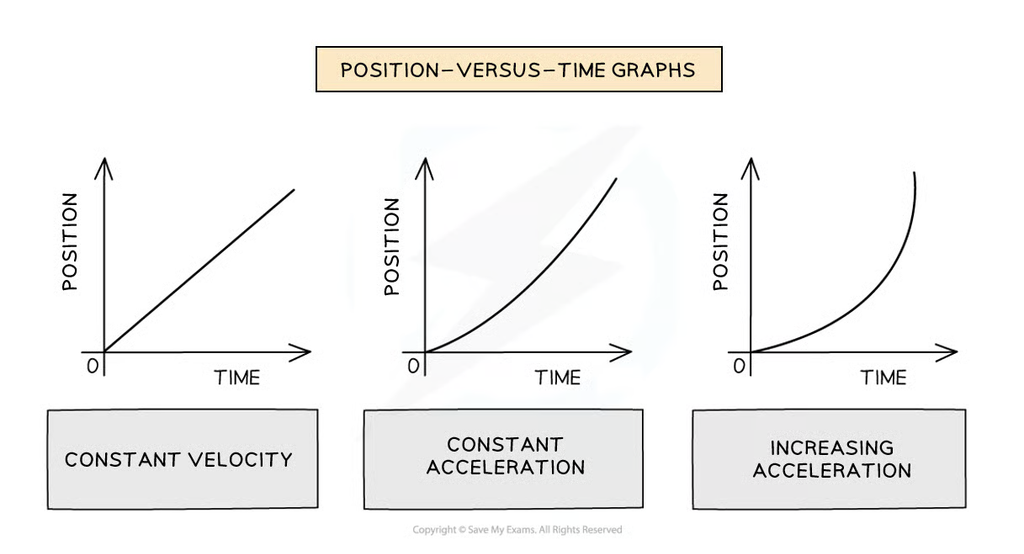
A position-time graph shows the change in position of an object with time.
The slope of a position-time graph represents velocity:
Slope = Δx/Δt = v
Source: https://cdn.savemyexams.com/cdn-cgi/image/f=auto,width=3840/https://cdn.savemyexams.com/uploads/2024/09/6493_position-versus-time-graphs-sketch
A straight line with a constant slope represents constant velocity. A changing slope indicates changing velocity.
For example, if the position of an object increases by equal amounts during equal time intervals, the object is moving with constant velocity.
Velocity-Time Graph
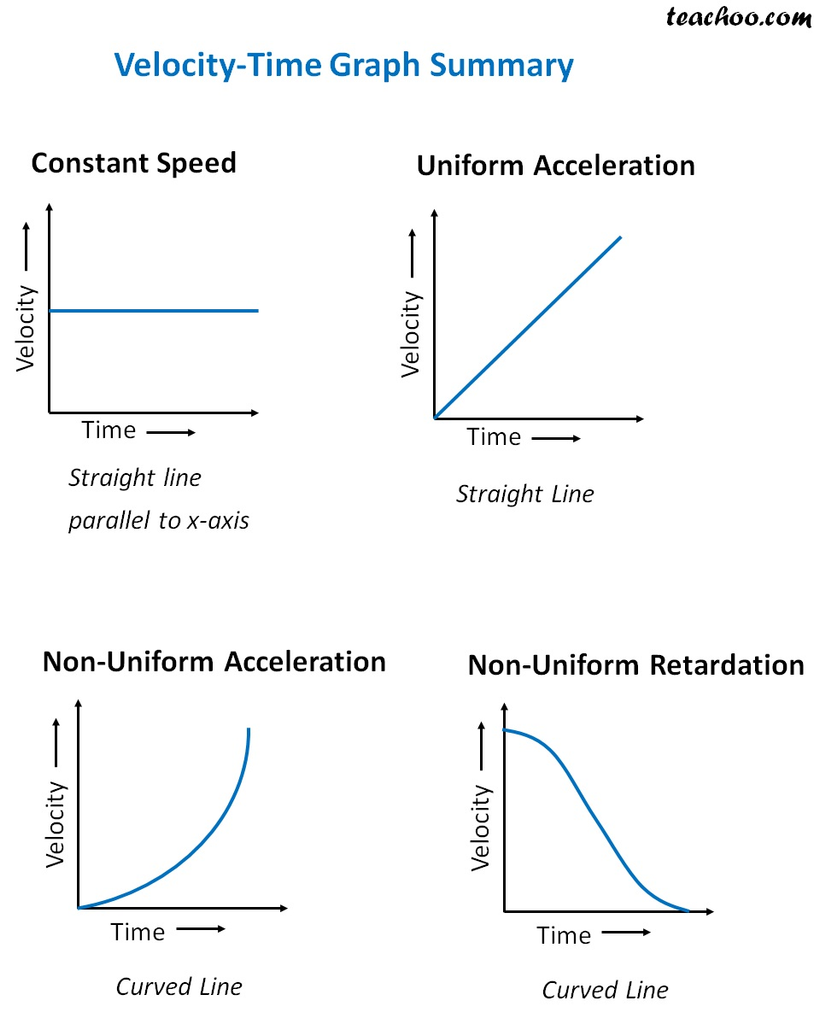
A velocity-time graph shows how velocity changes with time.
The slope of a velocity-time graph gives acceleration:
a = Δv/Δt
Source: https://d1avenlh0i1xmr.cloudfront.net/6188aeb6-6b48-4c51-b8a2-2b4d75b6dec4/velocity-time-graph-summary—teachoo.jpg
Therefore, a straight velocity-time graph with a constant slope represents constant acceleration.
The area under a velocity-time graph gives displacement:
s = Area under the v−t graph
This relationship is particularly useful for deriving the equations of motion.
Acceleration-Time Graph
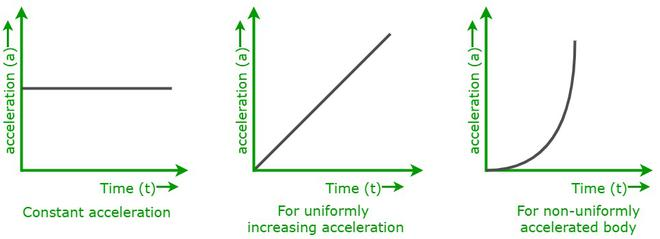
An acceleration-time graph shows how acceleration changes with time.
For constant acceleration, the graph is a horizontal line because the acceleration remains unchanged.
Source: https://media.geeksforgeeks.org/wp-content/uploads/20220702122840/at-660×239.jpg
The area under an acceleration-time graph gives the change in velocity:
Δv = Area under the a−t graph
Motion graphs therefore provide a useful connection between physical motion and mathematical equations.
Equations of Uniformly Accelerated Motion
The standard equations of motion are applicable when an object moves in a straight line with constant acceleration.
First Equation of Motion
The first equation is:
v = u+at
It relates the initial velocity, final velocity, acceleration, and time.
This equation is especially useful when displacement is not involved in the problem.
Second Equation of Motion
The second equation is:
s = ut+1/2at2
It relates displacement with initial velocity, acceleration, and time.
This equation is useful when the final velocity is unknown or unnecessary.
Third Equation of Motion
The third equation is:
v2 = u2+2as
This equation relates initial velocity, final velocity, acceleration, and displacement.
It is particularly useful when time is not given in a problem.
A Fourth Useful Relationship
Another useful equation can be obtained by combining the first two equations:
s = (u+v)/2 x t [Equation 4]
This equation is based on the fact that, for constant acceleration, the average velocity is:
vavg = (u+v)/2 [Equation 5]
Therefore:
s = vavgt [Equation 6]
and hence:
s = (u+v)/2 x t
The correct equation should always be selected according to the quantities given in the problem.
Derivation of the Equations of Motion
The equations of motion can be derived from the definitions of velocity and acceleration and from the interpretation of a velocity-time graph.
Derivation of the First Equation
Acceleration is defined as the rate of change of velocity:
a = (v−u)/t
Multiplying both sides by t:
at =v−u
Therefore:
v = u+at
This is the first equation of motion.
Derivation of the Second Equation
For an object moving with constant acceleration, the average velocity is:
vavg = (u+v)/2
Displacement is given by:
s = vavgt
Therefore:
s = (u+v)/2 x t
From the first equation:
v = u+at
Substituting this into the displacement equation:
s = u+(u+at)/2 x t
s = 2u+at/2 x t
Thus:
s = ut+1/2at2
This is the second equation of motion.
Derivation of the Third Equation
We begin with:
v = u+at
Therefore:
t = (v−u)/a
Using:
s = (u+v)/2 x t
we substitute the value of t:
s = (u+v)/2 x (v−u)/a
Multiplying:
s = (u+v)(v−u)/2a
Using the identity:
(u+v)(v−u) = v2−u2
we obtain:
s = v2−u2/2a
Therefore:
2as = v2−u2
or:
v2 = u2+2as}
This is the third equation of motion.
Graphical Derivation
The equations can also be understood using a velocity-time graph. For uniformly accelerated motion, the graph is a straight line.
The displacement is equal to the area under the graph. The area can be divided into a rectangle and a triangle:
s = ut+1/2(v−u)t
Since:
v−u = at
we get:
s = ut+1/2at2
Thus, the graphical interpretation gives the same result as the algebraic derivation.
Solving Problems Using the Equations of Motion
The equations of motion are most useful when solving numerical problems. A systematic approach makes these problems much easier.
- Identify the given quantities like u, v, a, t, s.
- Identify the unknown quantity to be determined.
- Choose the right equation that contains all the known quantities and that helps to find the unknown quantity.
- Substitute the given values correctly.
- Don’t forget to write the correct unit in the final answer.
Example 1: Finding Final Velocity
A car starts from rest and accelerates uniformly at 3 m/s2 for 5 seconds. Find its final velocity.
Given:
u = 0, a = 3 m/s2 and t = 5 s
Using:
v = u+at
we get:
v=0+(3)(5)
v=15 m/s
Example 2: Finding Displacement
An object starts from rest and accelerates at 2 m/s2 for 6 seconds. Find its displacement.
Given:
u=0, a=2 m/s2, t=6 s
Using:
s = ut+1/2at2
s = (0)(6)+1/2(2)(6)2
s=36 m
Example 3: Finding Acceleration
A vehicle increases its velocity from 10 m/s to 30 m/s in 55 seconds. Find its acceleration.
Using:
a = (v−u)/t
a = (30-10)/5 = 4 m/s2
These examples show how we can use the different equations on the demand of the question or situation.
Free Fall and Acceleration Due to Gravity
Free fall means the falling of a body only under the influence of gravity. In this case, other forces and air resistance are neglected.
When an object is in free fall near the surface of Earth, it falls with a constant acceleration called the acceleration due to gravity and is denoted by g. The approximate value of g is 9.8 m/s2. However, for easy calculations, it is supposed to be 10 m/s2 in some cases. The value of g is also affected on Earth by various factors such as altitude, depth, poles, etc.
When an object falls downward, its velocity increases because of gravity.
For an object falling from rest:
u=0
and:
a = g
Therefore, the equations of motion become:
v = gt,
s = 1/2gt2
and:
v2 = 2gs
If an object is thrown vertically upward, the acceleration due to gravity acts downward. If upward is taken as positive, then:
a = −g
The equations become:
v = u−gt
s = ut−1/2gt2
and:
v2 = u2−2gs
At the highest point of the motion, the instantaneous velocity becomes zero:
v=0
These relationships are useful for calculating the maximum height, time of flight, and velocity of vertically moving objects.
Projectile Motion
An object released in the air and moves completely under gravity is called a projectile, and such motion is called projectile motion. Hence, a projectile has only gravity as the force acting on it.
For example, a ball kicked upward from the ground, a stone thrown upward, the motion of a fountain, etc. Projectile motion is two-dimensional, and therefore the motion is split into horizontal and vertical components.
Suppose an object is projected with initial speed u at an angle θ above the horizontal.
The initial velocity can be resolved into:
ux = ucosθ
and:
uy=usinθ
The horizontal acceleration is:
ax = 0
when air resistance is neglected.
The vertical acceleration is:
ay = −g
Horizontal Motion
Since there is no horizontal acceleration:
vx = ucosθ
The horizontal displacement after time t is:
x = (ucosθ)t
Thus, the horizontal component of projectile motion is uniform motion.
Vertical Motion
The vertical component behaves like an object moving under gravity:
vy = usinθ−gt
The vertical displacement is:
y = (usinθ)t−1/2gt2
Thus, the vertical motion is uniformly accelerated motion.
Time of Flight
When a projectile lands at the same height from which it was launched, its total time of flight is:
T = 2usinθ/g
Maximum Height
The maximum height reached by the projectile is:
H = u2sin2θ/2g
Horizontal Range
For a projectile that lands at the same level from which it was launched, the horizontal range is:
R = u2sin2θ/g
These formulas show that projectile motion can be analyzed by applying the equations of motion independently to the horizontal and vertical directions.
It is important to note that these standard projectile formulas assume negligible air resistance and equal launch and landing heights where applicable.
Conclusion
The equations of motion are the building blocks of classical mechanics. All kinds of motions, like constant motions, varying velocities, and instantaneous velocities, are studied according to these equations. They also connect all variables like distance travelled, speed, velocity, time, acceleration, etc., in one frame. Graphical analysis is more powerful to interpret these terms. Slopes and areas of graphs are very important to represent any kind of motion.
The three fundamental equations are:
v = u+at
s = ut+1/2at2
and:
v2 = u2+2as
The types of motion, like free fall and projectile motion, can easily be interpreted through these equations. Understanding all the variables properly and assigning proper components can give a correct decision about the motion. Linear motion, circular motion, and orbital movements are also based on these fundamental equations. Therefore, from basic to advanced topics, these equations are very important in mechanics and physics.
References
- Wittenburg, J. (2016). Kinematics. Berlin, Heidelberg: Springer Berlin Heidelberg, 10, 978-3.
- Bottema, O., & Roth, B. (1990). Theoretical kinematics (Vol. 24). Courier Corporation.
- Zatsiorsky, V. M. (2002). Kinetics of human motion. Human kinetics.
- Markley, F. L., & Crassidis, J. L. (2014). Attitude kinematics and dynamics. In Fundamentals of spacecraft attitude determination and control (pp. 67-122). New York, NY: Springer New York.
- Teodorescu, P. P. (2007). Kinematics. In Mechanical Systems, Classical Models: Volume I: Particle Mechanics (pp. 287-351). Dordrecht: Springer Netherlands.
- Beggs, J. S. (1983). Kinematics. CRC Press.
- https://en.wikipedia.org/wiki/Equations_of_motion
- https://www.geeksforgeeks.org/physics/equation-of-motion/
- https://byjus.com/physics/equations-of-motion/
