
Non-uniform motion is the type of motion where an object has varying speed in a trajectory with respect to a reference point. This type of motion is a complex motion as the motion becomes unpredictable. Various external forces like friction, gravity, viscosity, air resistance, etc. keep affecting motion in the real world. Hence, the position, momentum, velocity, direction, etc. keep changing with time. An object is hence under a net force acting on it. The examples of non-uniform motion are: an accelerating car, a falling object, a spacecraft, etc. Any object under free-fall also has non-uniform motion.
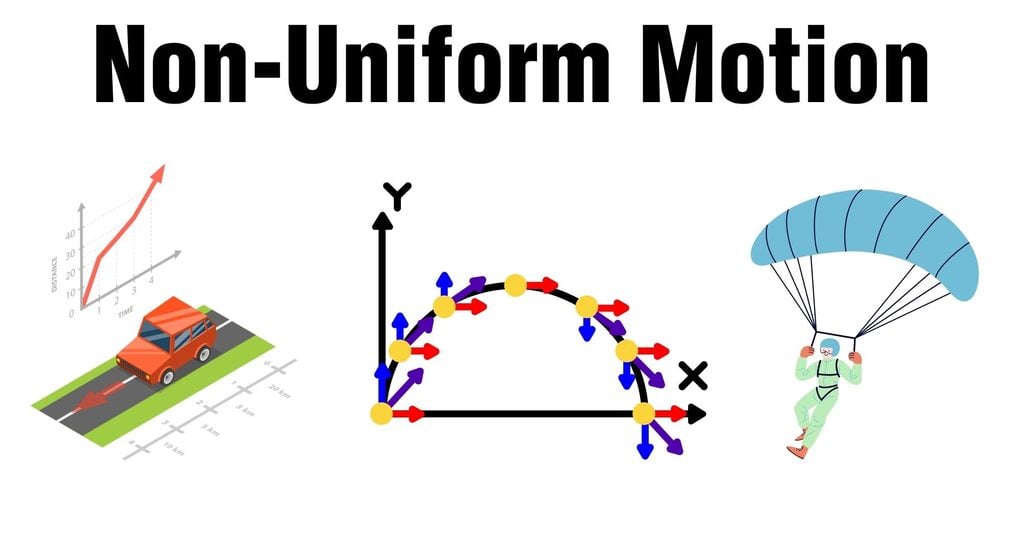
Non-uniform motion can also occur when the magnitude of velocity may be constant, but the direction is changing. A circular motion is an example of a non-uniform motion with constant velocity.
The main cause of non-uniform motion is the presence of a net force acting on an object. According to Newton’s second law of motion,
F→net=ma→ [Equation 1]
where Fnet is the net force, m is mass, and a is acceleration.
In real situations, these net forces make motion non-uniform. Understanding these effects is essential for explaining various simple motions like a falling raindrop to the complex motions like that of the spacecraft.
What Is Non-uniform Motion?
Non-uniform motion is motion in which the velocity, direction, or acceleration of a moving object keeps changing along its path. For example, if a car is moving with a speed of 20 m/s due east initially and then changes the speed to 30 m/s due south later, the motion becomes non-uniform.
Similarly, if a car is moving along a curved road with a constant speed of 20 m/s but is bending continuously, its direction is also changing continuously, and hence the motion becomes non-uniform.
Non-uniform Speed
If an object is moving along a path with different speeds in the same time period, the speed is called non-uniform speed.
For example, if a car moves:
- 10 m in the first second,
- 15 m in the second second,
- 20 m in the third second.
The car is covering unequal distances during equal time intervals. Hence, the car is accelerating.
Non-uniform Velocity
Velocity can change in two ways:
- The magnitude of velocity can change.
- The direction of velocity can change.
Therefore, an object can have non-uniform motion even if the speed is constant.
Acceleration in Non-uniform Motion
The rate of change in velocity with time brings acceleration.
a→ = Δv→/Δt
For instantaneous acceleration,
a→ = dv→/dt
An object with certain acceleration means that the velocity is changing. Therefore, an accelerated object is considered to have non-uniform motion.
Some external forces acting on real objects can also bring changes in velocity or position of those objects. Hence, the object can itself have a varying or non-uniform acceleration.
Frictional, Viscous, and Drag Forces
Objects moving through the real world rarely move without resistance. Different types of resistive forces oppose motion and can significantly affect an object’s acceleration.
Frictional Force
Friction is a force that opposes relative motion between surfaces in contact.
For example, when a box is pushed across a floor, friction acts opposite to the direction of motion.
For kinetic friction, the frictional force can often be approximated by
Ff = μkN
where:
- Ff is kinetic friction,
- μk is the coefficient of kinetic friction,
- N is the normal force.
Friction can cause a moving object to slow down. It can also influence acceleration when an external force is applied.
Viscous Force
When an object moves through a fluid such as water or oil, it experiences resistance due to the fluid’s viscosity. This resistance is called viscous drag.
For a small spherical object moving slowly through a viscous fluid, Stokes’ law gives
Fd = 6πηrv
where:
- η is the dynamic viscosity of the fluid,
- r is the radius of the sphere,
- v is its speed.
This equation shows that, under the conditions where Stokes’ law applies, viscous resistance is directly proportional to velocity.
Drag Force
Drag is the resistive force experienced by an object moving through a fluid, including air and water.
At sufficiently high speeds, drag is often approximated by
Fd = 1/2CdρAv2 [Equation 2]
where:
- Cd is the drag coefficient,
- ρ is the fluid density,
- A is the object’s cross-sectional area,
- v is its speed.
The v2 dependence is particularly important. As an object moves faster, drag can increase rapidly.
These forces are important reasons why many real-world motions cannot be described simply by assuming constant acceleration.
Air Resistance and Motion
Air resistance is also a drag force that acts on falling objects moving through the atmosphere. It acts opposite to the object’s velocity relative to the air.
Consider a ball thrown vertically upward. If air resistance is ignored, the only significant force after release is gravity. The ball experiences approximately constant downward acceleration:
a = −g
However, when air resistance is considered, the situation becomes more complicated.
During upward motion:
- The ball’s velocity is upward.
- Gravity acts downward.
- Air resistance also acts downward.
- The combined downward force changes as the ball’s speed changes.
As the ball rises, its speed decreases. Consequently, air resistance also decreases. At the highest point, the instantaneous velocity is zero, so the drag force associated with velocity is also zero in the simplest model. Gravity still acts downward, causing the ball to begin falling.
During downward motion:
- Gravity acts downward.
- Air resistance acts upward.
- As the ball speeds up, air resistance increases.
- Eventually, the upward resistance can balance the downward gravitational force.
This changing balance of forces produces non-uniform acceleration.
Why Air Resistance Matters
Air resistance becomes particularly important when:
- an object has a large surface area,
- the object moves rapidly,
- the object has a low mass,
- the surrounding air is dense,
- the object has a shape that produces significant drag.
This is why a feather and a stone fall very differently through ordinary air, even though gravity acts on both.
Motion in a Gravitational Field with Air Resistance
Gravity provides a particularly useful example of non-uniform motion.
Near Earth’s surface, gravitational acceleration is approximately
g = 9.8 m/s2
if air resistance is neglected.
In a vacuum, a freely falling object experiences approximately constant acceleration due to gravity. Its velocity increases by about 9.8 m/s9.8\,\text{m/s} every second during downward motion.
With air resistance included, however, acceleration is no longer constant.
For an object falling vertically downward, the forces can be represented as:
mg− = ma
where:
- mg is the gravitational force,
- Fd is upward drag,
- m is mass,
- a is downward acceleration.
Therefore,
a = g − Fd/m [Equation 3]
As the object falls faster, Fd increases. Consequently, the acceleration becomes smaller.
This produces three important stages:
Initial Falling Stage
Immediately after release, the object’s velocity is small. Therefore, air resistance is also relatively small.
Gravity is much larger than drag, so the object accelerates downward strongly.
Increasing Resistance
As the object speeds up, air resistance increases.
The net downward force becomes smaller:
Fnet = mg−Fd [Equation 4]
Therefore, the object’s acceleration decreases.
Terminal Motion
Eventually, air resistance can become equal to gravitational force:
Fd = mg
The net force then becomes zero:
Fnet = 0
and therefore,
a = 0
The object continues falling, but its velocity no longer increases. This constant final speed is called terminal velocity.
Terminal Velocity
Terminal velocity is the constant maximum speed reached by an object falling through a fluid when the resistive force balances the gravitational force.
At terminal velocity,
Fd = mg
Using the quadratic drag model,
Fd = 1/2CdρAvt2
where vt is terminal velocity.
Equating the two forces gives
mg = 1/2CdρAvt2
Therefore,
vt = √2mg/CdρA [Equation 5]
This expression applies under the assumptions of the quadratic-drag model.
It shows that terminal velocity depends on several factors.
Mass
A heavier object, all else being equal, generally has a greater terminal velocity because its weight is larger relative to its drag.
Cross-sectional Area
Increasing the object’s cross-sectional area generally increases drag and therefore decreases terminal velocity.
This principle is used by parachutes because on opening the parachute, the air exposed area becomes sufficiently larger. This reduces the drag force and slows the speed of the falling person.
Shape
The shape of an object highly affects the drag coefficient. Streamlined objects generally experience less drag than objects with shapes that create greater resistance.
Fluid Density
A denser fluid produces greater drag for a given speed. Therefore, terminal velocity can differ substantially between air and water.
Terminal velocity demonstrates how non-uniform motion can gradually approach a state of uniform velocity.
Force-Velocity Relationship in Non-uniform Motion
One of the most important features of non-uniform motion is that the net force may depend on velocity.
Newton’s second law states:
Fnet = ma
If the force changes with velocity, acceleration also changes as velocity changes.
Linear Drag
For some situations, the resistive force can be approximated as
Fd = bv
where b is a constant.
For a falling object,
ma = mg−bv
so
a = g − b/m v [Equation 6]
As velocity increases, acceleration decreases.
Quadratic Drag
At higher speeds, drag is often approximated as
Fd = cv2
where c is a constant.
For a falling object,
ma = mg−cv2
and therefore,
a = g − c/m v2 [Equation 7]
Again, acceleration decreases as velocity increases.
This is the mathematics that shows why many real-world motions cannot be accurately described with the concept of simple linear motion.
Force-Velocity Graph
A force-versus-velocity graph can help visualize this relationship. If resistive force increases with velocity, the graph rises as velocity increases.
Eventually, the resistive force may become equal to the driving force. At this point,
Fnet = 0
and the object stops accelerating.
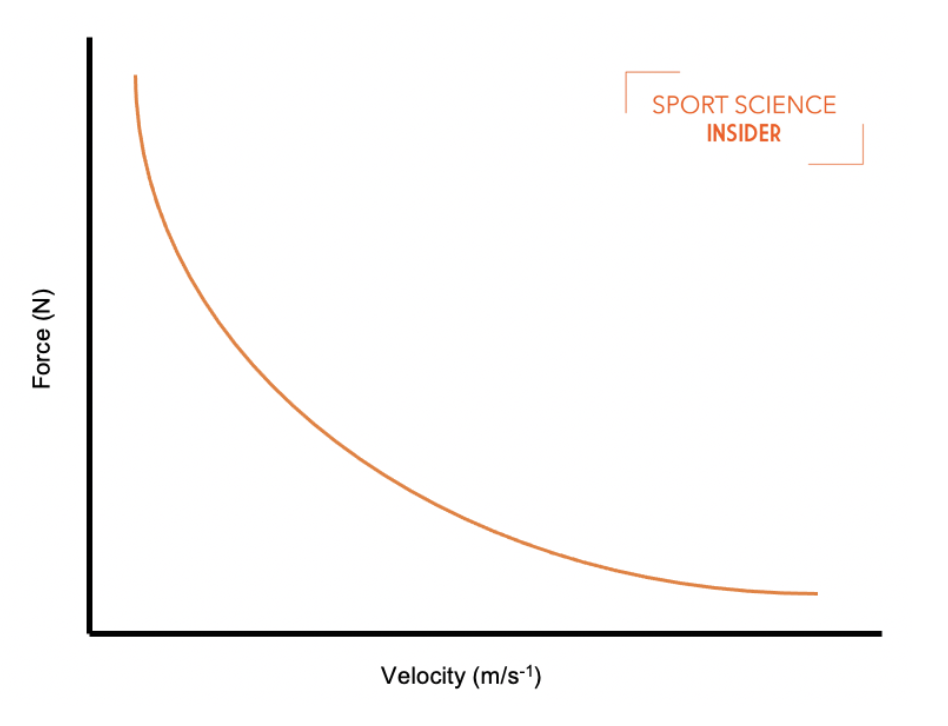
Source: https://sportscienceinsider.com/wp-content/uploads/2021/12/Screenshot-2021-12-13-at-13.02.57.png
This force-velocity relationship is important in transportation, fluid dynamics, engineering, and biomechanics.
Real-Life Examples of Non-uniform Motion
Non-uniform motion is very common in real situations. Some examples are given below:
A Car Starting from Rest
A car initially at rest increases its velocity, accelerates on smooth roads, changes its direction, and retards on curved or rough roads. Hence, a car, bike, or a moving bus all have non-uniform motion. The velocity therefore changes repeatedly. This is a common example in real life.
A Falling Raindrop
A raindrop initially accelerates under gravity. However, as it keeps approaching downward, the air resistance increases and its speed decreases. Eventually, it moves with the terminal velocity.
A Parachutist
A person falling through air initially accelerates because gravity exceeds air resistance. As speed increases, drag becomes stronger. Hence, on opening a parachute, the drag force increases as the area of the exposed body increases. This helps to decrease the downward speed of the person.
A Ball Thrown Upward
A ball thrown vertically upward will have low speed while moving upward due to gravity, drag force, etc. The velocity becomes zero at the highest point and then falls downward at greater speed under gravity. Hence, it is also a non-uniform motion and follows a parabolic path.
An Object Moving Through Water
A swimmer, boat, or underwater vehicle experiences fluid resistance. Changes in propulsion and drag can produce changing velocity.
Applications of Non-uniform Motion
The concepts of non-uniform motion are applied in various fields like science, engineering, transportation, and technology. Some important applications are given below:
In Vehicles and Transport Systems
The rapid or continuous changes in acceleration of vehicles, the braking systems, rolling resistance, aerodynamic drag, etc., are considered while designing them. This helps to understand the changes in the motion of vehicles and increase the performance of various systems.
Parachutes
Parachutes are used for safety and also for thrilling experiences while surfing in the air. They are designed to reduce the speed of a falling body. Hence, they are used to maintain a controlled motion during free-fall. Similar principles are used in some safety and recovery systems.
Spacecrafts and Aircraft Engineering
Aerospace engineers design aircraft such that the varying atmospheric conditions, velocity, and altitude do not affect the motion of the aircraft. The altering forces are modelled and calculated before flight.
Sports
Non-uniform motion is also used in sports analysis, like the motion of balls, athletes, cyclists, swimmers, etc. Factors like air resistance, friction, etc., can also affect their motion, and hence their trajectory is analyzed accordingly.
Fluid Dynamics
The motion of fluids like water droplets, bubbles, etc., and the objects in fluids is also affected by velocity and air resistance. Hence, these problems are solved through the analysis of non-uniform motion.
Robotics
Robotics also often involves changes in motion. Understanding changing forces and acceleration allows engineers to design more accurate movement and control systems.
Transportation Safety
Vehicles always have non-uniform motion as their velocity, direction, and acceleration must change from time to time. Hence, the braking system is made for safety in transportation systems.
Meteorology
The motion of raindrops, snowflakes, and atmospheric particles is influenced by gravity, drag, and air currents. Hence, these forces are studied properly by meteorologists to model atmospheric processes.
Conclusion
Non-uniform motion is the outcome of net external forces acting on a body. The external forces like air resistance, gravity, drag force, viscosity, friction, etc., cannot be neglected in real situations. These bring changes in the velocity of the object, and hence the motion becomes non-uniform. Hence, it is a vast topic rather than a simple uniform motion. A constant speed but a changing direction also gives rise to non-uniform motion.
Another important fact of non-uniform motion is that the acceleration also may not remain constant all the time. This further complicates the motion complex further. When resistive forces depend on velocity, the net force and acceleration also change as the object’s speed changes. For falling objects, their speed is initially accelerating due to gravity, but gradually decreases because of the increasing air resistance and again falls steadily after terminal velocity is reached.
To understand non-uniform motion, one must understand the inter-relationship of the force, velocity, and acceleration. From sports and vehicles to raindrops and aircraft, we are affected by non-uniform motion in practical situations. Hence, studying non-uniform motion can provide the basic knowledge of the laws of mechanics to cope with the real world. Further studies can build a strong foundation for modern technologies, engineering, and research. In a relativistic world, it becomes an essential concept of classical mechanics and reflects a strong base in physics.
References
- Mansfield, M. M., & O’sullivan, C. (2020). Understanding physics. John Wiley & Sons.
- Landau, L. D. (2013). General physics: mechanics and molecular physics. Elsevier.
- Halliday, D., Resnick, R., & Walker, J. (2009). Fundamentals of Physics, Chapters 1-11. John Wiley & Sons.
- Kleppner, D., & Kolenkow, R. (2014). An introduction to mechanics. Cambridge University Press.
- Goldstein, H. (2011). Classical mechanics. Pearson Education India.
- https://www.geeksforgeeks.org/physics/non-uniform-motion/
- https://physicsgoeasy.com/non-uniform-motion/
