
Density and pressure are inter-related and fundamental topics of physics. The mass distribution in a substance and its area help us to understand the forces acting over its surface. Density looks at the volume and mass present in that volume. Pressure, on the other hand, looks at the unit area where the force is acting. Hence, the behavior of all matter is closely related to density and pressure.
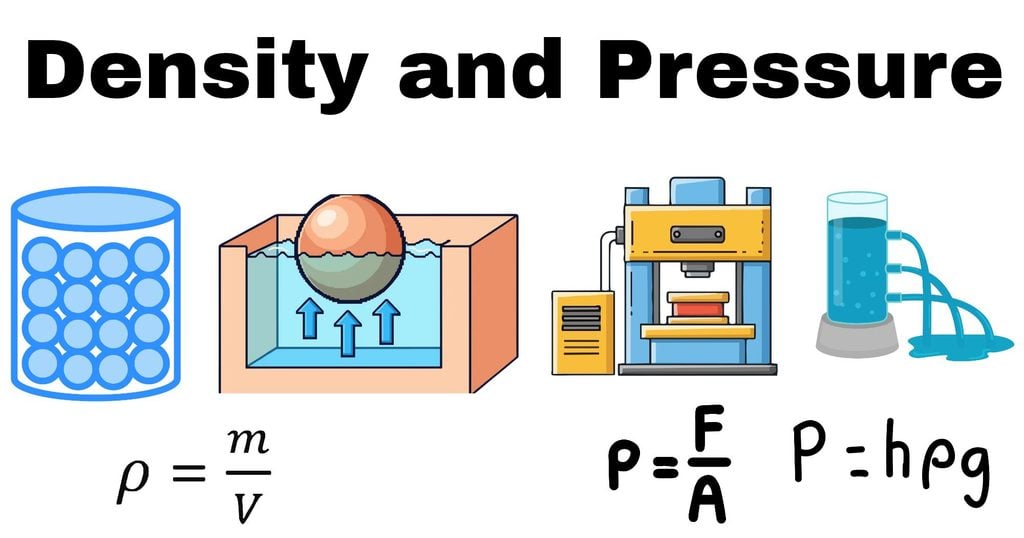
For example, in daily life we observe floating and sinking objects in water. Here, density is the physics behind those behaviors. Similarly, we see a sharp knife cutting vegetables more easily than a blunt one. The concept of pressure is used to explain this activity. There are also advanced examples like the design of a large ship floating in water and heavy lifting machines like hydraulic lifts and hydraulic jacks that are applications of the density and pressure concepts.
Understanding density and pressure is therefore essential to explain the physics behind everyday observations of objects. There are lots of simple to advanced applications of these basic concepts. A brief and simple explanation of these concepts is provided in this article.
What Are Density and Pressure?
Density
Density is the amount of mass present in a unit volume of a substance. It tells us how densely or loosely the particles (atoms or molecules) are packed inside a substance.
Mathematically, density has the SI unit kilogram per cubic metre (kg/m³) and is denoted as ρ. In equations, it is expressed as:
ρ = m / V [Equation 1]
where:
ρ = density of the substance
m = mass of the substance
V = volume occupied by the substance
A simple calculation includes a mass of 10 kg, occupying a volume of 2 m³; its density will be:
ρ = 10 / 2 = 5 kg/m³
A substance with greater density means it contains more mass in the same volume than a substance of lower density.
From equation (1), we see that density has a direct relation with the mass of a substance and an inverse relation with the volume of a substance. Density is a characteristic of a material or a particular substance, and for a particular substance under specified conditions, its density remains approximately constant. However, on changing the conditions like temperature and pressure, density can change. Gases are highly affected by these conditions.
For example, under normal conditions, the density of water is 1000 kg/m³, and that of iron is 7874 kg/m³. Generally, solids are densely packed and therefore have greater density than that of liquids and gases.
Pressure
Pressure is the quantity that measures the normal force acting per unit area of a surface. Mathematically, it is denoted by P and has the SI unit pascal (Pa). In equations, it is written as:
P = F / A [Equation 2]
where:
P = pressure
F = normal force
A = area over which the force acts
Similarly, one pascal is defined as the one newton force acting per unit area.
1 Pa = 1 N/m²
From equation (2), we see that pressure is directly related to the force acting and inversely related to the area. Thus, a sharp needle tip can generate more pressure than a thicker wooden stick.
Density and pressure both talk about the distribution of physical quantities, i.e., density describes the distribution of mass, whereas pressure describes the distribution of force.
Density and Its Applications
Density helps to identify the substance and compare the properties of various substances. It also helps to solve numerical problems dealing with mass and volume. From the relation,
ρ = m / V
we can also obtain:
m = ρV
and
V = m / ρ [Equation 3]
These relationships are widely used in physics.
Identifying Unknown Materials
The density of an unknown material can be measured experimentally if the mass and volume of that material are known.
Suppose a metallic ball has a mass of 780 g and a volume of 100 cm³. To find the density:
ρ = 780 / 100
ρ = 7.8 g/cm³
This value is close to the density of iron, so this material can be identified as iron.
Floating and Sinking
Floating and sinking are two important properties of objects in fluids that are determined by density. An object sinks in a fluid if its density is greater than that of the fluid. Similarly, to float, the object must have a lower density than that of the fluid.
An object having density equal to that of the fluid remains suspended within the fluid. Thus, this concept explains why a small metallic coin sinks in water but a large wooden block floats.
By increasing the volume, we can keep the object floating, as the best example is a ship. Although made of metals, ships can float in water because they are made up of hollow structures inside, giving a larger volume. This reduces the density (as density is inversely proportional to the volume) and allows them to float.
Density and Temperature
The volume of substances expands on heating while it contracts on cooling; as a result, this affects the density of that substance. As the mass of a substance is the same on heating or cooling,
ρ = m / V
Therefore, an increase in V with constant m produces a decrease in ρ.
This effect is especially important in gases because even a small amount of heat also causes a noticeable change in the density of gases.
Pressure in Solids, Liquids, and Gases
The behavior of pressure in solids, liquids, and gases is different.
Pressure in Solids
In solids, pressure is usually associated with the force applied to a surface.
The pressure is given by:
P = F / A
Consider a person standing on the ground. The person’s weight produces a downward force on the ground. The pressure depends on the surface area in contact with the ground. Hence, a person wearing high-heels produces greater pressure than a person wearing flat shoes.
Sharp blades have very small cutting edges so that a given force produces high pressure. On the other hand, the wheels of heavy vehicles and the foundations of buildings are designed to distribute forces over suitable areas.
Pressure in Liquids
Liquids exert pressure because of their weight. Liquids can flow and exert pressure in different directions.
Liquid pressure increases with depth. This is why the pressure of water flow is greater at ground level than at the top.
Liquid pressure also depends on the density of the liquid and the value of g.
For a liquid of density ρ at a depth h,
P = ρgh [Equation 4]
where:
P = pressure due to the liquid
ρ = density of the liquid
g = acceleration due to gravity
h = depth below the surface
This relation is extremely important in fluid mechanics.
Pressure in Gases
Gases also have pressure as molecules constantly move and collide with the walls of their container, giving it a pressure.
Earth’s atmosphere also creates pressure called atmospheric pressure.
The behavior of the pressure of a gas under various conditions of temperature, volume, or amount is different, and on this basis various gaseous laws are given.
Everyday examples of gas pressure include pressure inside vehicle tyres, pressure in balloons, aerosol containers, and bicycle pumps.
Hydrostatic Pressure
Hydrostatic pressure is exerted by a liquid at rest.
Consider a liquid contained in a tank. The liquid has weight, and this weight produces pressure on the bottom and sides of the container.
This pressure is given by:
P = ρgh
This shows that hydrostatic pressure depends on three factors:
- Density of the liquid
- Acceleration due to gravity
- Depth of the liquid
Pressure Increases with Depth
Suppose two points are located at different depths inside water. The point at greater depth has a greater amount of water above it. Therefore, the pressure at that point is greater.
The walls of dams are made thicker so that they can withstand the water pressure near the bottom because the pressure goes on increasing as we go to greater depths.
Hydrostatic Pressure and Container Shape
The shape of the container doesn’t have any effect on the pressure of the same liquid at the same depth. Therefore, a narrow and a wider container share equal water pressure at the same level of depth. We here assume that the effect of gravity is the same for both containers.
One thing to note is that the total force acting on a surface may be affected by the area and the pressure.
Hydrostatic pressure is observed in many natural and technological phenomena like groundwater pressure, water supply systems, and some devices based on fluids.
Upthrust and Archimedes’ Principle
Upthrust is another concept in fluid mechanics that is also a kind of force applied by the fluid on the objects that fully or partially get immersed inside that fluid. As the immersing object is moving downward, the fluid tries to throw it upward. This upward force is also called a buoyant force.
A rigid object has a top and a bottom level, and as the depth increases, the immersing object experiences different pressures at different surfaces. Hence, the lower part feels greater pressure than the upper part, and this pressure difference gives rise to the upward force or the upthrust.
Archimedes’ Principle
Archimedes’ principle states that when a body is wholly or partially immersed in a fluid, it experiences an upthrust which is exactly equal to the weight of the fluid displaced by the body.
Therefore,
Upthrust = Weight of displaced fluid
The weight of the displaced fluid is:
W = mg
Since the mass of displaced fluid is:
m = ρV
the upthrust can be written as:
U = ρVg [Equation 5]
where:
U = upthrust
ρ = density of the fluid
V = volume of fluid displaced
g = acceleration due to gravity
Floating Objects
For a floating object,
Upthrust = Weight of object
The fraction of an object that remains submerged depends on the densities of the object and the fluid.
This principle explains the floating of ships, boats, rafts, and other watercraft.
Applications of Archimedes’ Principle
Archimedes’ principle has many applications. It is used in hydrometers for measuring the relative density of liquids. It also helps in designing ships and submarines and in determining the volume or density of irregularly shaped objects.
A submarine changes its average density by taking water into or expelling water from its ballast tanks. This allows it to control whether it rises, sinks, or remains at a particular depth.
Pressure in Fluids
Any substance that is able to flow may be referred to as a fluid. Thus, liquid and gas both can be called fluids.
Pressure in a fluid at rest acts perpendicular to any surface in contact with the fluid. Unlike a solid, a fluid cannot normally support a tangential force when at rest.
Pressure Transmission in Fluids
One important property of fluids is that pressure applied to an enclosed fluid can be transmitted through the fluid.
This idea forms the basis of Pascal’s principle.
Pascal’s principle states that pressure applied to an enclosed fluid is transmitted equally and undiminished in all directions.
This principle is used in hydraulic machines.
For a hydraulic system,
P₁ = P₂
Since,
P = F / A
we get:
F₁ / A₁ = F₂ / A₂
Therefore,
F₂ = F₁A₂ / A₁ [Equation 6]
Hence, from equation (6), we can see that if the area of piston 1 is smaller than that of piston 2, a relatively small force applied to the smaller piston can produce a larger force at the larger piston.
Hydraulic Machines
Hydraulic machines are named so because they use liquids to transmit force and pressure according to the equation (6).
Some examples of hydraulic machines are hydraulic brakes, hydraulic lifts, hydraulic jacks, hydraulic presses, etc.
For example, hydraulic brakes are used in vehicles so that a small force applied to the brake pedal can transmit greater force to the wheels to stop the vehicle.
Atmospheric Pressure
The atmosphere surrounding the Earth also has mass and hence has weight. Because of this, the weight of the atmosphere also generates atmospheric pressure on surfaces.
At sea level, the standard atmospheric pressure has the approximate value of 1.013 × 10⁵ Pa at sea level. However, this pressure decreases as the altitude increases because the amount of air is smaller as we go above. Certain things like the weather conditions, breathing, boiling of liquids, barometers, etc. are affected by the atmospheric pressure.
Applications of Density and Pressure
Density and pressure have numerous applications in everyday life, engineering, medicine, meteorology, transportation, and industry.
Ships and Boats
The floating of ships is explained using density and Archimedes’ principle. They are designed in such a way that their volume is kept large to attain a lower density than water and hence can float easily.
Submarines
Submarines are able to move upward and downward by changing the amount of water in their ballast tanks. This changes their average density and controls the buoyancy of the submarine.
Dams
Water pressure increases with depth. Therefore, the lower part of a dam experiences greater pressure and must be constructed strongly enough to withstand this force.
Hydraulic Brakes
Hydraulic brakes use the transmission of pressure through a liquid. A force applied at one point is transmitted to braking mechanisms at the wheels.
Hydraulic Lifts
Hydraulic lifts are used to raise heavy vehicles and other loads. A small force applied over a small piston can produce a larger force through a larger piston.
Measuring Density
In laboratories, density can be determined by measuring the mass and volume of a substance.
For regular solids, volume can be calculated from dimensions. For irregular objects, the volume can be determined using the displacement method.
Hydrometers
Hydrometers are specific devices for measuring the relative density or specific gravity of liquids. They can float at different depths as per the density of the liquid.
Atmospheric Studies
Atmospheric pressure measurements are useful in weather forecasting. Changes in atmospheric pressure can provide information about changing weather conditions.
Medical Applications
Pressure measurements are important in many medical instruments and procedures. For example, pressure concepts are used in blood-pressure measurement and in respiratory systems.
Everyday Tools
Various tools and equipment like syringes, pumps, knives, needles, suction cups, drinking straws, etc. work according to the pressure conditions.
Solved Problems on Density and Pressure
Problem 1: Calculating density
If a metallic block has a mass of 6 kg and a volume of 0.002 m³, what is its density?
Given:
m = 6 kg
V = 0.002 m³
Using,
ρ = m / V
ρ = 6 / 0.002
ρ = 3000 kg/m³
Hence, the block has the density 3000 kg/m³.
Problem 2: Finding mass from density
For a liquid having density 800 kg/m³ and occupying a volume of 0.5 m³, find its mass.
Using,
m = ρV
m = 800 × 0.5
m = 400 kg
Hence, the liquid is of mass 400 kg.
Problem 3: Pressure produced by a force
Find the pressure produced by a force of 500 N acting normally on an area of 0.25 m².
Using,
P = F / A
P = 500 / 0.25
P = 2000 Pa
Hence, the pressure of 2000 Pa is produced.
Problem 4: Finding upthrust
An object displaces a volume of 0.02 m³ of water. What could be the upthrust acting on it? [Given: Density of water = 1000 kg/m³ , g = 9.8 m/s²]
Using,
U = ρVg
U = 1000 × 0.02 × 9.8
U = 196 N
Thus, the upthrust on the object is 196 N.
Problem 5: Hydraulic machine
Suppose we have a small piston of area 0.02 m² and a large piston of area 0.5 m². If a force of 100 N is applied to the small piston, find the force produced by the large piston.
Using Pascal’s principle,
F₁ / A₁ = F₂ / A₂
Therefore,
F₂ = F₁A₂ / A₁
F₂ = (100 × 0.5) / 0.02
F₂ = 2500 N
Hence, the force produced by the large piston is 2500 N.
Conclusion
The idea of density and pressure is a basic requirement in physics. They explain the behavior of fluids and objects in fluids. Both deal with the distribution of physical quantities: density describes the mass distribution, and pressure describes the force distribution on volume and surface area, respectively. To find the density of a substance, we use the formula: ρ = m/V, and for pressure, we use: P = F/A. These relationships are widely used to calculate and analyze density and pressure in various fields of science and technology.
Pressure relates differently on solids, liquids, and gases. Liquid pressure is calculated by the formula: P = ρgh, and hence we conclude that liquid pressure increases as the depth increases. This hydrostatic pressure explains why the lower portions of dams experience greater forces. This pressure difference gives rise to another important principle called Archimedes’ principle that describes upthrust. Upthrust is another force that comes into action on immersed objects due to the pressure difference at various levels of depths.
The basic principles of density and pressure are used in technologies like ships, submarines, hydraulic machines, brakes, hydrometers, pumps, atmospheric studies, etc. The natural phenomena of sinking and floating are beautifully described by these concepts. A lot of hydraulic machines are also designed on the basis of pressure transmission and continuity equations.
Density and pressure form a strong foundation in almost all fields of physics like fluid mechanics, thermodynamics, particle physics, atmospheric physics, etc. Engineering and medical fields also imply the study of density and pressure. Therefore, these concepts play an important role in providing basic physical principles and applying them to understand both natural phenomena and practical technologies.
References
- Walker, J., Halliday, D., Resnick, R., Resnick, R., Resnick, R., & Physicien, E. U. (2008). Fundamentals of physics (p. 1386). New York: Wiley.
- Schön, J. H. (2011). Density. In Handbook of Petroleum Exploration and Production (Vol. 8, pp. 97-105). Elsevier.
- Schön, J. H. (2015). Density. In Developments in petroleum science (Vol. 65, pp. 109-118). Elsevier.
- Mao, H. K., Chen, X. J., Ding, Y., Li, B., & Wang, L. (2018). Solids, liquids, and gases under high pressure. Reviews of Modern Physics, 90(1), 015007.
- Verma, H. C. (1993). Concepts of physics. New Delhi: Bharati Bhawan.
- https://phys.libretexts.org/Bookshelves/University_Physics/Physics_(Boundless)/10%3A_Fluids/10.2%3A_Density_and_Pressure
- https://pressbooks.online.ucf.edu/osuniversityphysics/chapter/14-1-fluids-density-and-pressure/
