
Forces can not only move objects but also create rotational effects on them, which is called the turning effects of forces. These forces act from a suitable position on objects. This creates a rotational motion in them and hence makes them turn about a fixed point or axis.
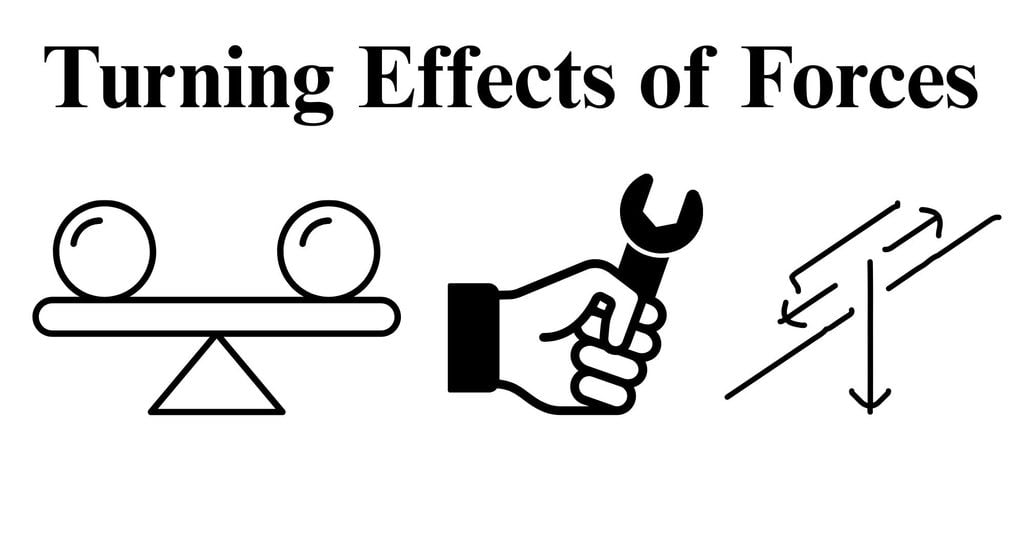
For example, when we open a door, we apply a force to the handle. The door rotates about its hinges. Similarly, while loosening a nut with a spanner, we apply force to the handle of the spanner. As a result, it produces a turning effect around the nut.
What Are the Turning Effects of Forces?
Turning effects are the action of the magnitude of the force and also, importantly, the distance between the pivot and the line of action of the force. Generally, the greater the distance kept, the greater will be the turning effect produced and vice versa. This simple idea has made huge applications in day-to-day life to the complex areas of physics and engineering. Many simple machines like levers, bicycles, cranes, etc. are based on the same concepts of rotational motion and turning effects.
To produce a turning effect, there is always a pivot or a fixed point of axis, and around it the object rotates. A perpendicular distance is maintained between the pivot and the line along which the force acts. This distance is called the moment arm.
Therefore, to increase the turning effects, two things can be done:
- increase the magnitude of the force or
- increase the moment arm
For example, it is easier to loosen or fasten a screw or nut by using a longer spanner than a shorter one by applying the same amount of force. The perpendicular distance plays a great role here. Many other important concepts of physics like centre of gravity, moment of force, torque, couple, etc. are closely related to the turning effects of forces.
Centre of Gravity
The centre of gravity of an object is that stable point where the entire weight of the object may be considered to act.
A rigid object is considered to consist of many particles. All these particles are pulled downward by gravity. Thus, instead of considering the gravity acting on every individual particle, we can find one point through the entire body where the total weight is acting. This point is called the centre of gravity.
If we consider a regular object whose mass distribution is uniform, the centre of gravity simply lies at its geometric centre. For example, the centre of gravity of a circular object lies at its geometric centre. But for irregular objects, the case may not be the same, and the centre of gravity can lie anywhere. This is the main point where the stability of an object lies.
An object tends to remain stable when the vertical line passing through its centre of gravity falls within its base. If this line is outside the base, the object falls or topples. Also, the wider the base, the greater the chance of an object remaining more stable. For example, a wider scale is more stable than a pen as the scale has a larger base. Many transport systems and vehicles are also made with the concept of maintaining stability by distributing mass equally.
Centre of Gravity and Stability
The three types of equilibrium are:
Stable equilibrium: An object is said to be in a stable equilibrium if it is able to return to its original position on slightly displacing it.
Unstable equilibrium: The object is in unstable equilibrium if it cannot come to its original position or moves farther away on slightly displacing it.
Neutral equilibrium: If the object remains in its new position on slightly displacing it, the object is said to be in neutral equilibrium.
In all cases of stability, the centre of gravity plays a key role, and hence constructions, designs, many other physical instruments, and also athletes keep focusing on stability. For example, gymnasts always keep their body in equilibrium while moving their body; otherwise they have high risks of toppling and getting injured.
Moment of a Force
The moment of a force is the turning effect produced by a force about a particular point or axis.
The magnitude of the moment is given by:
Moment = Force × Perpendicular distance from pivot
or,
M = Fd [Equation 1]
where:
- M = moment of the force,
- F = applied force,
- d = perpendicular distance from the pivot to the line of action of the force.
The SI unit of moment is the newton metre (N m).
For example, if a force of 20 N is applied perpendicular to a spanner at a distance of 0.25 m from the nut, the moment produced will be:
M = Fd
M=20×0.25
M=5 Nm
Thus, the turning effect on the nut is 5 Nm.
Direction of Moment
A force can have either a clockwise or anticlockwise turning effect.
If a force rotates an object clockwise about a pivot, the moment produced is called a clockwise moment, and if rotated anticlockwise about the pivot, the moment produced is called an anticlockwise moment.
The direction becomes particularly important when several forces act on the same object.
Factors Affecting the Moment
The moment of a force depends on:
Magnitude of force: A larger force produces a larger moment (keeping the distance the same).
Distance from the pivot: A force acting farther from the pivot produces a greater moment.
Angle of application: The turning effect depends on the component of the force perpendicular to the lever arm.
Generally, the magnitude of torque is given as:
τ = rFsinθ [Equation 2]
where r is the distance from the axis to the point of application of the force, and θ is the angle between r and F.
When the force acts perpendicular to the lever arm, θ = 90°, so:
τ = rF [Equation 3]
This is the situation commonly used when calculating the moment of a force.
Principle of Moments
The principle of moments is a condition to provide a balanced rotational equilibrium.
It states that to remain in an equilibrium position, the sum of the clockwise moments must be equal to the sum of the anticlockwise moments about the same point.
Therefore,
Sum of clockwise moments = Sum of anticlockwise moments
This principle has wide practical applications in maintaining stability, such as beams, levers, seesaws, balances, bridges, etc.
For example, a beam balance or a pan balance gets balanced if equal masses are kept on either side. Here the turning effects about the pivot are equal and hence keep it in equilibrium.
For example, a force of 300 N acts 2 m from the pivot.
Its moment is:
M = 300×2 = 600 Nm
Hence, a force of 200 N is needed to act on the opposite side at a distance d to balance this force:
200d = 600
Therefore,
d=3 m
Thus, the smaller force must act farther from the pivot.
Applications of the Principle of Moments
The principle of moments is used in:
- beam balances,
- weighing machines,
- seesaws,
- cranes,
- bridges,
- ladders,
- levers,
- mechanical tools, and
- structural engineering.
It provides a simple way of determining unknown forces and distances when a system is in equilibrium.
Couples and Torque
A couple consists of two equal and opposite parallel forces acting along different lines.
Although the two forces have equal magnitudes and opposite directions, they do not cancel their turning effects because they act along different lines. Instead, they produce a pure rotational effect.
The turning effect produced by a couple is called the torque of the couple.
It is given by:
τ = Fd [Equation 4]
where:
- F = magnitude of either force,
- d = perpendicular distance between the two forces.
Its SI unit is newton metre (N m).
A steering wheel provides a familiar example. When opposite forces are applied at different points on the wheel, they can produce rotation.
Other examples include:
- turning a steering wheel,
- rotating a screwdriver,
- opening a bottle cap,
- turning a tap,
- using a bicycle pedal,
- rotating a knob.
A single force and a couple are both forces but produce different effects on objects. A single force can cause both translation and rotation, but if it is a pure couple, it can only produce rotation.
Torque and Turning Effect
Moment and torque are two closely related but confusing topics. Both describe rotational effects. However, in many contexts, moment is described as the turning effect of a force about a specified point or axis, while torque is described only for the rotational effect and is associated with a couple. Torque is also equally essential in mechanical systems because it determines how a pure couple can produce rotational motion.
Equilibrium of Rigid Bodies
A rigid body is a regular or irregular-shaped object whose shape and size do not change significantly when forces act on it.
A rigid body is in equilibrium when the forces acting on it are balanced, and there is no unbalanced turning effect.
For complete equilibrium, two important conditions must be satisfied.
Translational Equilibrium
The resultant force acting on the body must be zero:
∑F=0
This means that the body does not accelerate linearly.
Rotational Equilibrium
The resultant moment about any suitable point must also be zero:
∑M=0
This means that the body does not have angular acceleration.
Therefore, a rigid body is in complete equilibrium when:
∑F=0
and
∑M = 0
For example, several forces may act on the horizontal beam supported at both ends, including its own weight and external loads. For the beam to remain stationary, the upward and downward forces must balance, and the clockwise and anticlockwise moments must also balance.
Importance of Equilibrium
The concept of equilibrium is very important in structural engineering. Engineers must ensure that the constructions they do can remain stable under different loads. Otherwise, there is a high chance of collapse and destruction.
Applications of Turning Effects of Forces
Turning effects of forces have many applications in everyday life, engineering, transportation, and machines.
Door Handles
The handles of doors are placed far from the hinges to increase the perpendicular distance from the pivot and allow a relatively small force to produce a sufficient turning effect.
Spanners
A long spanner increases the moment arm and increases the moment for the same applied force.
Seesaws
A seesaw operates according to the principle of moments. A smaller force can also balance a larger force if the distance is kept twice as far away from the pivot.
Wheelbarrows
A wheelbarrow acts like a lever. The wheel acts as the pivot, while the load and applied force act at different distances from the pivot.
Steering Wheels
A steering wheel allows a driver to produce a turning effect on the steering mechanism. Applying forces at suitable points on the wheel creates torque.
Cranes
Cranes must be designed carefully so that the load does not produce an excessive turning effect that could make the crane unstable. Engineers consider the position of the load, the mass of the crane, and the location of its centre of gravity.
Bicycles
Pedalling a bicycle involves torque. The force applied to the pedals produces a turning effect around the crank axle, which is transferred through the drivetrain to the wheels.
Bridges
Forces from vehicles, people, wind, and the structure’s own weight produce moments in bridges. Engineers calculate these moments to ensure structural stability.
Balancing Machines
Beam balances and other weighing devices use the principle of moments to compare forces or masses.
Human Body
Turning effects are also important in the human body. Muscles apply forces to bones at particular distances from joints. These forces produce moments that allow different parts of the body to rotate.
Thus, the principles of turning effects are not limited to machines. They are involved in many natural and technological systems.
Solved Problems on Moments and Torque
Problem 1: To calculate the moment of a force
If a force of 40 N is acting perpendicular to a lever at a distance of 0.5 m from its pivot, what will be the moment of the force?
Solution:
Using:
M = Fd
Given:
F = 40 N, d = 0.5 m
Therefore,
M = 40×0.5
M=20 Nm
Hence, the moment of the force will be 20 N m.
Problem 2: To find an unknown force
If a force of 100 N acts at a distance of 2 m from a pivot, what force must act 4 m from the pivot on the opposite side to balance the system?
For equilibrium:
Clockwise moment = Anticlockwise moment
Therefore,
100×2 = F×4
200 = 4F
F=50 N
Hence, the force is 50 N must act on the opposite side of the pivot to balance the system.
Problem 3: To find the distance
A force of 30 N produces a moment of 15 Nm about a pivot. Find the perpendicular distance from the pivot.
Using:
M = Fd
Therefore,
d = M/F
Substituting:
d =15/30
d=0.5 m
Thus, the force acts at a perpendicular distance of 0.5 m from the pivot.
Problem 4: Torque Produced by a Couple
Two equal and opposite forces of 25 N form a couple. The perpendicular distance between their lines of action is 0.4 m. Find the torque.
Using:
τ =Fd
τ=25×0.4
τ=10 Nm
Therefore, the torque of the couple is 10 N m.
Problem 5: Torque at an Angle
A force of 50 N acts on a lever of length 0.6 m at an angle of 30° to the lever. Find the torque.
Using:
τ = rFsinθ
Substituting:
τ = 0.6×50×sin30°
Since:
sin30°=0.5
we get:
τ=0.6×50×0.5
τ=15 Nm
Thus, the torque produced by the force is 15 N m.
Conclusion
The turning effect of forces has remained a very important topic in mechanics. It explains to us how a force can simply create rotational motion on objects. A force can also act from a fixed perpendicular distance to an object and make it rotate and produce a moment or torque. Here, the magnitude of force and the perpendicular distance are two key things to be noted for increasing the force.
Turning effect is also associated with the centre of gravity that helps to understand the exact point where all the weight of an object acts. Hence, with the help of this, we can point out the stable point of an object and hold it in an equilibrium position. Moment of force and the principle of moments give necessary insights to measure the rotational effect of forces and also conditions required for rotational equilibrium. Rotational motion can also occur with a pair of forces, which is called a couple. Torque is another important concept for this type of motion. Also, the equilibrium of rigid bodies requires both the resultant force and resultant moment to be zero.
This effect of force has multiple applications, varying from simple machines to vehicles and advanced applications like cranes, construction, etc. Even the physics of the movement of the human body holds this concept. Hence, the balanced action of forces on mechanical systems, their stability, and rotational motions can be explained based on the concept of turning effects of forces.
References
- Newman, J. (2008). Rotational Motion. Physics of the Life Sciences, 1-43.
- Beceiro-Novo, S. (2023). Dynamics of Rotational Motion: Rotational Inertia. Introductory Physics for the Health and Life Sciences I.
- Özkaya, N., & Nordin, M. (1999). Moment and Torque. In Fundamentals of Biomechanics: Equilibrium, Motion, and Deformation (pp. 29-46). New York, NY: Springer New York.
- Fridman, A. M., & Polyachenko, V. L. V. (2012). Physics of gravitating systems I: Equilibrium and stability. Springer Science & Business Media.
- Wang, C. (2025). Gravity and Inertia. Global Journal of Science Frontier Research: Physics and Space Science.
- Nonweiler, T. (1960). Effect of a Resisting Couple on the Rotational Motion of a Rigid Body. Nature, 187(4734), 311-311.
- https://www.savemyexams.com/a-level/physics/cie/25/revision-notes/4-forces-density-and-pressure/4-1-turning-effects-of-forces/turning-effects-of-forces/
