
Linear momentum is simply the measure of the quantity of motion contained by a moving mass. It is one of the fundamental concepts in mechanics. It depends directly on the mass of the objects, and hence a heavier object contains more momentum than a lighter object. Also, the linear momentum is directly proportional to the velocity of that moving object. Thus, a faster-moving object has more momentum than a slower object. In practical life, we find objects in motion frequently. For example, a heavy truck moving with a certain velocity, a moving person, a person moving on a bicycle, etc. Thus, the concept of linear momentum helps to understand the physics of motion, the force required to make them stop, or the physics in case of collision.
What Is Linear Momentum?
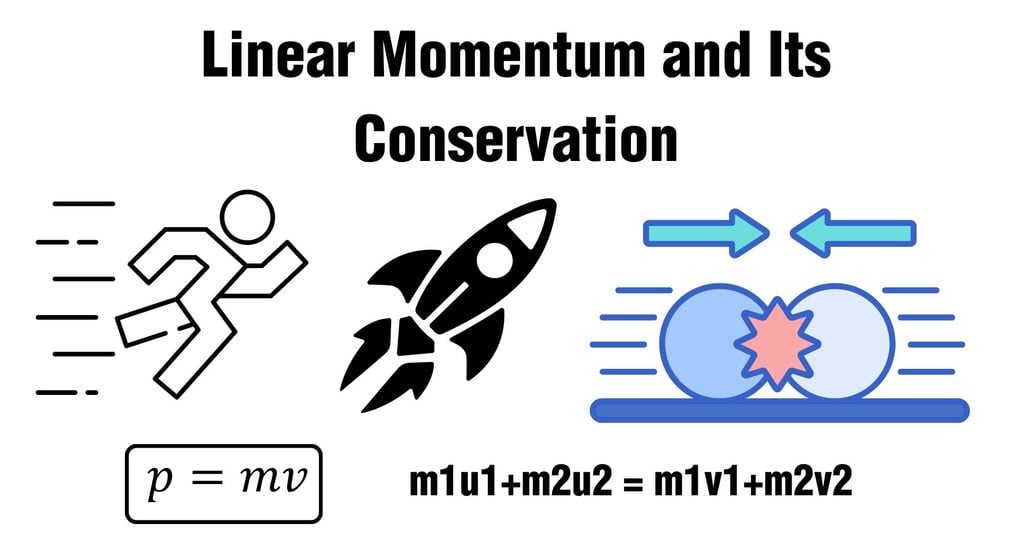
Mathematically, linear momentum is defined as the product of mass and velocity of a moving body and denoted by the symbol p.
p = mv [Equation 1]
Here, m is the mass and v is the velocity of the object.
Also, linear momentum is a vector quantity as it requires velocity that is a vector quantity, to calculate it. Therefore, momentum has both magnitude and direction. The direction of momentum depends upon the direction of the velocity.
Furthermore, as mass is expressed in kilogram and velocity in metre per second, the SI unit of linear momentum becomes kilogram metre per second (kg m/s). The unit can also be expressed as newton-second (N s), because:
1 N=1 kg m/s2
Thus,
1 N s = 1 kg m/s
For example, if a ball of mass 2 kg is moving with a velocity of 5 m/s, the momentum of the ball can be calculated as:
p = mv = 2×5 = 10 kg m/s
Momentum only considers objects in motion because, for an object at rest, its velocity becomes zero and hence the momentum becomes zero.
The concept of momentum is very important in practical life where we often meet collisions and interactions between objects. During a collision, objects can exert very large forces on one another for a very short time. Although the individual momenta of the objects may change, the total momentum of an isolated system remains constant. This concept is known as the principle of conservation of linear momentum.
Principle of Conservation of Linear Momentum
The principle of conservation of linear momentum states that, for an isolated system when no forces are involved, the total linear momentum of the system remains constant.
In other words, like energy, momentum also cannot be created or destroyed within an isolated system. It can only be transferred from one object to another.
Suppose we have two objects with masses m1 and m2. Suppose their initial velocities are u1 and u2, and after an interaction their final velocities become v1 and v2.
The total initial momentum is:
Pi = m1u1+m2u2
The total final momentum is:
Pf = m1v1+m2v2
According to conservation of momentum:
m1u1+m2u2 = m1v1+m2v2 [Equation 2]
This is the basic equation for collisions and interactions like processes.
Why Is Momentum Conserved?
Momentum conservation can be viewed classically, according to Newton’s third law of motion. The law simply states that the two interacting objects exert equal and opposite forces on each other. Thus, for no external forces acting on both objects, the momentum gained by one object will be equal to the momentum lost by the other object.
For example, a ball with a certain velocity rolls and collides with a stationary ball with lighter mass on a nearly frictionless surface; the stationary ball also gains some momentum and hence starts rolling. This gain in momentum of the lighter ball will be equal to the momentum lost by the heavier ball.
In more simple terms, we can also observe momentum conservation in a floating balloon. Assuming no air resistance, when an inflated balloon is released in air, the air released in one direction and the balloon goes in the opposite direction to the air. Thus, the motion of the air and the balloon is balanced by the conservation of linear momentum.
Impulse and Change in Momentum
Impulse is another important concept closely connected with linear momentum. When a force acts on a body for a certain time period, the momentum of that body changes. Thus, the product of this force and the time gives rise to another quantity called impulse.
Impulse is given by:
J = FΔt [Equation 3]
In equation 3,
-J is the impulse
-F is the applied force
-Δt is the time interval
From Newton’s second law,
F=ma [Equation 4]
Since acceleration is:
a = (v−u)/t
we get:
F = m (v−u)/t
Multiplying both sides by t:
Ft = mv−mu
Since mv is final momentum and mu is initial momentum,
J = Δp [Equation 5]
Equation 5 gives rise to the impulse-momentum theorem. This theorem states that the impulse acting on an object is equal to its change in momentum.
FΔt = Δp [Equation 6]
From equation 6, we can also see that the force produced and the time period are inversely proportional. Therefore, this principle explains that by increasing the collision or interaction time, we can reduce the force acting on an object and vice versa. This simple concept can explain many real-life situations.
For example, a fielder while playing cricket lowers his hand while catching the ball. This increases the time over which the ball is brought to rest. Hence, the force of the ball can be decreased, and the hit produced on the hand can be less. Also, other safety practices like airbags, seat belts, helmets, crash barriers, and other safety devices are designed with the same principle.
Elastic and Inelastic Collisions
A collision occurs when two or more objects interact over a relatively short period of time. Collisions can be classified according to what happens to kinetic energy during the interaction.
Elastic Collision
In an elastic collision, both momentum and kinetic energy of the interacting objects are conserved.
For two objects:
m1u1+m2u2 = m1v1+m2v2
and
½ m1u12 + ½ m2u22 = ½ m1v12 + ½ m2v22 [Equation 7]
Perfectly elastic collisions are an idealization, but they can be approximated in situations such as collisions between certain hard balls or particles.
In an elastic collision, deformation can occur on the objects during collision and kinetic energy can be transformed into elastic potential energy. However, this is temporary and regained after the collision.
Inelastic Collision
In an inelastic collision, kinetic energy gets transformed and cannot remain conserved. However, the momentum is conserved before and after the collision. The energy is lost in the form of sound, heat, deformation, etc., produced during the interaction process.
When the collision is perfectly inelastic, the two striking objects stick together.
If two objects stick together:
m1u1+m2u2 = (m1+m2)v [Equation 8]
In equation 8, v is the common velocity of the two objects stuck together after the collision.
For example, if two lumps of clay collide and stick together, the collision is approximately perfectly inelastic.
Conservation of Momentum in One and Two Dimensions
Conservation of momentum is flexible for all three classical dimensions.
One-Dimensional Momentum Conservation
It is simple to apply conservation of momentum to a one-dimensional motion because the objects move along a straight line. We can take a particular positive direction, and for opposite motion we take negative velocity.
If we consider two objects moving along the x-axis, our conservation equation will be:
m1u1+m2u2 = m1v1+m2v2
If one object moves to the right and another moves to the left, their velocities must have opposite signs. As momentum is a vector quantity, the direction must be taken carefully, as well as the sign convention.
Two-Dimensional Momentum Conservation
If two objects are moving in two dimensions, the momentum is considered along both co-ordinates. Therefore,
For the x-direction:
∑px,initial = ∑px,final
For the y-direction:
∑py,initial = ∑py,final
Therefore, to solve two-dimensional problems, we use the momentum vector and its horizontal and vertical components.
If an object has momentum p at an angle θ, its components are:
px = p cosθ
and
py = p sinθ
The conservation equations can then be applied separately in the two directions.
Two-dimensional momentum conservation is useful for studying collisions between objects moving at angles.
Momentum and Kinetic Energy
Momentum and kinetic energy both involve movement, but they are two different quantities with their own significance. Linear momentum is:
p = mv
while kinetic energy is:
K = ½ mv2
The main difference is that momentum depends linearly on velocity, whereas kinetic energy depends on the square of velocity.
For a given mass, doubling the velocity doubles the momentum:
p′ = m(2v) = 2p
But doubling the velocity makes kinetic energy four times larger:
K′ = ½ m(2v)2 = 4K
This difference is important in practical situations. A vehicle traveling at twice the speed has twice the momentum but four times the kinetic energy.
Momentum can be related directly to kinetic energy. Starting with:
p = mv
we have:
v = p/m
Substituting into the kinetic-energy equation:
K = ½ m(pm)2
Therefore,
K = p2/2m
This relationship shows that two objects of different masses and different kinetic energies can also have the same momentum. Therefore, a small object moving very fast and a large object moving slowly can have the same momentum.
Thus, momentum conservation and kinetic-energy conservation should not be confused.
Applications of the Conservation of Momentum
The conservation of linear momentum is used widely in every physical practice. Some important applications are given below:
Recoil of a Gun
While shooting or firing a bullet, the gun recoils in the opposite direction. Initially, the gun and the bullet are at rest, and hence the total momentum is zero. After firing, the bullet moves forward, and this forward momentum is balanced by the gun’s backward momentum.
Rocket Propulsion
Rockets operate through the conservation of momentum. A rocket pushes gases backward at high speed, and hence is able to move forward with the same high speed. Therefore, the backward momentum of the gases is balanced by the forward momentum of the rocket.
Collisions Between Vehicles
Momentum conservation helps engineers analyze vehicle collisions. The final velocities and masses of colliding vehicles before and after a collision can be analyzed by this principle when no external forces are acting on them, and the collision is also sudden.
Sports
As sports are all about motion, momentum is important in sports like football, cricket, tennis, hockey, and basketball. The motion of the ball and the players can be predicted through the principle.
Airbags and Safety Equipment
Airbags increase the time over which a passenger’s momentum changes during a crash. According to the impulse-momentum relationship, a longer collision time means a smaller average force for the same change in momentum.
Explosions
When an initially stationary object explodes into several pieces, the total momentum of all the pieces remains equal to the initial momentum, provided external forces are negligible.
Particle Physics
At the subatomic level, conservation of momentum is very important to analyze the interactions of particles. Hence, the properties of those particles can be studied by analyzing their momentum.
Solved Problems on Linear Momentum
Problem 1: Calculating Momentum
A truck of mass 5000 kg is moving with a velocity of 30 m/s. Find its linear momentum.
Solution:
Given:
m = 5000 kg, v = 30 m/s
Using:
p = mv, p = 5000×30
p=150,000 kg m/s
Hence, its momentum is 150,000 kg m/s
Problem 2: Change in Momentum
An object of mass 3 kg initially moving at 4 m/s increases its velocity to 8 m/s in the same direction. Find its change in momentum.
Solution:
Initial momentum:
pi=mu
pi = 3×4 = 12 kg m/s
Final momentum:
pf = mv
pf = 3×8=24 kg m/s
Therefore,
Δp =pf−pi
Δp=24−12
Δp=12 kg m/s
Problem 3: Perfectly Inelastic Collision
An object of 2 kg mass, moving with a velocity of 6 m/s, hits an object at rest of mass 4 kg. The two objects stick together after the collision. Find their common velocity.
Solution:
Given:
m1 = 2 kg,
u1 = 6 m/s
m2 = 4 kg,
u2 = 0
Since the objects stick together, conservation of momentum gives:
m1u1+m2u2 = (m1+m2)v
Substituting:
(2)(6)+(4)(0)=(2+4)v
12 = 6v
Therefore,
v = 2 m/s
The two objects move together at 2 m/s after the collision.
Problem 4: Impulse
An external force of 50 N acts on an object for 2 seconds. Find the impulse produced.
Solution:
Using:
J = FΔt
J = 50 x 2 = 10 N s
Since impulse equals change in momentum:
Δp = 10 kg m/s
Thus, the force produces a momentum change of 10 kg m/s
Problem 5: Recoil
A 5 kg object initially at rest breaks into two pieces. One piece of mass 2 kg moves to the right at 10 m/s. Find the velocity of the other 3 kg piece.
Solution:
Initially, the system is at rest, so:
Pi = 0
After the explosion:
m1v1+m2v2 = 0
Taking the right direction as positive:
(2)(10)+(3)v2=0
20+3v2 = 0
v2 = −20/3
v2 ≈ −6.67 m/s
The negative sign indicates that the second piece moves to the left, opposite to the direction of the first piece.
Conclusion
Linear momentum has wide importance from theory to practice. This fundamental concept reveals the physics of motion and interaction of objects. It is defined as the product of an object’s mass and velocity:
p = mv
Because velocity is a vector, momentum also has both magnitude and direction. One of the most important laws associated with momentum is the principle of conservation of linear momentum. This law gives a strong idea to analyze several physical processes like collisions, interactions, recoil, rocket propulsion, etc. It also turns out to be useful because the change in kinetic energy can keep the momentum conserved.
Impulse provides another important connection, showing that a force acting over a period of time produces a change in momentum. This explains the operation of safety devices such as airbags and helmets and also helps us understand how forces act during collisions.
Although momentum and kinetic energy are related to motion, they are two different concepts. Momentum is directly proportional to the velocity, whereas kinetic energy is directly proportional to the square of velocity. Understanding this distinction is essential when analyzing physical systems.
From simple collisions to rocket launches and explosions to subatomic interactions, conservation of linear momentum deals with all these motions involving processes. Hence, it has become the most important concept of mechanics and classical physics.
References
- Housel, T. (2025). Linear momentum. Tribology & Lubrication Technology, 81(6), 42-46.
- Gregory, R. D. (2006). Classical mechanics. Cambridge University Press.
- Chow, T. L. (2024). Classical mechanics. CRC press.
- Corben, H. C., & Stehle, P. (2013). Classical mechanics. Courier Corporation.
- Baez, J. C., & Wise, D. K. (2019). Lectures on classical mechanics. Manuscript. Available online at https://math. ucr. edu/home/baez/classical/texfiles/2005/book/classical. pdf.
- Gerjuoy, E. (1949). On Newton’s third law and the conservation of momentum. Am. J. Phys, 17, 477-482.
- https://www.geeksforgeeks.org/physics/linear-momentum-definition-formula-examples/
- https://en.wikipedia.org/wiki/Momentum
