Nitriles (A Level Chemistry Revision Notes)
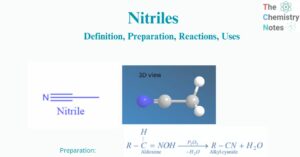
Nitriles

Nitriles are considered a derivative of hydrocyanic acid (HCN). When the hydrogen atom of HCN is replaced by an alkyl or aryl group, the compounds obtained are called cyanides or nitriles. The organic derivatives of hydrocyanic acid HCN are alkyl … Read more
Amines (A Level Chemistry Revision Notes)

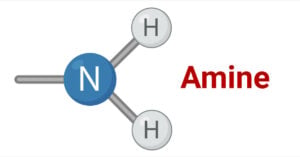
Amines

Amines are the class of organic compounds obtained by replacing one, or more hydrogen atoms of ammonia with alkyl groups. On the basis of the number of alkyl groups present in the compounds, amines are classified as primary secondary, tertiary. … Read more

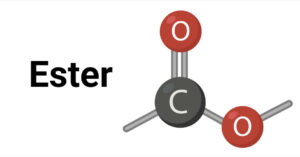
Esters (A Level Chemistry Revision Notes)

Ester Functional Group

Esters are the derivatives of carboxylic acids containing -COOR as a functional group, in which the -OH group of a carboxylic acid is replaced by the -OR group. Esters are important derivatives of an acid. The ester of a carboxylic … Read more

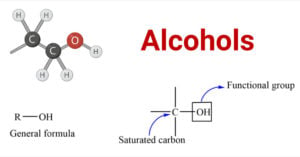
Alcohols (A Level Chemistry Revision Notes)

Alcohols

Alcohols are the organic compounds containing the hydroxyl (-OH) group attached to the saturated carbon. The -OH group acts as a functional group of alcohols that determines the characteristic properties of alcohols. They have the general formula R-OH. where R= alkyl or … Read more

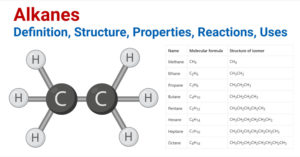
Alkanes (A Level Chemistry Revision Notes)

Alkanes- Definition, Structure, Properties, Reactions, Uses

Alkanes are the simplest organic compounds made up of carbon and hydrogen only. They have the general formula CnH2n+2. They are also known as saturated hydrocarbons since their carbon skeleton is entirely saturated with hydrogens. Alkanes consist of strong C-C … Read more

Alkenes (A Level Chemistry Revision Notes)

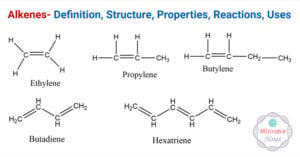
Alkenes

Alkenes are unsaturated hydrocarbons containing carbon-carbon double bonds. The carbon-carbon double bond is the functional group for alkenes, known as ethylenic linkage. The general formula of an alkene is CnH2n, where n is the integer number. Alkenes consist of two … Read more

Isomerism (A Level Chemistry Revision Notes)

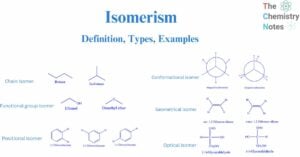
Isomerism

Isomerism occurs when many substances have the same chemical formula but different chemical structures. The term “isomer” comes from the Greek words “isos” and “meros,” both of which signify “equal parts.” In the year 1830, the Swedish chemist Jacob Berzelius … Read more