
Physical quantities are divided into two types: scalars and vectors. On the basis of certain categories, the physical quantities are divided into these two types. The quantities like mass, distance, speed, displacement, force, etc., are described and measured accordingly.
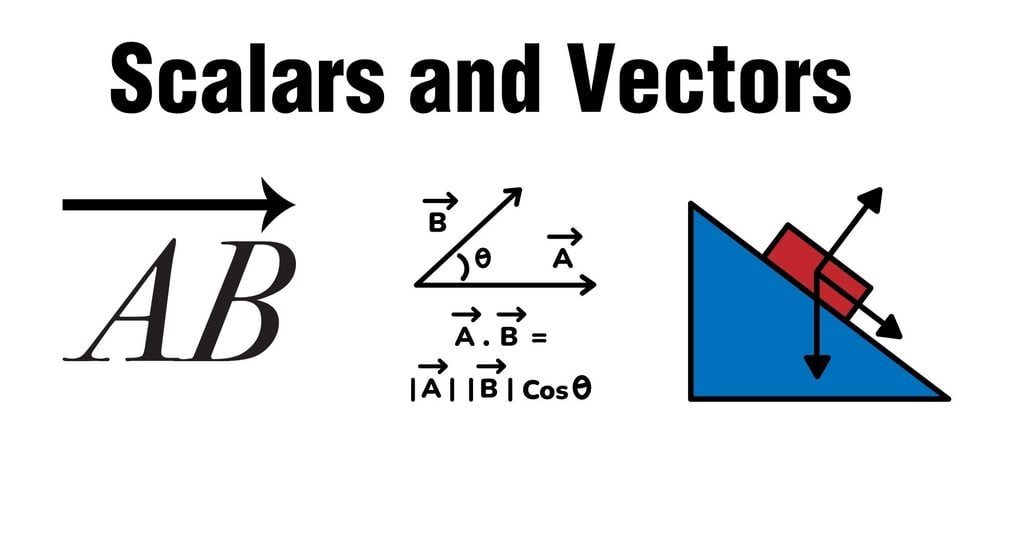
Scalars are the physical quantities which only need magnitude to be described while vectors are described using magnitude and direction. Hence, direction plays a key role in physics, to describe a physical quantity. Hence, understanding the difference between scalars and vectors is very essential.
Vectors require extra knowledge of vector addition, subtraction and resolution while scalars can be measured or calculated using simple algebraic rules. In physics, many topics like mechanics, motion, forces, momentum, etc., require strong knowledge of vectors. Hence, both quantities most be studied and solved systematically.
What Are Scalar and Vector Quantities?
A scalar quantity is a measurable quantity on the basis of magnitude only. Magnitude gives us information about the quantity of object present but not about its direction. Therefore, another concept of vector is driven. A vector quantity is a measurable quantity which includes both magnitude and direction.
Examples of scalar quantities include mass, time, temperature, distance, speed, energy, and power. For example, if a car travels at a speed of 20 m/s, the value 20 m/s tells only how fast the car is moving but not which direction it is travelling.
Examples include displacement, velocity, acceleration, force, and momentum. For example, a velocity of a car is 20 m/s due east means its magnitude is 20 m/s and its direction is east.
The concept of direction is very important because the magnitude may remain constant but changing the direction of a vector changes the vector. A car travelling at 20 m/s north and another car travelling at 20 m/s south have the same speed but different velocities.
Vectors are represented using arrows. The length of an arrow can represent the magnitude of the vector, while the arrowhead indicates its direction.
Differences Between Scalars and Vectors
The main difference between scalars and vectors is the information they contain.
| Feature | Scalar | Vector |
| Magnitude | Yes | Yes |
| Direction | No | Yes |
| Representation | Usually a number and unit | Arrow or vector notation |
| Addition | Ordinary arithmetic can often be used | Direction must be considered |
| Examples | Mass, time, energy, speed | Force, velocity, displacement |
Scalar quantities can usually be added or subtracted using ordinary arithmetic. For example, if a student studies for 2 hours and then studies for another 3 hours, the total study time is 5 hours.
Vectors cannot always be added in a simple manner. Their directions are also considered. For example, when a force of 10 N east and a force of 10 N west are added, the magnitude may be 20 N but, considering their directions will give the resultant zero.
For instance we can take distance and displacement. Distance is a scalar quantity and only considers the total length of a path while displacement is a vector quantity and needs the change in position from the starting point to the final position with directions to describe it.
Examples of Scalar and Vector Quantities
Many physical quantities encountered in AS and A Level Physics can be classified as scalars or vectors.
Common Scalar Quantities
Some important scalar quantities are:
- Mass: It is the amount of matter in an object and measured in kilograms (kg).
- Time – It is the duration of an event and measured in seconds (s).
- Temperature – It is a measure of the thermal condition of a body and measured in kelvin (K) or degrees Celsius (°C).
- Distance – It is the total length of a path travelled and measured in metres (m).
- Speed – It is the rate of change of distance and measured in metres per second (m/s).
- Energy – It is the capacity of doing work and measured in joules (J).
- Power – It is the rate of energy transfer and measured in watts (W).
- Work – It is the energy carried by a force, covering a certain distance and measured in joules (J).
Common Vector Quantities
Important vector quantities include:
- Displacement – It is a change in position of a moving body in a specified direction and measured in metres (m).
- Velocity – It is the rate of change of displacement and measured in metres per second (m/s).
- Acceleration – It is the rate of change of velocity and measured in metres per second squared (m/s²).
- Force – It is an external factor that changes the position or momentum of a body and measured in newtons (N).
- Momentum – It is the measure of a motion contained by a bosy and given by the product of mass and velocity. It is measured in kg m/s.
- Gravitational field strength – It describes the force per unit mass at a point and measured in N/kg.
It must be carefully understood that the units of scalars and vectors may be same but these are different concepts.
Addition and Subtraction of Vectors
Vectors are added or subtracted to give one result called a resultant vector. The resultant is a single vector and overally shows the effect on a whole quantity.
When two vectors act in the same direction, they can be added simply. For example, two forces of 5 N and 8 N acting eastward have a resultant force of:
5 N + 8 N = 13 N east
When two vectors are moving in opposite directions, their magnitudes are subtracted. For example, a 12 N force east and a 7 N force west give:
12 N − 7 N = 5 N east
For vectors acting at an angle, simple arithmetic is not sufficient. A vector diagram or mathematical method involving components must be used.
Triangle and Parallelogram Methods
The triangle law includes placing the tail of one vector at the head of another vector. The tail of the first vector to the head of the second vector gives the resultant vector.
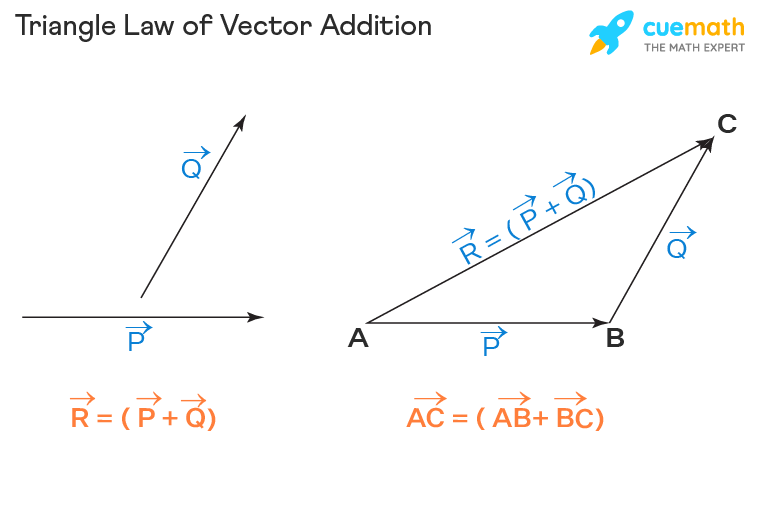
Source: https://www.cuemath.com/calculus/triangle-law-of-vector-addition
The parallelogram method can also be used when two vectors start from the same point. The diagonal of the parallelogram represents the resultant vector.
For perpendicular vectors, the magnitude of the resultant can often be calculated using Pythagoras’ theorem.
If two perpendicular vectors have magnitudes (P) and (Q), the resultant magnitude (R) is:
/R/ = √(P2+Q2+2PQcosθ) [Equation 1]
The direction can then be found using trigonometric relationships.
Direction of Resultant Vector R
If the Resultant Vector R make Φ angle with vector P then the direction of resultant vector is given as follows
tan ϕ = [( Qsinθ ) / (P + Qcosθ )] [Equation 2]
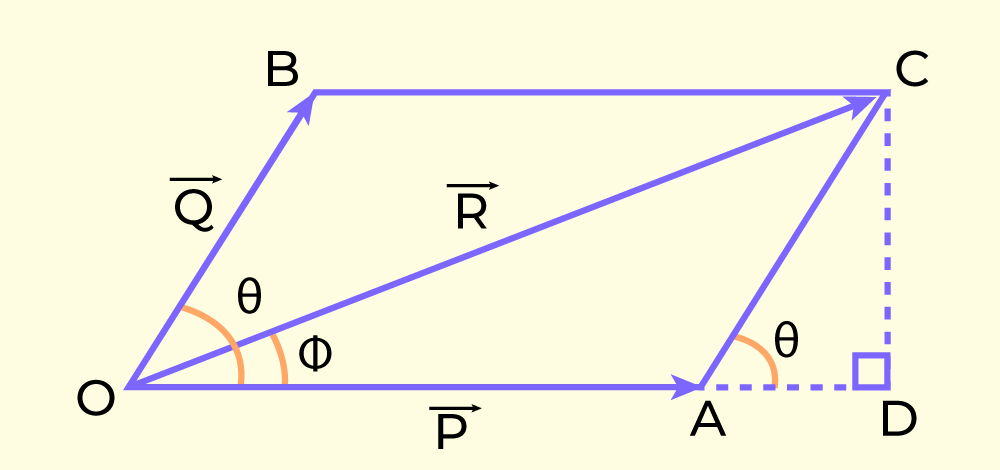
Source: https://media.geeksforgeeks.org/wp-content/uploads/20231011102508/Parallelogram-Law-of-Vector-Addition-2.png
Vector subtraction is denoted as a − b. This means adding the negative of the second vector to the first:
a − b = a + (−b).
Here, −b is a vector with the same magnitude as b but pointing in the opposite direction. The parallelogram law uses this idea to find the resultant vector graphically.
Resolution of Vectors into Components
Resolution of a vector means splitting a single vector into two or more components, usually along perpendicular directions.
In many physics problems, the most useful components are the horizontal component and the vertical component.
Consider a vector (F) making an angle (\theta) with the horizontal. Its components can be written as:
Fx = Fcosθ and
Fy = Fsinθ
where:
- Fx is the horizontal component,
- Fy is the vertical component,
- F is the original vector,
- θ is the angle measured from the horizontal.
The original vector can be reconstructed from its components:
F = √(Fx2+Fy2 [Equation 3]
This technique is extremely important in mechanics.
For example, when an object is pulled by a force at an angle, the force can be resolved into horizontal and vertical components. The horizontal component may affect the object’s horizontal acceleration, while the vertical component may affect the normal reaction or balance against weight.
Resolution of vectors is also useful when studying objects on inclined planes. The weight of an object can be resolved into components parallel and perpendicular to the slope, making the problem much easier to analyse.
Vector Diagrams and Representation
Vector diagrams provide a visual way of representing vector quantities. A vector is normally drawn as an arrow.
Three main features of a vector arrow are important:
- Length represents magnitude according to a chosen scale.
- Arrowhead represents direction.
- Starting point and ending point indicate where the vector acts or the change represented by the vector.
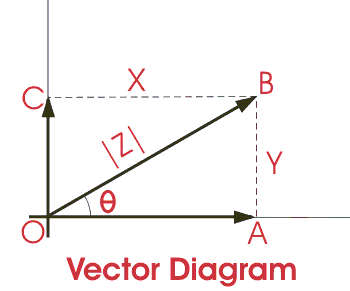
Source: https://th.bing.com/th/id/R.57eeeedc139e6c40333514bde149e5f9?rik=f1HnypI%2bawQ1jA&riu=http%3a%2f%2fwww.electrical4u.com%2fimages01%2fvector-diagram.gif&ehk=2DNL1gj%2bpajLtcanvEzORsTsOaeuegoupWNV8l0gCMY%3d&risl=&pid=ImgRaw&r=0
For example, a scale might be chosen such that 1 cm represents 10 N. A force of 30 N would then be represented by an arrow 3 cm long.
A suitable scale is important when drawing accurate vector diagrams. The diagram should also include clear labels and angles where necessary.
Vector diagrams can be used to determine resultant forces graphically. The vectors are drawn head-to-tail, and the resultant is then drawn from the starting point of the first vector to the ending point of the final vector.
Although graphical methods are useful for understanding vectors, mathematical methods are generally more precise. At A Level, students should be comfortable using both diagrams and calculations.
Vectors can also be written using components. For example:
A vector A with horizontal and vertical components can be written as:
A=(Ax,Ay)
Similarly, another vector B can be written as:
B=(Bx,By)
When adding the two vectors, add their corresponding components:
A+B=(Ax+Bx,Ay+By)
So, in simple terms:
Resultant horizontal component:
Rx=Ax+Bx
Resultant vertical component:
Ry=Ay+By
Therefore, the resultant vector is:
R=(Rx,Ry)
or
R=(Ax+Bx,Ay+By)
Applications of Scalars and Vectors
Scalars and vectors are used throughout physics to describe real physical situations.
Motion
Motion involves several important scalar and vector quantities like distance and speed (scalars), displacement and velocity (vectors).
Acceleration is is described according to the change in velocity and hence is a vector. Hence, an object can be accelerating even if its speed is constant but the direction is changing.
Forces
Forces are vectors because they are described by mass and also changing acceleration. We use vector addition to determine the resultant force when multiple forces are acting in an object.
Newton’s second law can be written as:
F→ = ma→
This shows that force and acceleration have a vector relationship.
Projectile Motion
Projectile motion provides an important application of vector resolution. The initial velocity of a projectile can be resolved into horizontal and vertical components.
The horizontal and vertical motions can then be analysed separately. This makes it possible to determine quantities such as time of flight, maximum height, and horizontal range.
Momentum
Momentum is a vector quantity as it requires velocity to describe it.
P→ = mv→
In collisions and explosions, the direction of momentum must be considered when applying the principle of conservation of momentum.
Engineering and Navigation
Vectors are widely used in engineering and navigation.The real-world systems are modelled by using vectors like forces, velocities, accelerations, displacements etc.
Scalars are equally important for measuring the magnitude of quantities like energy, temperature, mass, power, etc. These quantities do not require direction to describe them.
Common Mistakes in Scalar and Vector Problems
Magnitudes and units of scalars and vectors may look sometime confusing. During the learning process students may make some common mistakes which are given below:
Confusing Physical Quantities
Some quantities like displacement and distance, speed and velocity, etc. look confusing. However, displacement and velocity are vectors are incomplete without direction but speed and distance are scalars and their magnitude gives complete information about them.
Describing all Physical Quantities Like Scalars
Adding vector magnitudes without considering direction can produce an incorrect answer. For example, forces acting in opposite directions cannot simply be added as positive numbers.
Using Trigonometric Function in Wrong Way
Vector resolution is also confusing in starting phase and sine and cosine can be misplaced. To resolve vestors correctly, the role of angle must be studied carefully.
Horizontal angle is measured as:
Fx = Fcosθ
Fy = Fsinθ
This mistake can be removed by drawing a right-angled triangle before calculating the components.
Forgetting Direction
A vector answer should normally include its direction. A result such as 5 N is incomplete if the question asks for a resultant force.
Mixing Up Distance and Displacement
Distance is the total path length and is always scalar. Displacement depends only on the initial and final positions and has a direction.
Ignoring Negative Components
A negative vector component usually indicates that the component acts in the opposite direction than the chosen positive axis. Hence, it is not an error and must be carefully treated.
Using an Inappropriate Diagram
If the vector diagram is not labelled correctly, it leads to wrong calculations. Axes, angles, directions, and vector magnitudes should be clearly identified.
Conclusion
Scalars and vectors are two totally different concepts for describing physical quantities. Magnitude and direction are two important properties to describe a physical quantity and hence distinguish between scalars and vectors. A fundamental knowledge about them is crucial in the field of physics and engineering.
Scalar quantities like mass, time, energy, distance, and speed can generally be solved using simple idea of arithmetics. However, vectors like displacement, velocity, acceleration, force, and momentum require the knowledge of directions, vector rules and also resolution to handle them.
Vector addition and subtraction helps to combine several vectors and give a resultant vector. On the other hand, vector resolution can separate a single vector into useful components. These techniques are generally used in topics of mechanics like projectile motion, forces, and momentum.
To develop strong knowledge on physics it is important to identify scalar and vector quantities correctly. For advanced knowledge, it is necessary to draw accurate vector diagrams, resolve vectors into components, and include both magnitude and direction. Scalars and vectors are hence essential tools for describing and analysing the physical world.
References
- Joshi, A. W., & Kumar, A. (2004). Scalar and vectors in physics-I. Resonance, 9(10), 62-77.
- Bernstein, D. S. (2018). Scalar, vector, and matrix mathematics: theory, facts, and formulas-revised and expanded edition. Princeton university press.
- Vince, J. (2007). Scalars and Vectors. In Vector Analysis for Computer Graphics (pp. 1-10). London: Springer London.
- https://sciencenotes.org/scalar-vs-vector-definitions-and-examples/
- https://physicsfundamentals.org/blog/vectors-and-scalars
- https://openstax.org/books/universihttps://www.geeksforgeeks.org/physics/scalars-and-vectorty-physics-volume-1/pages/2-1-scalars-and-vectors/
