Introduction and Definition of Einstein’s Mass–Energy Relation
Einstein’s Mass–Energy Relation is one of the most important theories in physics. It was given by Albert Einstein in 1905 in his Special Theory of Relativity. This theory states that mass and energy can be converted into each other as they are two equivalent quantities.
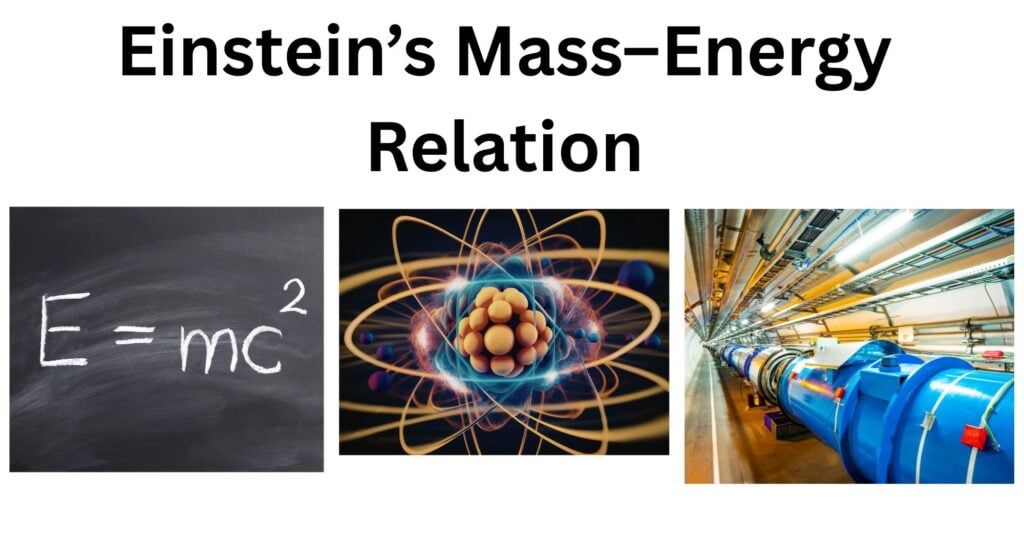
The relation theory was written in an equation as:
E = mc2 [Equation 1]
The above equation reveals a very strong theory that, since the speed of light is squared, even a very small mass can have a huge amount of energy. The speed of light is already very high, and again, squaring it gives a tremendous amount of energy.
Before Einstein’s theory, mass and energy were treated as two different quantities. On the development of theories, it was found that a particle can show dual nature, i.e., both particle and wave nature, and vice versa. This relation was connected by Einstein in his mass-energy relation. Thus, these two quantities are interchangeable.
The relation is mainly used in nuclear physics to understand nuclear processes like fusion, fission, radioactivity, etc. It is also used in particle physics to form new particles. It is the basis of Einstein’s special theory of relativity.
With the use of this relation, the universe can be understood differently. Cosmology and astronomy are rapidly progressing to reveal new secrets of the beginning of the universe.
What is E = mc²? Meaning, Formula, and Key Concepts
The mass-energy equivalence relation is given by E = mc². This relation tells that the mass can be converted into energy and vice versa. Here:
- E represents energy
- m represents mass and
- c is the speed of light in vacuum
The speed of light is always constant, i.e., 3 x 10⁸ m/s.
Meaning of the Equation
The equation means that matter itself stores energy. Every object with mass contains internal energy even when it is at rest. This energy is called rest energy.
The relation also explains why nuclear reactions release so much energy. For example, in nuclear reactions, a nucleus of small mass involved in a reaction can produce significant energy.
Key Concepts of E = mc²
Some important concepts related to the equation are:
- Mass and energy are equivalent.
- Matter can be converted into energy.
- Energy can create matter under certain conditions.
- A small mass can produce a huge amount of energy.
- The speed of light has a key role in relativity.
The equation may look very simple while viewing, but it carries a deep insight into physics.
Derivation and Principle of Mass–Energy Equivalence
Einstein’s special theory of relativity explained the curvature of space-time and also the relativistic motions of particles. This study helped to derive the mass-energy relation.
Einstein discarded the fact from classical physics that mass and energy were two different quantities. He connected both terms and showed them in combination as a single conserved quantity.
Principle of Mass–Energy Equivalence
The principle of mass-energy equivalence states that “Mass and energy are two forms of the same physical reality.”
This means:
- Mass can become energy.
- Energy can be converted into mass.
- The total amount of mass and energy contained in a body remains constant.
From [Equation 1], we see that energy and mass are directly proportional to each other. Thus, when an object emits energy, its mass decreases slightly and vice versa.
Simple Understanding of the Derivation
Einstein considered an object emitting light energy in opposite directions. By applying the laws of momentum conservation and relativity, he found that loss of energy must correspond to loss of mass.
This relationship led to E = mc².
The derivation proved mathematically that mass and energy are equivalent.
Rest Energy
An object at rest still contains energy because of its mass. This energy is called rest energy and is given by the same equation.
For a moving object, total energy includes:
- Rest energy
- Kinetic energy
This concept became an important theory in particle physics.
Explanation of Terms in E = mc² (Energy, Mass, Speed of Light)
To understand Einstein’s equation clearly, let’s expand each term involved in the equation.
Energy (E)
Energy is a conserved quantity for a body. It is also defined as the ability to do any work. It has different forms like:
- Heat energy
- Electrical energy
- Chemical energy
- Mechanical energy
- Nuclear energy
In Einstein’s equation, energy is the total energy stored in mass.
The SI unit of energy is the joule (J).
-Characteristics of Energy
- Energy cannot be created
- Energy cannot be destroyed
- Energy can change from one form to another.
- Energy always remains conserved for an isolated system
Einstein’s equation shows that mass itself is a form of energy.
Mass (m)
Mass is the quantity of matter contained in an object. It also measures the inertia of an object.
The SI unit of mass is kilogram (kg).
Mass is generally considered constant in ordinary situations. However, Einstein showed that mass can change during nuclear reactions.
-Types of Mass
- Rest mass
- Relativistic mass
Rest mass refers to the mass of an object at rest.
In nuclear reactions, a small amount of mass converts into energy. This missing mass is called the mass defect.
Speed of Light (c)
The speed of light in a vacuum is the fastest in the universe.
Its value is:
c = 3 x 10⁸ m/s
The square of the speed of light is extremely large:
c2 = 9 x 10¹⁶ m2/s2
Because of this huge value, tiny amounts of mass can release enormous energy.
The speed of light is constant for all observers according to Special Relativity.
Physical Significance of Einstein’s Mass–Energy Relation
Einstein’s mass–energy relation has deep physical significance.
Unity of Matter and Energy
The equation shows that matter and energy are not separate entities. Matter is concentrated energy.
Explanation of Nuclear Energy
The relation explains the source of energy in nuclear reactions. Small mass losses produce large amounts of energy.
Understanding Stellar Energy
The Sun and stars produce energy through nuclear fusion. Einstein’s equation explains how this energy is generated.
Basis of Modern Physics
The theory became one of the foundations of:
- Nuclear physics
- Particle physics
- Cosmology
- Relativity
Conservation of Mass–Energy
Classical conservation laws were modified into a single law called conservation of mass–energy.
This means total mass and energy together remain constant.
Creation of Matter from Energy
High-energy particles can create matter. This process is observed in particle accelerators.
Einstein’s theory completely changed scientific understanding of the universe.
Conversion of Mass into Energy and Vice Versa
One of the most important ideas of Einstein’s theory is the conversion between mass and energy.
Conversion of Mass into Energy
When mass converts into energy, enormous energy is released.
Examples include:
- Nuclear fission
- Nuclear fusion
- Radioactive decay
In these reactions, the final mass is slightly smaller than the initial mass. The missing mass becomes energy.
-Example
If 1 kg of matter completely converts into energy:
E = (1)(3 x 10⁸ )2
The energy produced is 9 x 10¹⁶ J.
This is an enormous amount of energy.
Conversion of Energy into Mass
Energy can also produce matter.
When very high-energy photons collide, they can create particles such as electrons and positrons.
This process occurs:
- In particle accelerators
- In cosmic rays
- During the early universe after the Big Bang
The conversion proves that mass and energy are interchangeable.
Applications of E = mc² in Nuclear Physics and Energy Production
Einstein’s equation has many practical applications.
Nuclear Power Plants
Nuclear power plants use heavy nuclear fuels like uranium, thorium, etc., and perform a nuclear fission reaction. This produces a huge amount of energy. However, nuclear fusion produces significantly more energy than nuclear fission.
Even a small quantity of uranium is enough to produce heat energy. Thus, steam is generated, which is used to rotate the turbines. The motion of turbines can produce electricity.
Atomic Bombs
Atomic bombs work on uncontrolled nuclear fission.
A rapid conversion of mass into energy produces a massive explosion.
The bombs used during World War II demonstrated the destructive power of mass–energy conversion.
Hydrogen Bombs
Hydrogen bombs are based on a nuclear fusion reaction. It is far more devastating than the atom bombs as fusion is capable of producing infinite energy than fusion.
Particle Accelerators
Particle accelerators convert energy into matter by colliding particles at high speeds.
Scientists use these machines to study fundamental particles.
Medical Applications
Mass–energy principles are used in:
- Radiation therapy
- PET scans
- Medical imaging
Radioactive isotopes release energy used for diagnosis and treatment.
Space Research
Nuclear energy systems are used in spacecraft and satellites.
The Sun’s energy also follows Einstein’s equation through fusion reactions.
Role of Mass–Energy Relation in Nuclear Fission and Fusion
Einstein’s equation is extremely important in understanding nuclear reactions.
Nuclear Fission
Nuclear fission is the splitting of a heavy nucleus into smaller nuclei.
Example:
- Uranium-235 splits into smaller elements.
During fission:
- Final mass is less than the initial mass.
- Missing mass converts into energy.
This energy appears as:
- Heat
- Radiation
- Kinetic energy
Nuclear reactors use controlled fission.
Nuclear Fusion
Nuclear fusion is the joining of light nuclei to form a heavier nucleus.
Example:
- Hydrogen nuclei combine to form helium.
Fusion occurs in the Sun and stars.
In fusion:
- Some mass disappears.
- The lost mass becomes energy.
Fusion produces more energy than fission.
-Energy in the Sun
The Sun converts millions of tons of hydrogen into helium every second.
The small mass difference produces enormous solar energy.
Einstein’s equation explains why stars shine.
Real-Life Examples of Mass–Energy Conversion
Mass–energy conversion occurs in many natural and technological processes.
The Sun and Stars
Stars produce energy through nuclear fusion.
Hydrogen converts into helium and releases energy.
This energy provides sunlight and heat to Earth.
Nuclear Power Plants
Electricity generation in nuclear reactors depends on mass conversion.
Tiny mass losses produce huge amounts of heat energy.
Atomic Bombs
Atomic explosions demonstrate rapid mass-to-energy conversion.
A small amount of mass produces destructive energy.
Radioactive Decay
Radioactive substances release energy as particles and radiation.
Mass decreases slightly during decay.
PET Scans
In medical imaging, matter and antimatter annihilate and produce gamma rays.
This helps doctors detect diseases.
Particle Accelerators
High-energy collisions create new particles from energy.
This demonstrates energy-to-mass conversion.
Advantages and Importance of Mass–Energy Equivalence in Modern Physics
Einstein’s theory has many advantages and scientific benefits.
Foundation of Nuclear Physics
The theory explains nuclear reactions and atomic structure.
Efficient Energy Production
Nuclear fuels produce enormous energy from small amounts of matter.
This makes nuclear energy highly efficient.
Understanding the Universe
The theory helps scientists study:
- Stars
- Black holes
- Galaxies
- Cosmology
Advancement of Technology
Many modern technologies use nuclear principles:
- Nuclear reactors
- Medical imaging
- Radiation therapy
- Space systems
Scientific Development
Einstein’s relation encouraged further discoveries in:
- Quantum physics
- Relativity
- Particle physics
Better Understanding of Matter
The equation revealed the hidden energy inside matter.
This completely changed scientific thinking.
Limitations and Misconceptions of E = mc²
Although Einstein’s equation is extremely important, people often misunderstand it.
Common Misconceptions
-Complete Conversion Does Not Happen Easily
Not all matter can fully convert into energy under ordinary conditions.
Complete conversion mainly occurs in matter–antimatter annihilation.
-The Equation Is Not Limited to Nuclear Bombs
Many people associate the equation only with atomic bombs.
In reality, it also explains:
- Solar energy
- Nuclear medicine
- Particle physics
- Natural cosmic processes
-Mass Does Not Increase Dramatically in Daily Life
Relativistic effects become noticeable only at very high speeds close to the speed of light.
-E = mc² Is Not the Entire Theory of Relativity
The equation is only one result of Special Relativity.
Relativity includes many other concepts, such as:
- Time dilation
- Length contraction
- Relativity of simultaneity
Limitations
-Practical Difficulty of Conversion
Converting mass into energy requires nuclear or high-energy reactions.
Ordinary chemical reactions convert very little mass.
-Technological Challenges
Controlled nuclear fusion is still technologically difficult.
Scientists are still researching efficient fusion reactors.
-Safety Concerns
Nuclear energy can produce harmful radiation and radioactive waste.
Improper use can lead to accidents and environmental problems.
Conclusion
Einstein’s mass-energy relation was a revolutionary invention in physics and got a Nobel Prize for the work. It proved that mass and energy are inter-connected to each other. Also, a small mass was capable of storing and releasing a huge amount of energy. Thus, modern physics was transformed by Einstein’s work. Till now, it has been dominating sectors like nuclear physics, particle physics, cosmology, and astronomy.
Technologies are highly advanced with the use of the mass-energy relation. Atom bombs were the massive invention after this theory. Particle accelerators are the greatest achievements of today. Medical science is also growing with the theory. This shows that the theory has a powerful impact on human beings. It is the guidance for every research and scientific development. In the future, further discoveries are on the way, with the proper use of the theory.
References
- Ives, H. E. (1952). Derivation of the mass-energy relation. Journal of the Optical Society of America, 42(8), 540-543.
- Fernflores, F. (2001). The equivalence of mass and energy.
- Hecht, E. (2009). Einstein on mass and energy. American Journal of Physics, 77(9), 799-806.
- Sharma, A. (2008). The generalized conversion factor in Einstein’s mass-energy equation. Progress in Physics, 3, 76.
- Rabinowitz, M. (2015). General derivation of mass-energy relation without electrodynamics or Einstein’s postulates. Journal of Modern Physics, 6(09), 1243.
- Wong, C. L., & Yap, K. C. (2005). Conceptual Development of Einstein’s Mass-Energy Relationship. New Horizons in Education, 51, 56-66.
- Annamalai, C. (2024). Einstein’s Special Theory of Relativity: A New Mass-Energy Equivalence. SSRN Electronic Journal.
- https://en.wikipedia.org/wiki/Mass%E2%80%93energy_equivalence
- https://www.britannica.com/science/E-mc2-equation
- https://modern-physics.org/mass-energy-equivalence-emc%C2%B2/
