
Introduction and Definition of Photovoltaic Cell
Photovoltaic cells (PV cells) are modern devices that directly convert sunlight into electricity. They are also called solar cells. Solar panels are the most popular applications of photovoltaic cells. The word “photovoltaic” is composed of two words: photo (i.e light) and voltaic (meaning electricity), which suggests electricity generated from light.
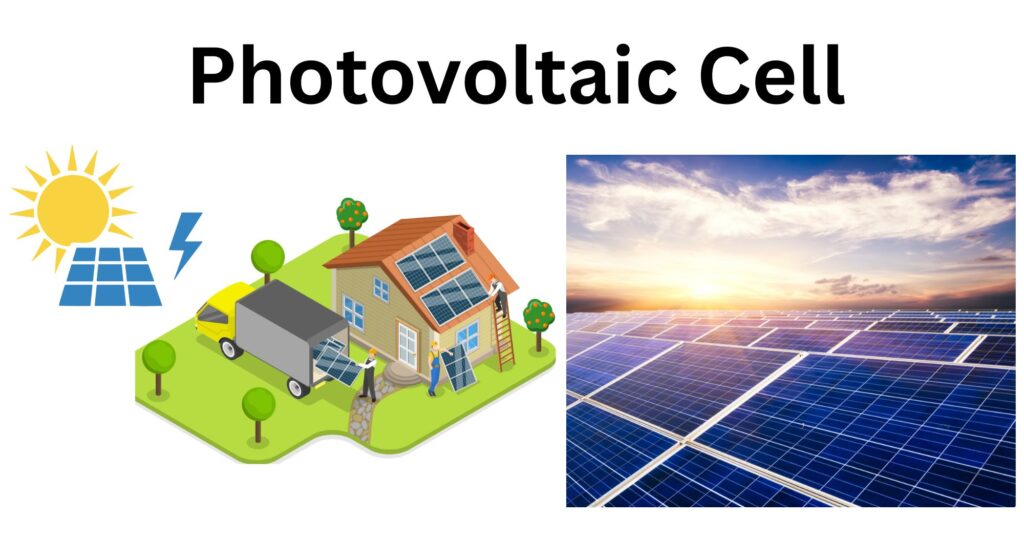
In the present scenario, the world is extremely searching for a good replacement for non-renewable energy. Thus, photovoltaic cells can be the best idea in this growing demand for clean energy. Moreover, the sunlight is eternal and hence is a sustainable energy source. Hence, we can depend on solar energy for the lifetime.
Solar cells are common in homes, industries, and some electronic devices. Many transportation systems, communications systems, spacecraft, and satellites also depend on them. People are being more alert to using renewable sources than non-renewable sources. This can protect the environment from further degradation. With time, they can fully replace other sources of energy and become more reliable and efficient.
Principle of Photovoltaic Cell (Photovoltaic Effect)
Solar cells work according to the Photovoltaic effect. It also depends on the photoelectric effect to produce free electrons.
As light contains photons, when sunlight falls on the metallic face of the cell, photons are absorbed by the semiconductor material used in the cell. Photons expel electrons from the surface and hence can flow randomly. The metallic plates of the semiconductor control their movements and give a direction. When electrons flow in a finite direction, electric current is produced, and hence electricity is generated.
In this process, there are no harmful emissions and disturbing noises. The amount of electricity production solely depends on sunlight collection and the quality of the device. Hence, it is a very reliable method of getting electricity.
Structure and Components of a Photovoltaic Cell
A number of components are used in the conversion process of solar energy to electricity, which are given below:
Semiconductor Material
Semiconductor plays a major role in showing the photovoltaic effect. Basically, silicon is used as the semiconductor material as it is easily available and stable. It effectively converts sunlight to electricity.
-P-Type Layer
The p-type semiconductor layer contains an excessive amount of holes as impurities. These holes can facilitate the flow of electric current.
-N-Type Layer
The n-type semiconductor layer contains an excessive amount of electrons as impurities. These electrons flow to produce electricity
-P-N Junction
A small gap between the p-type and n-type layers is called the p-n junction. This junction automatically creates an internal electric field and separates positive and negative charges.
Front Metal Contacts
Thin metal contacts are placed on the front surface to make maximum release of electrons when photons fall on it. These contacts allow electricity to flow into an external circuit.
Back Metal Contact
With the metal contact layer on the back of the cell, the electrical circuit becomes complete. This helps to collect electrons.
Anti-Reflective Coating
An anti-reflective coating is added to capture light and do not let it escape. This helps in minimising the back reflection of light, and absorption becomes efficient.
Protective Glass Layer
A transparent protective layer covers the cell to shield it from external damage. It doesn’t disturb the absorption of light and also safeguards the cell.
These components are crucial in the solar energy harvesting process.
Mechanism of Working of a Photovoltaic Cell
The operation of a photovoltaic cell involves several steps.
Absorption of Sunlight
First, the sunlight is absorbed in the PV cell. This is done by the semiconductor material as a photon of light hits the metallic layer.
Excitation of Electrons
The absorbed photon energy now expels electrons from the surface.
Generation of Electron-Hole Pairs
As electrons are freed, holes are created in the semiconductor. Thus, electron-hole pairs are formed.
Separation of Charges
The electric field at the p-n junction separates the electrons and holes. Electrons move toward the n-type layer, while holes move toward the p-type layer.
Flow of Electric Current
The separated electrons travel through the external circuit, which is formed by connecting the two sides of the cell. This electron flow produces the current.
Production of Electricity
The flowing current can power electrical devices or be stored in batteries for later use.
This entire process occurs continuously as long as sunlight is available. The conversion of sunlight directly into electricity makes photovoltaic cells highly useful for renewable energy generation.
Types of Photovoltaic Cells
There are different kinds of PV cells available at present. Some major types are given below:
Monocrystalline Photovoltaic Cells
The word ‘mono’ represents single. Therefore, it suggests that only a single crystal of silicon is used in these cells.
-Characteristics
- Uniform dark appearance
- High efficiency
- Long lifespan
- Better performance in limited space
-Advantages
- Highest efficiency among common silicon cells
- Requires less installation area
- Excellent durability
-Disadvantages
- Higher manufacturing cost
- More expensive than other types
Monocrystalline cells are commonly used where maximum energy production is required.
Polycrystalline Photovoltaic Cells
Polycrystalline cells are made by the fusion of multiple silicon crystals.
-Characteristics
- Blue-colored appearance
- Moderate efficiency
- Lower production cost
-Advantages
- Less expensive than monocrystalline cells
- Easier manufacturing process
-Disadvantages
- Slightly lower efficiency
- Requires more installation area
Polycrystalline cells are widely used in residential and commercial solar installations.
Thin-Film Photovoltaic Cells
Thin-film cells are manufactured by depositing thin layers of photovoltaic materials onto substrates such as glass, plastic, or metal.
-Characteristics
- Lightweight
- Flexible
- Lower material usage
–Advantages
- Lower manufacturing cost
- Suitable for flexible applications
- Easier integration into buildings
–Disadvantages
- Lower efficiency
- Larger area required for the same power output
Thin-film technology is useful for portable devices, building-integrated photovoltaics, and large solar farms.
Factors Affecting the Efficiency of Photovoltaic Cells
The efficiency of a photovoltaic cell depends upon the following factors:
Sunlight Intensity
The higher the intensity of sunlight, the greater the chance of electricity production.
Temperature
High-intensity requirement doesn’t mean a high temperature. High temperatures can damage the cell components. Therefore, photovoltaic cells work efficiently under moderate temperature conditions.
Angle of Sunlight
A sufficient amount of light cannot be absorbed if the cell is not faced towards the light properly. Therefore, the PV cells must be kept at certain angles to get maximum light collected.
Dust and Dirt
External factors like the accumulation of dust, dirt, and other materials can disturb the light from striking the cell. Hence, the cell must be cleaned regularly.
Shading
Shading of the cell from factors like trees, tall buildings, etc., can also disturb the electricity production.
Quality of Semiconductor Material
High-quality semiconductor materials are only efficient in producing electricity.
Cell Design
Advanced cell designs improve light absorption and reduce energy losses.
Age of the Cell
Photovoltaic cells can lose their ability over time because of continuous exposure. However, some cells are made that can last for more than 25 years.
Understanding these factors can help to increase the performance of the cell.
Applications of Photovoltaic Cells in Solar Energy Systems
The applications of Photovoltaic cells are given below:
Household Electricity Generation
Solar panels are used in houses and buildings to generate electricity. This electricity is used for lighting purposes, appliances, and electronic devices.
Business
In business sectors, PV cells are used to reduce electricity bills. They are also used for sustainability.
Industries
The electricity from PV cells is also used in industries for manufacturing processes and system operations.
Rural and Remote Areas
Rural and remote areas are highly benefitted by Photovoltaic systems because power grids are difficult to access for electricity.
Street Lights
Streetlights are also powered by solar cells. The electricity is stored during the day and illuminated at night.
Water Pumping Systems
Solar-powered pumps are widely used in agriculture and rural water supply systems.
Telecommunications
Remote communication towers are powered by PV cells as they are reliable.
Satellites and Spacecraft
Photovoltaic cells are also the energy source for satellites, space stations, and spacecraft.
Portable Devices
Calculators, watches, portable chargers, etc., are the portable devices using photovoltaic cells.
Advantages of Photovoltaic Cells
Photovoltaic cells offer many benefits that contribute to their growing popularity.
Renewable Energy Source
Sunlight is continuously obtained from the sun, which is a renewable source of energy. Hence, energy from PV cells is sustainable.
Conservation of the Environment
The electricity produced by the Photovoltaic cells does not release any harmful gases and also offers no pollution.
Reduced Bills and Operating Costs
The bills for electricity are very low with PV cells. They also require minimal maintenance.
Self-Energy Generation
Users can generate their own electricity and should not have to rely on external power sources.
No Disturbance
Photovoltaic cells do not produce noise while operating, and hence they do not create any disturbances.
Durability
Most photovoltaic systems can run efficiently for more than 25 years.
Flexibility
Photovoltaic systems can range from small portable devices to large solar power plants.
These advantages make photovoltaic technology a key component of sustainable energy development.
Limitations of Photovoltaic Cells
Despite their many benefits, photovoltaic cells also have certain limitations.
Dependence on Sunlight
Electricity generation decreases during cloudy weather and stops at night.
High Installation Cost
Installing photovoltaic systems is costly.
Energy Storage Requirements
Batteries are needed to store excess energy and use it when needed.
Limited Efficiency
Present cells have limited efficiency and can convert only a limited range of sunlight into electricity.
Large Space Requirements
As the amount of energy production also depends on the area, generating large amounts of power requires a huge piece of land. This is not possible in all cases.
Manufacturing Impact
The production of photovoltaic cells goes through a lot of manufacturing issues, such as the need for energy, raw materials, and industrial processes. This might be challenging.
Reduced Performance
Long exposure to the environment can degrade Photovoltaic cells and can cause them to lose efficiency over time.
Further research is being carried out to solve these problems.
Future Trends in Photovoltaic Technology
Some advanced works that can be done in the future regarding solar cells are as follows:
More Efficient Solar Cells
Advanced solar cells are being developed that can convert a larger percentage of sunlight into electricity.
Perovskite Solar Cells
Perovskite materials are also kept in the option as they show high efficiency and low manufacturing costs.
Tandem Solar Cells
One can think about embedding multiple semiconductor materials so that a huge range of light can be absorbed.
Flexible Solar Panels
Flexible and portable photovoltaic materials can be integrated into clothing, vehicles, electronics, and even into the parts of a building (roofs, windows, walls, etc.).
Smart Solar Systems
Artificial intelligence and advanced monitoring systems are being developed to increase energy production.
Improved Energy Storage
Advanced battery technologies can be brought to store greater energy and secure it in need.
Recycling Technologies
New recycling methods can recover valuable materials from old photovoltaic panels. This reduces environmental impacts.
Conclusion
Photovoltaic cells or solar cells are the reliable and efficient devices to obtain electricity from a never-ending energy source, i.e the Sun. They use semiconductor materials like silicon to absorb the sunlight. Free electrons are obtained from the light hitting their surface, and hence an electric field and electricity are generated.
The performance of PV cells is influenced by factors such as sunlight intensity, temperature, material quality, and system design. They also offer low bills with efficient and flexible use. Thus, they are suitable for homes, industries, transportation, agriculture, space exploration, etc.
There are also a handful of challenges, like the installation costs, weather dependence, the need for professionals for installation, etc. However, these are nothing if we go through the advantageous side. Efficiency and cost issues can be reduced with the growing technology and advancements.
The main reason for bringing the concept of this technology is to reduce the use of non-renewable energy. Growing pollution, climate change, and greenhouse gas emissions are the major problems today. Hence, being clean and sustainable, it is a perfect solution for them. It secures energy for the lifetime and hence meets future goals with improving technologies.
References
- Hao, D., Qi, L., Tairab, A. M., Ahmed, A., Azam, A., Luo, D., … & Yan, J. (2022). Solar energy harvesting technologies for PV self-powered applications: A comprehensive review. Renewable energy, 188, 678-697.
- Mohammadnia, A., Rezania, A., Ziapour, B. M., Sedaghati, F., & Rosendahl, L. (2020). Hybrid energy harvesting system to maximize power generation from solar energy. Energy conversion and management, 205, 112352.
- Vasiliev, M., Nur-E.-Alam, M., & Alameh, K. (2019). Recent developments in solar energy-harvesting technologies for building integration and distributed energy generation. Energies, 12(6), 1080.
- Guilar, N., Chen, A., Kleeburg, T., & Amirtharajah, R. (2006, October). Integrated solar energy harvesting and storage. In Proceedings of the 2006 international symposium on low power electronics and design (pp. 20-24).
- Mekhilef, S., Saidur, R., & Kamalisarvestani, M. (2012). Effect of dust, humidity and air velocity on efficiency of photovoltaic cells. Renewable and sustainable energy reviews, 16(5), 2920-2925.
- Polman, A., Knight, M., Garnett, E. C., Ehrler, B., & Sinke, W. C. (2016). Photovoltaic materials: Present efficiencies and future challenges. Science, 352(6283), aad4424.
- Deb, S. K. (1998). Recent developments in high eficiency photovoltaic cells. Renewable energy, 15(1-4), 467-472.
- https://www.geeksforgeeks.org/physics/photovoltaic-cell/
- https://en.wikipedia.org/wiki/Solar_ceii
- https://electricalacademia.com/renewable-energy/photovoltaic-pv-cell-working-characteristics/
