
Introduction and Definition of Solar Cooker
A solar cooker is a cooking appliance that is based on solar energy. We generally cook food using gas, stoves, induction, etc. Moving further back, we were dependent on firewood, coal, kerosene, etc. Unlike these methods, a solar cooker is a pure use of sunlight to cook food.
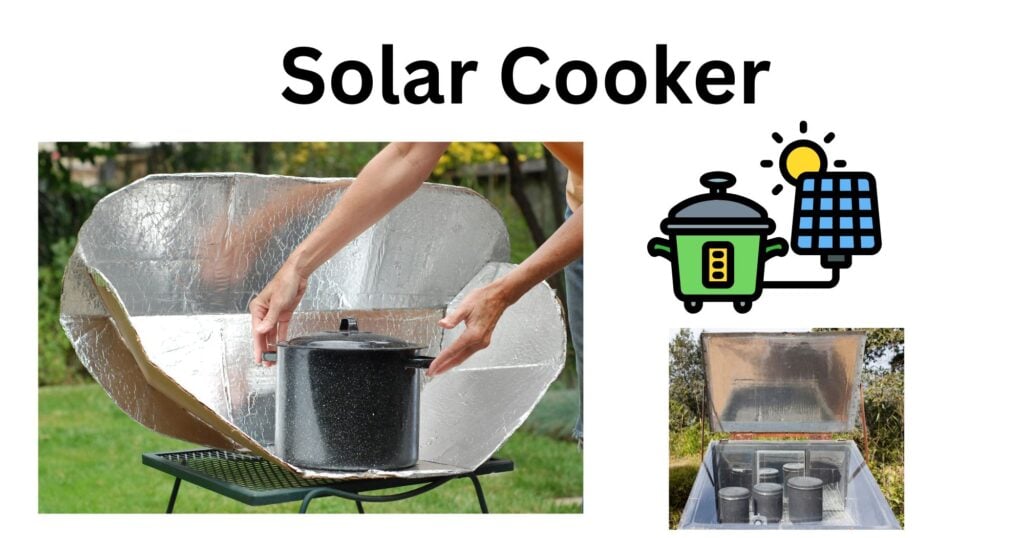
Traditional methods released a high amount of smoke and other gases, which increased pollution. Hence, a solar cooker was brought as an option to control the use of non-renewable sources of fuel. Solar energy has no side effects on the environment. It is easily available, and we can rely on it.
A solar cooker needs a good amount of sunlight to collect. Hence, the process of cooking is easier. It is also economical compared to other cooking sources. Solar cookers are slowly being noticed at homes, schools, camps, and in rural areas. They can fully replace other sources with the growing technologies.
Principle and Working of a Solar Cooker
Solar cookers are based on the principle of solar energy harvesting. The solar energy is converted into heat or thermal energy in order to cook. The outer surfaces of the cooker are made up of glass or plastic and are reflective so that light enters the cooker. The light rays are directed towards the cooking vessel. There are also dark surfaces inside the cooker, made to absorb light. Thus, the incident light is converted to heat.
As the mechanism of the greenhouse effect, the heat is not allowed to escape from the cooker. The light can enter but cannot escape. This heats the cooker, and it is able to cook. The temperature inside the vessel can range from 80°C to more than 300°C. This depends upon the type of cooker and the intensity of light. This cooking method might be slower than our regularly used conventional methods, but it is safe to use and clean for the environment.
Types of Solar Cookers
The three main types of solar cookers are box cookers, parabolic cookers, and panel cookers.
Box Solar Cooker
The box solar cooker is the most common type. It consists of an insulated box with a transparent glass cover.
Sunlight enters through the glass cover and is absorbed by the black interior surface. Reflectors attached to the cooker increase the amount of sunlight entering the box.
Box cookers are simple in design and also cheap. They are suitable for household purposes and can easily cook vegetables, pulses, and other food items.
Parabolic Solar Cooker
As suggested by the name, a parabolic solar cooker has a parabolic reflector. The light is accumulated at this single point. A very high temperature is obtained by this method. Hence, foods can be cooked faster than other cooking types. Unlike other cookers, it can also be used for frying and baking. However, the position of the reflector must be adjusted from time to time.
Panel Solar Cooker
In a panel solar cooker has reflective panels around the cooking pot is surrounded by a number of reflective panels. They can easily focus the light on the pot. Panel cookers are portable and simple. Hence, they are easy to carry out in emergencies and for camping.
All solar cookers have their own advantages and applications according to the need.
Structure and Components of a Solar Cooker
A solar cooker has various important parts which are given below:
Reflector
Reflectors are reflecting surfaces. They are made from shiny materials like aluminum foil, mirrors, or polished metal. They help to focus light on the cooking point.
Cooking Chamber
The cooking chamber is the spot where we place the stuff to be cooked. It absorbs solar energy and converts it into heat.
Transparent Cover
A glass or plastic cover helps the sunlight to enter the cooking chamber and prevents it from escaping. This raises the temperature inside.
Insulation
Insulating materials prevent the flow of heat from the cooker to the surrounding. Generally, foam, wool, and fiberglass are used for insulation.
Cooking Pot
The cooking pot often black in colour. It absorbs heat more effectively than other colored surfaces.
Support Structure
The support structure is for holding the cooker in position. This fixes the orientation of the vessel towards the Sun.
How Solar Cookers Use Solar Energy for Cooking
Solar energy is the source of heat for the solar cookers. It is made up of reflecting and non-reflecting surfaces. The reflecting surfaces are kept on the outer surface. These are generally made up of glass or plastic. The light needs to hit these surfaces to get the energy primarily.
After the light strikes the reflecting surface, the light is directed toward the cooking vessel. The light needs to generate heat. Therefore, the light must be trapped inside. To not let light escape, the inside surfaces are made black. This helps to absorb the light and generate heat.
As the heat is trapped, the temperature inside the chamber gradually starts increasing. Hence, our food can be cooked with the rising temperature. The cooking process has no additional requirements. It just needs sufficient sunlight, and the material used for the cooker must be of good quality. Hence, it is an efficient process with no need for costly fuels and other requirements.
Factors Affecting the Efficiency of Solar Cookers
The efficiency of a solar cooker depends on several factors.
Intensity of Sunlight
High intensity of sunlight increases the amount of heat generated. Cloudy weather hampers the performance of the cooker.
Reflector Quality
Highly reflective surfaces can accumulate more sunlight. This can generate more heat inside.
Orientation Toward the Sun
Proper alignment of the cooker with the Sun can help to collect enough sunlight for heating.
Insulation Quality
Good insulation reduces the chances of heat loss. Thus, the temperature remains higher and stable inside.
Color of Cooking Pots
The black color choice of the cooking pots will be best as it absorbs more heat than other colors.
Ambient Temperature
Higher surrounding temperatures improve the performance of solar cookers.
Wind Speed
Strong winds increase heat loss and reduce cooking efficiency.
Size of Cooking Vessel
Larger vessels require more energy and longer cooking times.
By properly understanding these factors, we can optimize the efficiency of solar cookers.
Applications and Uses of Solar Cookers in Daily Life
Solar cookers have many practical applications in everyday life.
Household Cooking
They are used for preparing rice, vegetables, lentils, soups, and various other foods.
Rural Areas
In remote regions where fuel is scarce or expensive, solar cookers provide an alternative cooking solution.
Camping and Outdoor Activities
Campers and hikers use portable solar cookers for cooking without carrying fuel.
Disaster Relief
Solar cookers can be valuable during emergencies when fuel supplies are disrupted.
Educational Purposes
Schools and colleges use solar cookers to demonstrate renewable energy concepts and environmental science.
Community Kitchens
Large solar cooking systems can prepare meals for hundreds of people in institutions and community centers.
Water Pasteurization
Solar cookers can also be used to heat water and make it safer for drinking.
These applications demonstrate the versatility and usefulness of solar cookers in various situations.
Advantages of Solar Cookers
Various advantages of solar cookers are as follows:
Renewable Energy Source
They use sunlight, which is free and continuously available.
Environmentally Friendly
Solar cookers are very safe for the environment. They produce no smoke, harmful gases, or air pollution.
Fuel Savings
Costly fuels like coal, kerosene, gas, etc., are not needed, and hence we can save on our expenditure.
Reduced Deforestation
As one does not need firewood to cook, deforestation is demotivated.
Safe Operation
Solar cookers are enclosed, and no flames are released. Hence, the risk of burning or other accidents is minimal.
Low Operating Cost
Once installed, the operation requires no cost.
Nutrient Preservation
As cooking needs time, this helps to preserve the nutrients and natural flavors of the food.
Easy Maintenance
Usually, solar cookers are simply constructed. They also require minimal maintenance.
Because of these advantages, solar cookers are a very useful technology for cooking.
Limitations of Solar Cookers
There are also some difficulties faced while using solar cookers. Some limitations are given below:
Require High Intensity of Sunlight
Solar cookers cannot be heated if the intensity of light falling on their surface is not high enough.
Time Consuming
The vessel takes time to get heated. Hence, the cooking process will be longer and time-consuming.
Weather Dependency
Cloudy days or fog disturb the light from reaching the Earth. This highly affects cooking as it cannot heat the cooker enough.
Limited Night Use
Solar cookers cannot be used effectively after sunset.
Need for Sun Tracking
Some cooker types cannot produce heat if not properly faced towards the light regularly.
Lower Temperatures
Sometimes the temperature inside the vessel may not be enough to cook.
Space Requirement
Solar cookers require open areas with direct sunlight.
These limitations can make the use of solar cookers a bit difficult.
Solar Cooker vs Conventional Cooking Methods
The differences between solar cookers and conventional cooking methods are tabulated below:
| Feature | Solar Cooker | Conventional Cooking |
| Energy Source | Sunlight | Wood, gas, coal, electricity |
| Fuel Cost | Almost zero | Continuous fuel expense |
| Pollution | No pollution | Produces emissions and smoke |
| Cooking Speed | Slower | Faster |
| Safety | Safer | Risk of fire and burns |
| Availability | Depends on sunlight | Available anytime |
| Environmental Impact | Eco-friendly | May contribute to pollution |
| Operating Cost | Very low | Relatively high |
In comparison, solar cookers are found to be safer and more reliable than the conventional methods.
Environmental and Economic Importance of Solar Cookers
The sun is a pure source of energy. Hence, its direct conversion to heat is also clean. This is the fact that we call solar cookers safe and environmentally friendly. By using them, we will use the non-renewable sources like coal and petroleum products less. Solar energy is also freely available. Thus, it will be cheap to use solar cookers. Fossil fuels are already expensive and can be exhausted over time. So, a solar cooker is also helpful to save our economy.
Smokes and the release of carbon dioxide bring pollution and harmful effects like global warming, climate change, acid rain, etc. But solar energy is sustainable and has no such side effects on the environment.
Various world organisations are conducting conferences and campaigns to stop further environmental degradation. In this run, solar cookers can also contribute to saving the environment. Hence, awareness and educational programs about the use of solar cookers are highly recommended.
Conclusion
Solar cookers are very simple devices made to convert light into heat energy. This energy is used to cook food. It cooks by following the principle of light reflection, absorption, and trapping of heat. Hence, it depends directly upon the sunlight to operate.
The important components of a solar cooker are reflectors, absorbers, cooking chambers, and cooking pots. Basically, the intensity of sunlight, quality of absorbers and reflectors, cooking surface, and the angle facing the sunlight, etc., affect the efficiency of solar cookers.
These cookers are suitable for household and official cooking processes. Also, it is a suitable method for those places that do not have the various facilities of conventional cooking. It is also affordable, as does require only sunlight to cook. However, cooking can be difficult if the weather is not good and enough light cannot be absorbed.
Neglecting small limitations, solar cookers are sustainable, economical, and environmentally friendly. As technologies continue to develop, solar cookers will become our first choice of cooking.
References
- Hao, D., Qi, L., Tairab, A. M., Ahmed, A., Azam, A., Luo, D., … & Yan, J. (2022). Solar energy harvesting technologies for PV self-powered applications: A comprehensive review. Renewable energy, 188, 678-697.
- Mohammadnia, A., Rezania, A., Ziapour, B. M., Sedaghati, F., & Rosendahl, L. (2020). Hybrid energy harvesting system to maximize power generation from solar energy. Energy conversion and management, 205, 112352.
- Vasiliev, M., Nur-E.-Alam, M., & Alameh, K. (2019). Recent developments in solar energy-harvesting technologies for building integration and distributed energy generation. Energies, 12(6), 1080.
- Guilar, N., Chen, A., Kleeburg, T., & Amirtharajah, R. (2006, October). Integrated solar energy harvesting and storage. In Proceedings of the 2006 international symposium on low power electronics and design (pp. 20-24).
- Páez-Montoro, A., García-Valderas, M., Olías-Ruíz, E., & López-Ongil, C. (2022). Solar energy harvesting to improve capabilities of wearable devices. Sensors, 22(10), 3950.
- Mirdha, U. S., & Dhariwal, S. R. (2008). Design optimization of solar cooker. Renewable energy, 33(3), 530-544.
- Joshi, S. B., & Jani, A. R. (2015). Design, development and testing of a small scale hybrid solar cooker. Solar Energy, 122, 148-155.
- Panwar, N. L., Kaushik, S. C., & Kothari, S. (2012). State of the art of solar cooking: An overview. Renewable and Sustainable Energy Reviews, 16(6), 3776-3785.
- https://en.wikipedia.org/wiki/Solar_cooker
- https://solarpowernerd.com/best-solar-ovens/
