Organosilicon Compounds- Preparation, Properties, Uses

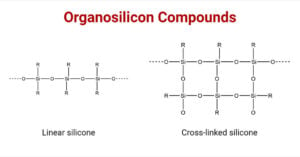
Organosilicon Compounds

Organosilicon compounds are organometallic compounds that contain Si-C bonds. As the Si-C bond is extremely hard and stable, many organosilicon compounds containing Si-C have been synthesized. However, silicon has little tendency to form a bond with itself and does not … Read more

Aromatic Nucleophilic Substitution Reactions with Types

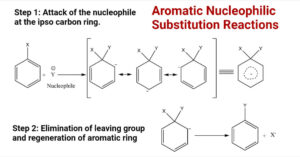
Aromatic Nucleophilic Substitution Reactions

An aromatic nucleophilic substitution reaction is the replacement of hydrogen or substituent on an aromatic ring by a nucleophile. Aromatic rings do not undergo the aromatic nucleophilic substitution reaction under ordinary conditions. The reason for this low reactivity of the … Read more

Pericyclic Reactions- Characteristics, Theories, Types

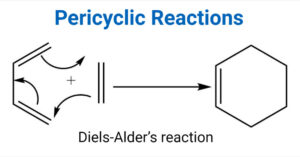
Pericyclic Reactions- Diels-Alder’s reaction

Pericyclic reactions are concentrated reactions that proceed through the cyclic transition state. It requires light or heat and is highly stereospecific. Pericyclic reactions involve the cyclic rearrangement of π or σ electrons in a single concerted step. Since the electronic … Read more

Titrimetric Analysis- Terms, Types, Principle, Advantages

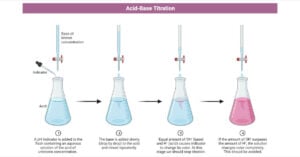
Acid-Base titration

The titrimetric analysis is an analytical method involving measuring the volume of a reagent reacting stoichiometrically with the analyte. The volumetric analysis measures the volume of the solution of known concentration required to react completely with the analyte. The volumetric … Read more

SN1 Reaction vs. SN2 Reaction- 11 Key Differences

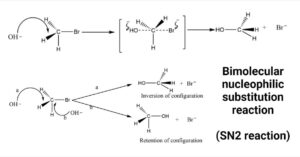
SN1 and SN2 reactions

SN1 reaction of a two-step reaction mechanism. In which the formation of carbocation takes place before the nucleophile approaches the substrate. Generally, secondary and tertiary haloalkanes show SN1 reactions. The SN2 reaction is a concerted reaction in which the attack … Read more