Skip to content
Science Info
  • Home
  • Astronomy
  • Physics
  • Chemistry
    • Periodic Table
    • Analytical Chemistry
    • Basic Chemistry
    • Biochemistry
    • Computational Chemistry
    • Environmental Chemistry
    • Inorganic Chemistry
    • Nanochemistry
    • Organic Chemistry
    • Pharmaceutical Chemistry
    • Physical Chemistry
  • Biology
    • Plants
    • Animals
  • Science Facts
  • Top 10 in Science

Periodic Table

The periodic table is an arrangement of all known elements in order of increasing atomic number and recurring chemical properties. 

  • To facilitate the study of elements, all known elements must be arranged according to their properties, with related elements falling into the same groups and dissimilar elements being separated. This process is known as element classification.
  • The Mendeleev periodic table, an earlier version of the periodic table, was based on the law that “Physical and chemical properties of elements are the periodic function of their atomic masses”.
  • Mendeleev’s (1861) scientific classification of chemical elements based on their masses or atomic weights has been disproved, leading to the development of the modern periodic table law.
  • The Modern periodic table, long form of the periodic table, is based on the law that “Physical and chemical properties of elements are the periodic function of their atomic numbers”.
  • The classification of elements in the long version of the periodic table is based on the order of increasing atomic numbers or Periodicity (i.e., periodic repetition of attributes).
  • Periodicity is the recurrence of similar-behaving elements at regular intervals when these elements are grouped in ascending order of their atomic numbers.
  • There are 18 vertical columns of elements known as groups and seven horizontal rows of elements known as seven periods. The modern periodic table, therefore, contains 18 groups, which are numbered from 1 to 18.
  • The periodic table contains interesting facts that clearly illustrate the relationship between electronic structure and periodic accommodation capacity as the purpose of chemical elements.
  • The atomic structure or the electrical arrangement of an element determines its periodicity.
  • As a result, the recurrence of comparable features results from repeated electrical configurations or atomic structures. Thus, the repetition of an analogous electrical arrangement is the cause of periodicity.
  • The many kinds of metals and non-metals in chemistry are arranged into the s, p, d, and f-block on the periodic table by the modern periodic law, which is based on the atomic number and valence shell electron configuration of elements.
  • s- block elements: The arrangement of electrons in the periodic table gives rise to the designation “s-block element” in which the valence electron enters the ns-orbital and gradually fills it by the configuration rules. S-block elements are the 1st and 2nd group elements.
  • p-block elements: The last electron in a P block element enters one of the three p-orbitals of its corresponding shell. As a p-subshell has three degenerate p-orbitals, each of which may hold two electrons, there are six groups of p-block elements. P-block elements are those that belong to groups 13 to 18. ns2 np1-6 is the general electrical configuration for these elements.
  • d-block elements: d-block elements are those that are found from Group 3 to Group 12 in the middle of the periodic table. Because the final electron gets to the d-orbital of the penultimate shell, they are known as a “d-block” element.
  • f-block elements: The f-block elements, also known as inner transition elements, are those whose final electron to enter the f-orbital is known. In addition to having electrons in the outermost orbital, these elements also have electrons (0 to 1) in the penultimate energy level’s d orbital and (1 to 14) in the f orbital. In the f-block, there are mainly two series that correspond to the filling of the 4f and 5f orbitals.

Argon (Ar) Element: Properties, Amazing Uses, Facts
May 15, 2023April 24, 2023 by Jyoti Bashyal
Argon (Ar) Element

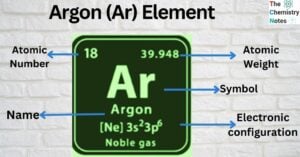
Argon is a chemical element represented by symbol (Ar). Atomic number of argon is 18. It is in the group 18 of the periodic table and it’s a noble gas which comes after Chlorine in periodic table. The name of … Read more
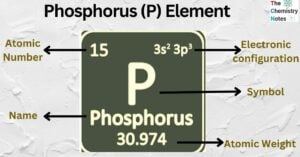
Phosphorus (P): Devil’s Element Important Information

April 24, 2023 by Jyoti Bashyal
Phosphorus (P) Element

Phosphorus is a chemical element with the atomic number 15 and the symbol P. Although phosphorus occurs in two primary forms, white phosphorus and red phosphorus, it is never found as a free element on Earth due to its extreme … Read more

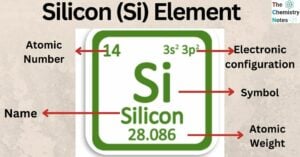
Silicon (Si) Element: Significant Properties, Applications, Health Effects

May 15, 2023April 24, 2023 by Jyoti Bashyal
Silicon (Si) Element

Silicon (Si) is a non-metallic chemical element in the carbon family (Group 14 [IVa] of the periodic table). Silicon is the most prevalent electropositive element in the Earth’s crust. It is a metalloid that has a distinct metallic sheen and … Read more

Potassium (K) Element: Properties, Uses, Facts

May 15, 2023April 19, 2023 by Jyoti Bashyal
Potassium (K) Element

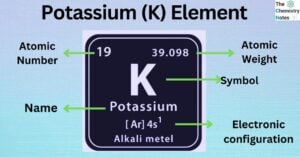
Potassium is the first element of the fourth row in the periodic table. It is denoted by the symbol ‘K’. It is the nineteenth (19th) on the periodic table of elements, and is seventh (7th) most abundant element on Earth’s … Read more

Aluminium (Al) Element: Important Information, Properties, Uses

April 15, 2023 by Jyoti Bashyal
Aluminium (Al) Element

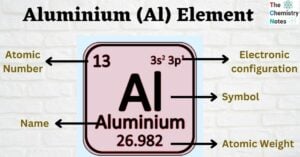
Aluminium, with the atomic symbol Al, has an atomic number of 13 and is found in Periodic Group 13. Aluminum, a post-transition metal, is a solid at ambient temperature. Aluminum is a metal, and it belongs to the third period. It … Read more

Magnesium (Mg) Element: Properties, Uses, Interesting Facts

April 15, 2023 by Jyoti Bashyal
Magnesium (Mg) Element

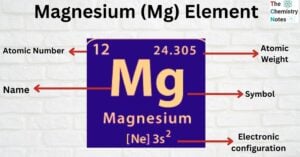
Magnesium is an element with the chemical symbol Mg and atomic number 12. Magnesium, which is classified as an alkaline earth metal, is solid at ambient temperature. It is a lightweight, silver-colored metal with a reflective sheen. In actuality, it … Read more

Sodium (Na) Element: Properties, Applications, Important Reactions

April 13, 2023 by Jyoti Bashyal
Sodium Element

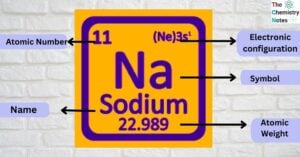
Sodium is a whitish metal that is easily melted and burnt. Sodium, which gets its name from the English word for “soda,” includes compounds that are quite useful in everyday life. Sodium is found in many common household items, like … Read more

Neon (Ne) Element: Properties, Uses, 10 Incredible Facts

April 8, 2023 by Jyoti Bashyal
Neon (Ne) Element

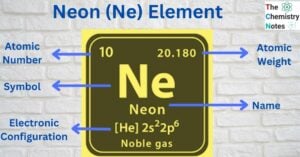
Neon (atomic number 10, symbol Ne) is an inert noble gas and a chemical element. The name neon derives from the Greek word νέoν, the neuter singular form of νέος (neos), meaning ‘new’. Neon is chemically inert, and there are no … Read more

Copper (Cu) Element: Important Physical-Chemical Properties,

April 4, 2023April 3, 2023 by Jyoti Bashyal
Copper (Cu) Element Properties, Uses

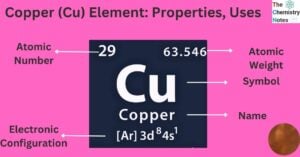
Copper is an element with the chemical symbol Cu and atomic number 29. Copper, which is classified as a transition metal, is solid at ambient temperature. Copper is a soft, malleable metal that conducts electricity and heats exceptionally well. Pure … Read more

Older posts
Newer posts
← Previous Page1 … Page12 Page13 Page14 Page15 Next →

Topics

  • Analytical Chemistry (164)
  • Animals (2)
  • Astronomy (4)
  • Basic Chemistry (144)
  • Biochemistry (38)
  • Book Reviews (1)
  • Botany (2)
  • Computational Chemistry (4)
  • Differences Between (70)
  • Environmental Chemistry (31)
  • Events (2)
  • Inorganic Chemistry (183)
  • Journals (1)
  • Nanochemistry (17)
  • Organic Chemistry (177)
  • Periodic Table (130)
  • Pharmaceutical Chemistry (15)
  • Physical Chemistry (199)
  • Physics (115)
  • Plants (13)
  • Science Facts (12)
  • Syllabus (5)
  • Top 10 in Science (14)
  • Universities (4)
  • Zoology (1)
  • Redox Reactions (A Level Chemistry Revision Notes)
  • Oxidation Numbers (A Level Chemistry Revision Notes)
  • Electrochemistry (A Level Chemistry Revision Notes)
  • Hess’s Law (A Level Chemistry Revision Notes)
  • The Gaseous State: Ideal and Real gases (A Level Chemistry Revision Notes)
  • About
  • Our Team
  • Contact Us
  • Editorial Policy
  • Privacy Policy
  • Cookie Policy
  • Disclaimer (Terms and Conditions)
© 2026 Science Info. Made with ♡ by Sagar Aryal.