
Introduction to Compound Machines in Physics
A compound machine is named so because it is made up of two or more simple machines. The simple machines are designed to perform any work easily, faster, and more conveniently. Thus, compound machines are designed to perform any tasks even more efficiently and achieve maximum efficiency.
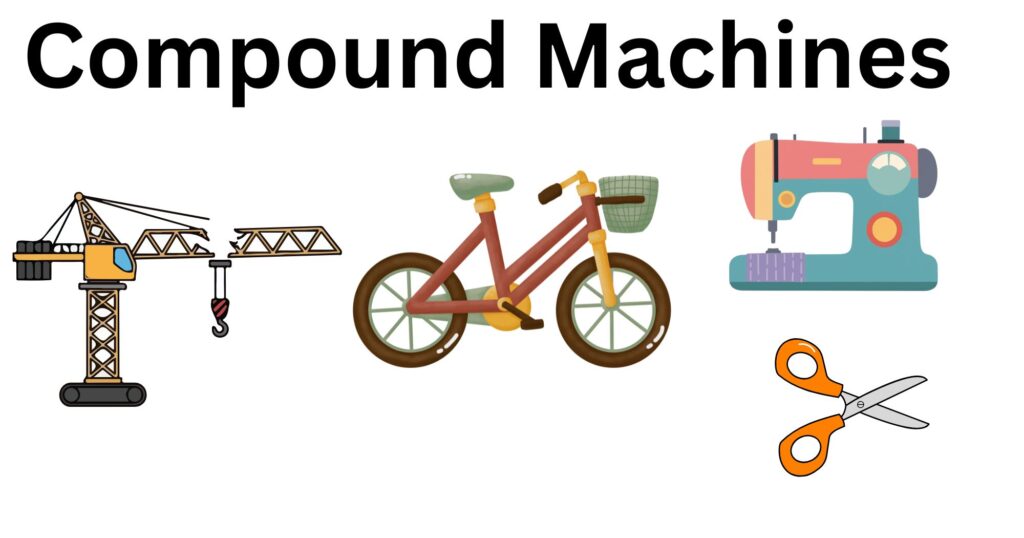
We are also habituated to the compound machines in our daily life to perform simple to complex tasks. The famous tool is a scissor which has levers and wedges in combination to function. In most of the contexts, simple machines are being replaced by compound machines to achieve multiple functions from a single device. Hence, a single machine can reduce effort, multiply force, increase speed, and also increase efficiency.
Although they are superior to simple machines, the foundation of every compound machine is a simple machine. A complex mechanical system can be formed by combining two or more simple machines. This can increase the mechanical advantage and can be very advantageous with its versatile nature. The limitation of a simple machine being used for only one specific task is overcome by the use of a compound machine. Therefore, compound machines are vital parts of everyday lives and complicated applications.
How Compound Machines Work?
Compound machines are brought into action by combining two or more simple machines. Each simple machine have their unique role, and together they help complete a task with less effort.
Basic Principle
The working of a compound machine is based on the efficiency of each simple machine. All the simple machines used in a compound machine contribute to reducing the effort or changing the direction of force. Hence, they all give a mechanical advantage. On combining all of their mechanical advantage, we get the total mechanical advantage of a compound machine. This mechanism shows that the mechanical advantage and hence the efficiency of a compound machine is increased.
For example, in a wheelbarrow:
- A lever is used to lift the load.
- A wheel-and-axle is used to move the load easily.
Thus, on combining these two simple machines, the wheelbarrow becomes more efficient than using either lever or a wheel-and-axle only.
Energy Transformation
In compound machines, energy is transferred from one part to another. When we apply effort, the energy moves through the different components, which are actually the simple machines. Each of them modifies the force or motion, and hence we achieve a desired output.
Step-by-Step Working
- Effort is applied to one part of the machine.
- The first simple machine uses the force as input and gives an output.
- The output of the first machines becomes the input for the next.
- This process keeps continuing until the final task is completed.
This chain of operations makes compound machines powerful and efficient.
Components of Compound Machines and Their Simple Machines
A compound machine is made up of multiple simple machines. Understanding its components helps us see how it works as a whole.
Levers are used to lift or move loads. They consist of a fulcrum, effort, and load. In compound machines, levers help increase force or change direction.
Pulley
Pulleys are used to lift heavy objects. They change the direction of force and can reduce the effort needed.
This simple machine helps in movement. It reduces friction and allows easy transportation of loads.
Inclined Plane
Inclined planes help move objects to a higher or lower level with less effort.
Wedge
Wedges are used for cutting or splitting objects. They convert force into separation.
Screw
Screws are used for fastening or lifting. They convert rotational motion into linear motion.
Combination of Components
In a compound machine, these simple machines are combined in different ways depending on the task. For example:
- Scissors combine two levers and wedges.
- A crane combines pulleys, levers, and wheels.
Each component plays a specific role in making the machine effective.
Efficiency and Energy Transfer in Compound Machines
Efficiency is a major concern when using any machine. It measures how well our effort is converted into useful output. The efficiency of a compound machine is supposed to be relatively greater than that of a compound machine. The efficiency of a compound machine is expressed as:
Efficiency = (Output Work / Input Work) × 100% [Equation 1]
In practice, no machine is ideal, and the efficiency is never 100%. Some energy is always wasted to overcome the friction. Moreover, using multiple simple machines also means a greater chance of losing energy at various points. However, the advantages of compound machines are far more than those of the simple machines. There is minimal energy loss if everything is taken seriously.
Energy Transfer
Energy flows through the machine from one component to another. Each simple machine may change:
- The magnitude of force
- The direction of force
- The speed of motion
Even though some energy is lost, the overall system is designed to make the task easier.
Improving Efficiency
Efficiency can be improved by:
- Reducing friction (using lubrication)
- Using better materials
- Proper maintenance of machines
Examples of Compound Machines in Everyday Life
Compound machines are part of our daily lives. Some common examples include:
Scissors
Scissors are the combination of two levers and wedges. The handle of the scissor acts as a lever, and the blade acts as a wedge that helps to cut or split materials..
Bicycle
A bicycle is a complex compound machine. It includes:
- Wheel and axle (wheels)
- Levers (pedals and brakes)
- Gears (modified wheels)
Wheelbarrow
It combines a lever and a wheel and axle to lift and move loads.
Crane
A crane uses pulleys, levers, and sometimes wheels to lift heavy objects.
Can Opener
It includes a wheel and axle, lever, and wedge to open cans.
Sewing Machine
It combines multiple simple machines to stitch fabric efficiently.
Stapler
A stapler uses a lever and a wedge to fasten papers together.
Hence, compound machines show a huge importance from simple daily activities to complex heavy tasks.
Compound Machines vs. Simple Machines
Although the roots of compound machines are the simple machines, there are a lot of differences between the two. Some distinctive features between them are tabulated below:
| Feature | Simple Machine | Compound Machine |
| Definition | It is a single machine with a single function | It is a combination of two or more simple machines and has multiple functions |
| Complexity | It is simple in structure | The design is more complex |
| Efficiency | It has less energy loss | It has more parts and hence consumes more energy |
| Examples | Lever, pulley | Bicycle, scissors |
| Function | Performs one basic task | Performs complex tasks |
Simple machines are the foundation, while compound machines build on them to perform more advanced functions.
Applications of Compound Machines
Various fields rely on compound machines to perform their tasks. Some of the applications are given below:
Construction
Heavy devices like cranes, bulldozers, excavators, etc., are complicated uses of many simple machines like inclined planes, wheel-and-axle, wedges, screws, etc. Hence, they can perform heavy tasks efficiently.
Transportation
Simple to complex transport devices like bicycles, cars, and trains are built of compound machines. Hence, we can get faster speeds, reduced efforts, and good efficiency from a single device.
Manufacturing
Manufacturing industries use compound machines like pressing machines, hydraulic jacks, elevators, etc., for production and assembly.
Agriculture
Tools like tractors and harvesters rely on compound systems.
Household Uses
Common tools like scissors, knives, and can openers are compound machines.
Medical Field
Complex machines are used in surgeries and diagnostics.
Advantages of Compound Machines
Compound machines offer several benefits:
Increased Efficiency
They make tasks easier by combining the advantages of simple machines.
Reduced Effort
Less force is needed to perform heavy tasks.
Versatility
They can perform multiple functions.
Time-Saving
Tasks can be completed faster.
Improved Performance
They allow better control and precision.
Limitations of Compound Machines
Despite their usefulness, compound machines have some drawbacks:
Energy Loss
More parts mean more friction and energy loss.
Complex Design
They are more complicated to design and maintain.
Higher Cost
Compound machines are usually more expensive.
Maintenance Required
They require regular care to function properly.
Possibility of Breakdown
More components increase the chances of failure.
Conclusion
Modern technologies are the functions of compound machines. They work on the principle of two or more simple machines. Hence, simple machines are the vital organs of compound machines. A single device performing multiple tasks makes it superior to simple machines. Hence, our ability to perform very complex tasks has also been possible. They are the functional devices or tools in industries, transportation, and even in household activities.
With the profound use of compound machines, the principles of physics are being spread all over the world. Therefore, a simple concept of a simple machine that has surpassed many civilizations is a key in creating a technological world. No work is efficient today without using a machine. Hence, simple and compound machines are our helping hands in all types of work.
Compound machines also have some limitations, as they are complicated, require high maintenance, and incur repair costs, but the careful use and handling can make them durable and reliable. These limitations are nothing when we look at the advantageous side.
The future advancements also heavily rely on compound machines. As we are surrounded by machines everywhere, they will be the basic needs of growing problems and the new era of technology.
References
- https://studiousguy.com/compound-machines-examples/
- https://biologyinsights.com/what-is-a-compound-machine-and-how-does-it-work/
- https://flexbooks.ck12.org/cbook/ck-12-middle-school-physical-science-flexbook-2.0/section/13.13/primary/lesson/compound-machine-ms-ps/
- https://study.com/academy/lesson/what-is-a-compound-machine-definition-examples.html?msockid=06adcffa22ad6ebf171eda2723ab6f89
- https://examples-of.net/10-examples-of-compound-machines/
- https://www.scribd.com/document/922388347/10-EXAMPLES-OF-COMPOUND-MACHINES
