
What is Deforming Force? Definition and Basics
Among the various contact forces, deforming force is the one that causes changes in the shapes, sizes and the dimensions of the objects. There are other contact forces responsible for changing the directions, velocities etc. of the moving objects. While the deforming forces do not care about rest or motion but affect the physical structure of the object. In our daily lives, we perform actions like pulling, pushing, squeezing etc. to the objects which bring changes in those objects. For example, stretching a rubber means applying a force to change the size of the rubber. The object may also show the reaction by moving because of the deforming force. Hence, the force bringing any kind of physical change in an object is called the deforming force.
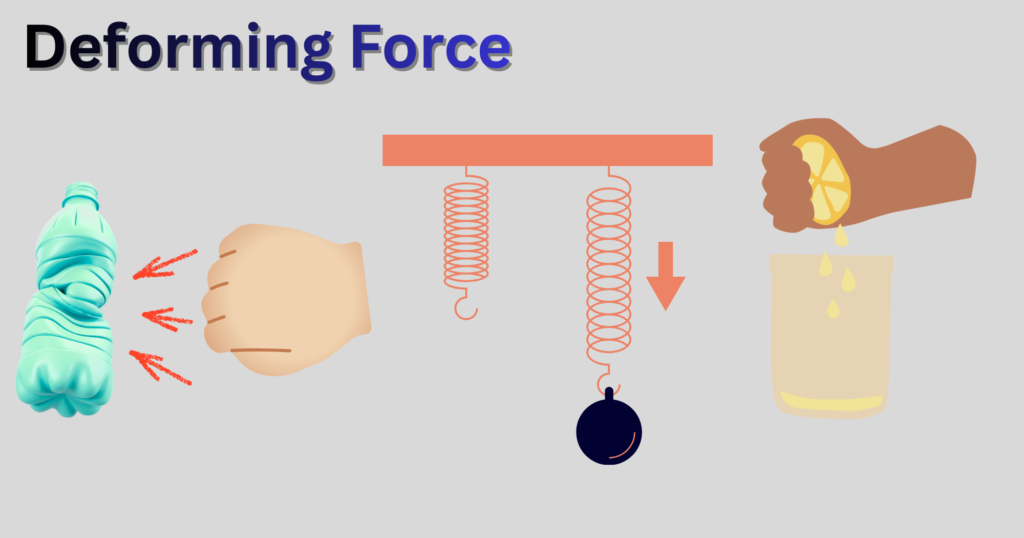
Deformation: What Does It Mean?
Deformation means any kind of change in the physical structure of the substance. In physics, deformation means the change is length, area, volume or shape of the object. This occurs due to the activities like stretching, compressing, bending, squeezing or expanding the object. All these activities mean applying force on that body. Since, this force brings deformation in the substance, it is known as a deforming force.
Are All Forces Deforming Forces?
Not all forces necessarily cause deformation. The contact forces mainly cause deformation in the objects. We know, the change of state in a body is due to an external force. So, there are forces that make an object move. During motion, the objects go through deformation that may be negligible or in very small amounts. When the objects are at rest over a surface also, they will be applying force on the surface that deforms it. However, this change may not be visible to our naked eyes.
In physics, these forces are studied in detail because they carry lots of information about that typical object. Some significances of deforming forces are:
- We can study the behavior of an object when load is applied on it.
- The structures like buildings, bridges are designed by engineers by studying the effect of deforming forces on land.
- These forces also explain the elasticity and plasticity of the material.
The Difference Between Deforming Force and Restoring Force
Restoring and deforming forces are two opposite forces in nature. A deforming force is responsible for changing the shape, size or dimension of an object and hence any push, pull, tension or load applied on an object causes deformation of that object. For example, when we bend a stick or a ruler, it may be broken as our hands apply force on them. Also, a deforming force is always applied by an external agent.
Restoring force on the other hand is an internal force produced by the object itself. It is responsible to bring an object back to its original position after the removal of force acting on the body. Here the force acting on the body is the deforming force and after removing it, if the body stays as it was before, then the body will be applying the restoring force to recover its early condition. In the above example, if we stop applying force by our hands on the ruler or stick, then if the stick or ruler comes to its initial position rather than breaking down or stretching, it is due to the restoring force.
Simple Comparison
| Deforming Force | Restoring Force |
| Applied from outside | Produced inside the object |
| Causes deformation | Tries to remove deformation |
| Changes shape or size | Brings object back to original shape |
| Acts in the direction of deformation | Acts opposite to deformation |
Both forces have their own significance. As one tries to deform the object, the other tries to oppose the change set by the former one. They are inversely related to each other because if the deforming force is greater, the object cannot come back to its original condition after removing the deforming force and may get broken because of the smaller restoring force to resist it. In contrast, if the deforming force is smaller, the object can quickly get back to its position due to the overcoming restoring force.
Elasticity vs. Plasticity: How Materials Respond to Deformation
Elasticity and plasticity are two different properties of materials introduced due to the restoring force applied by the internal molecules of the materials.
Elasticity
Elasticity is the property of those materials which can gain their original position after the removal of the deforming force. For example, a spring extends under load and comes back when the load is removed. A steel wire stretches slightly under tension and returns when the force is removed (as long as the force is not too large). In these cases, the deformation is temporary. This kind of deformation is called elastic deformation.
So, elastic materials:
- Can be deformed by a force,
- But recover their original shape after the force is removed (if the force is within the limit).
Plasticity
Plasticity is the property of those materials which cannot gain their original position after the removal of the deforming force. For example, when force is applied to a glass, it may break. A rubber band, if stretched strongly, remains extended. In these cases, the deformation sets permanently.
So, plastic materials:
- Can be easily shaped by force,
- Do not recover their original shape after the force is removed,
- Are useful for making objects with permanent shapes.
Elastic vs. Plastic Behavior in the Same Material
Surprisingly, the same material can have both the elastic and plastic behavior. This depends upon the force applied to that object. For small forces, materials usually behave elastically. In this case the restoring forces of materials would be larger and can easily come to the initial shape, size or length. However, for large forces, the restoring force cannot overcome the external force and hence the nature of the object would be plastic.
Stress and Strain: Measuring the Impact of Force
Stress and strain are two important quantities to measure the impact of forces on the bodies. Hence, by studying these quantities we can tell if the object would be showing elastic or plastic nature. They are the important parameters to measure the deforming and the restoring forces.
Stress
Stress is defined as the force applied per unit area of cross-section of a material.
Mathematically:
Stress = Force/Area [Equation 1]
- The SI unit of stress is pascal (Pa) or N/m².
- Stress tells us how strongly a force is acting on a material.
Types of Stress
Depending on how the force is applied, stress can be of different types:
- Tensile stress – when the material is stretched.
- Compressive stress – when the material is compressed or squeezed.
- Shearing stress – when the material is twisted or layers slide over each other.
We will discuss these in detail later.
Strain
Strain is defined as the ratio of change in dimension to the original dimension of a material.
For example, if ΔL is the change in length of an object with L being the original length, then:
Strain=ΔL/L [Equation 2]
- Strain has no unit because it is a ratio of two lengths.
- Strain tells us how much deformation has occurred compared to the original size.
If stress gives, the force is applied per area then strain measures the deformation created by that force or stress. Together they can measure:
- How strong a material is,
- How elastic or plastic it is,
- When it will return to its shape,
- And when it will permanently deform or break.
Hence, both are the foremost things to be studied while studying deforming forces.
Hooke’s Law: The Relationship Between Force and Extension
Hooke’s Law is the important and basic law behind any deformation. It states that, within the elastic limit, the extension produced in the material is directly proportional to the applied force.
Mathematically: F∝x
Or, F = -kx
Where:
- F = applied force,
- x = extension (change in length),
- k = spring constant (a measure of stiffness of the material or spring).
Meaning of the Spring Constant (k)
The spring constant tells us:
- How stiff a spring or material is.
- A large value of k means the material is stiff (hard to stretch).
- A small value of k means the material is soft (easy to stretch).
Elastic Limit
Hooke’s Law has also a fixed boundary which is called the elastic limit. The significance of this elastic limit is that the object behaves elastically within this elastic limit while the object behaves as of plastic nature beyond this limit.
Importance
Hooke’s Law is very important because:
- It helps us design springs, shock absorbers, and elastic materials.
- It is used in weighing machines, balances, and many measuring instruments.
- It helps engineers calculate how much structures will stretch or compress under load.
Types of Deformation: Tensile, Compressive, and Shearing Stress
Deformations are also of different types. The three main types of deformations are tensile, compressive and shearing stress.
Tensile Deformation
Tensile deformation is the deformation occurring when a material is stretched along its length and acted by forces acting in opposite directions. Common examples are:
- Stretching a rubber band.
- Pulling a metal wire from both ends.
- Hanging a weight from a rope.
In tensile deformation the length of the object increases and hence the material experiences tensile stress. Here too, if the force is substantially larger, the object cannot return to its original condition after removing the force and can break or tear.
Compressive Deformation
Compressive deformation occurs when a material is compressed or squeezed by forces acting towards each other. For example, pressing a spring, pressing a dough etc. In compressive deformation:
- The length or volume of the object decreases.
- The material experiences compressive stress.
The objects under force may or may not return to the original shape after compression is removed.
Shearing Deformation
Shearing deformation is quite different from tensile and compressive deformation. Unlike causing changes in shapes and dimensions of an object it causes sliding motion of the internal surface of the materials. This is due to the parallel force acting in opposite directions on different layers of the same material. For example tearing a paper, rubbing clothes while washing etc.
In shearing deformation, the layers of the object may move changing its shape, but the volume remains approximate. If the material experiences too large shearing stress, the object may break down.
The Stress-Strain Curve: Elastic Limit, Yield Point, and Fracture
A stress-strain curve is designated to visualize the behavior of a material with an increasing stress or force. This graph clearly helps to understand the relation between stress and strain. While plotting the graph, stress is kept along the y-axis while strain is kept along the x-axis.
Shape of the Stress-Strain Curve
For a typical metal wire, the stress-strain curve has several important regions:
- Proportional Region
- In this region, stress is directly proportional to strain.
- The graph is a straight line.
- Hooke’s Law is valid here.
- Elastic Limit
- This is the maximum point up to which the material can return to its original shape after the force is removed.
- Beyond this point, permanent deformation begins.
- Yield Point
- This is the point from which the material starts to deform plastically.
- Large deformation occurs with little or no increase in stress.
- The material will not return to its original shape after this point.
- Plastic Region
- In this region, deformation is permanent.
- The material stretches a lot but will not fully recover.
- Fracture or Breaking Point
- This is the end point of strain and the material breaks.
Hence, a lot of conclusions can be drawn from the stress-strain curve. The properties like elasticity, plasticity, strength etc. can be studied under this graph. This information is very important in designing materials and structures.
Factors Affecting the Deformation of Solids
Several factors affect how much a solid deforms under a force. Some important factors are given below:
Nature of the Material
Every metal has unique physical properties like some are strong while some are fragile. Similarly, some are of brittle nature while some are ductile and stiffer. Hence, all these materials have a unique nature and play an important role in deformation.
Magnitude of the Force
A small force produces a small deformation while a larger force makes it larger. Hence, force also determines whether the material restores after removing force or deforms permanently.
Dimensions of the Object
- Length: An object longer than the other stretches more than the shorter one with the same force.
- Area of cross-section: It is easier to stretch a thin wire than a thicker wire under the same force.
- Temperature: We know that heating objects expand easily. Therefore, greater temperature can deform materials quickly.
- Type of Stress Applied: All the three kinds of strain affect materials in different ways. An easily breakable material under shear may not show any effects under tensile deformation and vice-versa.
All these factors are very important to be considered before applying forces to the objects.
Real-World Applications: Deforming Forces in Engineering and Construction
Deforming forces play a huge role in real life. Some of their applications are:
- Buildings and Bridges
- Buildings experience compressive forces in pillars and columns.
- Bridges experience tensile and compressive forces in different parts.
- Engineers calculate deformation to make sure structures:
- Do not bend too much,
- Do not crack,
- Do not collapse under load.
- Springs and Shock Absorbers
- Springs are designed using Hooke’s Law.
- Shock absorbers in vehicles use controlled deformation to:
- Reduce shocks,
- Have a comfortable ride
- Ensure safety
- Wires, Cables, and Ropes
- All electrical networks are under tensile stress.
- They must be able to:
- Carry loads,
- Not stretch too much,
- Not break suddenly.
- Machines and Tools
- Many machine parts experience repeated deformation.
- Engineers choose materials that:
- Can handle stress,
- Do not deform permanently too easily,
- Have a long life and safety.
- Everyday Objects
- From chairs to beds and shoes to floors, all are made able to withstand the deforming forces applied on them.
Conclusion
Among all other forces, deforming forces have a direct impact on the objects. This might be useful and harmful too. Restoring and deforming forces act in opposite nature. The reaction of an object to the deforming force determines the nature of the object. The strength of force applied on an object can be measured by Hooke’s law. The relation of stress and strain produced by that stress on the object also determines the strength of the object. Hence the stress-strain curve is equally important to understand the effect of deforming forces more clearly;
Various factors like nature, dimension of the material, force limit, temperature etc. also determine the deformation of objects. These properties are studied well while designing various materials and structures like buildings and bridges. Therefore, deforming force is a fundamental force to study nature and its contents. It directly affects our daily lives. Hence, a basic knowledge about deforming force is commendable.
References
Thompson, J. O. (1926). Hooke’s law. Science, 64(1656), 298-299.
Jones, R. M. (2009). Deformation theory of plasticity. Bull Ridge Corporation.
Marrett, R., & Peacock, D. C. (1999). Strain and stress. Journal of structural geology, 21(8-9), 1057-1063.
https://en.wikipedia.org/wiki/Deformation_(physics)
https://byjus.com/physics/solid-deformation
