
What is Distance in Physics?
In physics, when we talk about motion, we look for the path covered by an object which is called the distance travelled. We are also concerned about the direction of that object. However, distance is a scalar quantity which only focuses on the length of that path and not the direction. While looking at that numerical value of distance we can get no extra information about that object but just a length of that certain path. It is the most fundamental idea required in any calculation in every branch of physics and also in mathematics and other technical subjects. It can characterize a simple motion to advanced motion of planets and galaxies. Hence, from mechanics to astrophysics and classical to quantum physics, the calculation of speed, velocity, acceleration and different kinds of forces (like gravitational and electrostatic) depend on the quantity distance travelled.
We have to remember that it is never zero for a moving object neither is it negative. If distance travelled is zero means that the object is at rest. From walking, running or moving by a vehicle, we practice distance in our everyday life. Hence, it also needs to be understood by common people.
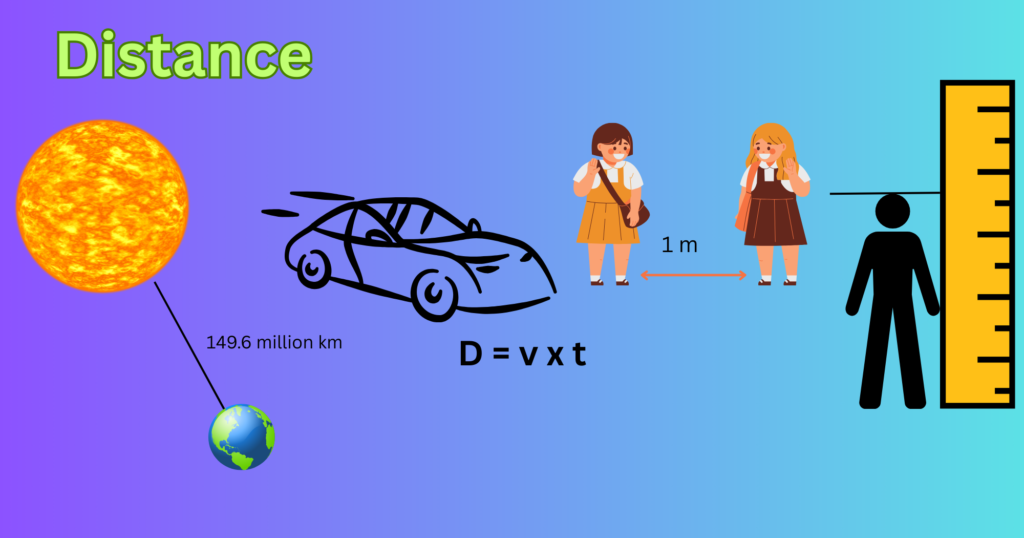
The SI Unit of Distance: Meters and Conversions
Distance is a measurable physical quantity. It has its own standard unit and conversion technique from one measurement system to the other. According to the SI system, distance is measured in meters. One meter is the length of the path that light takes in vacuum in 1/299792458 of a second. It is the universal language for measuring distance. However other units like foot, inch, millimeter, centimeter and kilometer are also familiar in practice.
One meter by definition is a precise calculation and is consistent throughout the world. Hence it is a scientific and universally accepted unit.
Other units can be derived in terms of meter as::
- 1 Millimeter (mm) = 1/1000 meter
- 1 Centimeter (cm) = 1/100 meter
- 1 Kilometer (km) = 1000 meters
- 1 nanometer = 10^-9 meters
- 1 angstrom = 10^10 meters
For very small distances, like that of the size of atoms and molecules, nanometers (nm) are used. Similarly, for very large distances, such as distances between planets, kilometers or angstroms are easier to use.
Conversions
The inter-unit conversion is also not that complex. They can be expressed simply in the powers of 10. For example,
- 1 km = 1000 m
- 1 m = 100 cm
- 1 cm = 10 mm
The knowledge of conversion is important because the demand of measurement may be different for different contexts. For example, it will be easier to express the distance between two cities in terms of kilometers than in centimeters and meters. Similarly, to express the size of hair would be simpler in terms of millimeters.
Distance vs. Displacement: Key Differences Explained
Distance and displacement may look similar but have vast differences. Displacement is the shortest distance between two points and is a vector quantity. Some differences between distance and displacement are given below:
| Distance | Displacement |
| Total length of the path covered by an object from one point to another.Depends on the path chosenScalar quantity (only has magnitude)Is always positive | Shortest distance travelled by the object from one point to anotherDepends only on the initial and final pointsVector quantity (has both magnitude and direction)Can be positive, negative or zero |
Suppose if a boy travels from home to school and back school to home, with the same shortest distance, then his net displacement will be zero. However, he will travel a distance twice the length from his home to the school.
Hence, both are certain lengths of the paths but are very different concepts.
Scalar vs. Vector Quantities: Why Direction Doesn’t Matter for Distance
Physical quantities are classified into scalar and vector quantities.
Scalar Quantities
Scalar quantities have only magnitude (only numeric value) and no direction. Quantities like mass, length, time, speed, distance etc. do not require direction to characterize them. They are simply expressed in a number. The path taken is not important here and hence, only length is measured. Therefore, direction is not considered important here.
Vector Quantities
Vector quantities have both magnitude and direction. Physical quantities like displacement, velocity, acceleration, force etc. are vector quantities. To calculate them, obviously direction plays a great role. Just a numeric value cannot fully describe these vector quantities.
Why Distance Has No Direction
To find the distance, we only keep adding the lengths of those paths taken. It doesn’t matter in which direction the motion is going. The distance stays the same. Only the length of movement matters. Therefore, direction is not crucial in measuring the distance.
How to Calculate Distance: Speed, Time, and Formulas
To calculate distance travelled we know,
Speed = Distance / Time
Therefore, we can derive from above that,
Distance = Speed x Time [Equation 1]
Thus, speed, time and distance are inter-related. Equation (1) is valid only if the speed is uniform. For non-uniform speed, its average is to be calculated to find the net distance travelled.
Non-Uniform Motion
If the speed is non-uniform the we can calculate the distance by:
- Breaking the motion into parts with constant speed
- Using distance-time graphs (or speed-time graphs)
- Applying calculus in advanced physics
Average Speed
Average speed for a non-uniform motion can be determined as:
Average Speed = Total Distance/Total Time [Equation 2]
This concept is widely used in our daily life like calculating the mileage of our vehicles, the distance we walked away etc.
Interpreting Distance-Time Graphs: Slope and Speed
A distance-time graph is a visual interpretation of how distance changes with time.
Axes of graph
- Horizontal axis is the x-axis where the time-taken is kept
- Vertical axis is the y-axis where distance travelled is kept
- Slope of the Graph
- Slope = Speed
- A steeper slope means higher speed
- Straight Line
- Indicates uniform speed
- Curved Line
- Indicates changing speed
- Horizontal Line
- Distance constant
- Object is at rest
Interpretation of the graph
- If the distance-time graph is a uniform straight line, then it is concluded that the object is moving at constant speed.
- If a steeper line is obtained, then we can say that the object is moving faster.
Thus, the distance-time graph is an important tool to understand how distance and time are related and hence to visualize virtually the nature of motion.
Measuring Distance in Geometry: The Euclidean Distance Formula
In geometry and physics, the calculation of the distance between two points is done by using the Euclidean distance formula.
In One Dimension
Distance = modulus of the difference between those two points:
d = |x2 – x1| [Equation 3]
In Two Dimensions
For points ((x1, y1)) and ((x2, y2)):
d = √ (x2 – x1)^2 + (y2 – y1)^2 [Equation 4]
In Three Dimensions
d =√ (x2 – x1) ^2 + (y2 – y1)^2 + (z2 – z1)^2 [Equation 5]
In physics there are not only linear motions but also two- or three-dimensional motions. Thus, the Euclidean distance formula is very important in higher level calculations.
Astronomical Distances: Light Years and Parsecs
Distances in space are extremely large, so meters and kilometers become impractical.
Light Year
A light year is the distance light travels in one year.
- 1 light year ≈ (9.46 x 10^15} m
It is a unit of distance (do not get confused with time)
Parsec
It is another astronomical unit for measuring distance.
- 1 parsec ≈ 3.26 light years
In astronomy very huge distances are made simpler by converting them into the light years and parsecs. Thus, the distances between stars, galaxies, and other celestial objects can be simply understood.
For example, Proxima Centauri is 4.24 light years away from the earth, which is the nearest star to the earth.
Real-World Examples: Total Path Length vs. Shortest Path
- Walking: If a person walks around a rectangular park and returns to the starting point:
- Distance = circumference of the park
- Displacement = 0
- Transportation: A car travels through many turns and roads to reach a destination:
- Distance = total road length traveled
- Displacement = straight-line distance between start and end
In addition, a track of the distance travelled by those vehicles is always displayed in vehicles like motorcycles, scooters, cars, buses etc.
- Navigation: In navigations, it is necessary to determine the shortest distance first, to have an efficient travel.
- Engineering: While designing any device or structure in engineering, it is important to note the size and length of various components to make it work properly.
- Plotting: While plotting and planning, every inch of land is measured carefully to have an accurate and precise land structure.
- Medical Fields: It is important to measure the height of a person or the size of the body parts to properly diagnose a patient and suggest a medicine.
- Mathematics: Mathematical measurements like the area of triangle, square, circle or any shapes, length of sides of geometrical shapes, radius etc. are done with the measurement of distance.
- Sports: The playgrounds and the structure of a game are first determined by proper measurement. If athletes run a 400-meter race, then they cover the same distance, no matter what twists or turns they make.
These are only some important uses of distance measurement. There are other numerous examples that have left this measurement fundamental in daily lives.
Conclusion
Distance is a fundamental concept in physics. It helps us to describe and understand motion. It represents the total length of the path traveled by an object. It is a scalar quantity, which has magnitude but no direction. In the SI system distance is measured in meters and can be calculated using simple formulas involving speed and time or practically by using a measuring scale. It is also interpreted by using graphs. Its measurement has broader use from simple geometry to complex astronomy.
To understand distance clearly, one must be able to distinguish between distance and displacement. For this the concept of scalar and vector is the foremost. This builds a strong foundation for the beginners, trying to step in physics and mathematics. This must be understood even for ordinary senses, because every step of motion needs to be guided. Hence, it is not only a mathematical tool needed for science and technology only, but a very common concept required for intelligence.
References
https://byjus.com/physics/distance-and-displacement
https://www.geeksforgeeks.org/physics/distance-and-displacement
https://www.physicsclassroom.com/class/1DKin/Lesson-1/Distance-and-Displacement
https://en.wikipedia.org/wiki/Distance
