
What is Force in Physics
According to the theories, force came into existence just after the Big-Bang. Since then, force has remained as the most studied concept in physics. Physics came into action after the discovery of force and found that four types of forces are actually ruling the universe. From the simple walking movement to motion of planets, sun and the galaxies, force is responsible for all the processes.
In physics, force is responsible for changing the position, shape, velocity or bringing any other changes in the object. While studying the motion and rest action of a body, force was first introduced. Thus, after the formulation of three laws of motion, force was derived mathematically and theoretically. The credit for Newton’s work is also given by assigning the SI unit of force as Newton. Today four forces are known to exist namely, strong force, weak force, electromagnetic force and the gravitational force. The brief description about the concept of force in physics is given in this article.
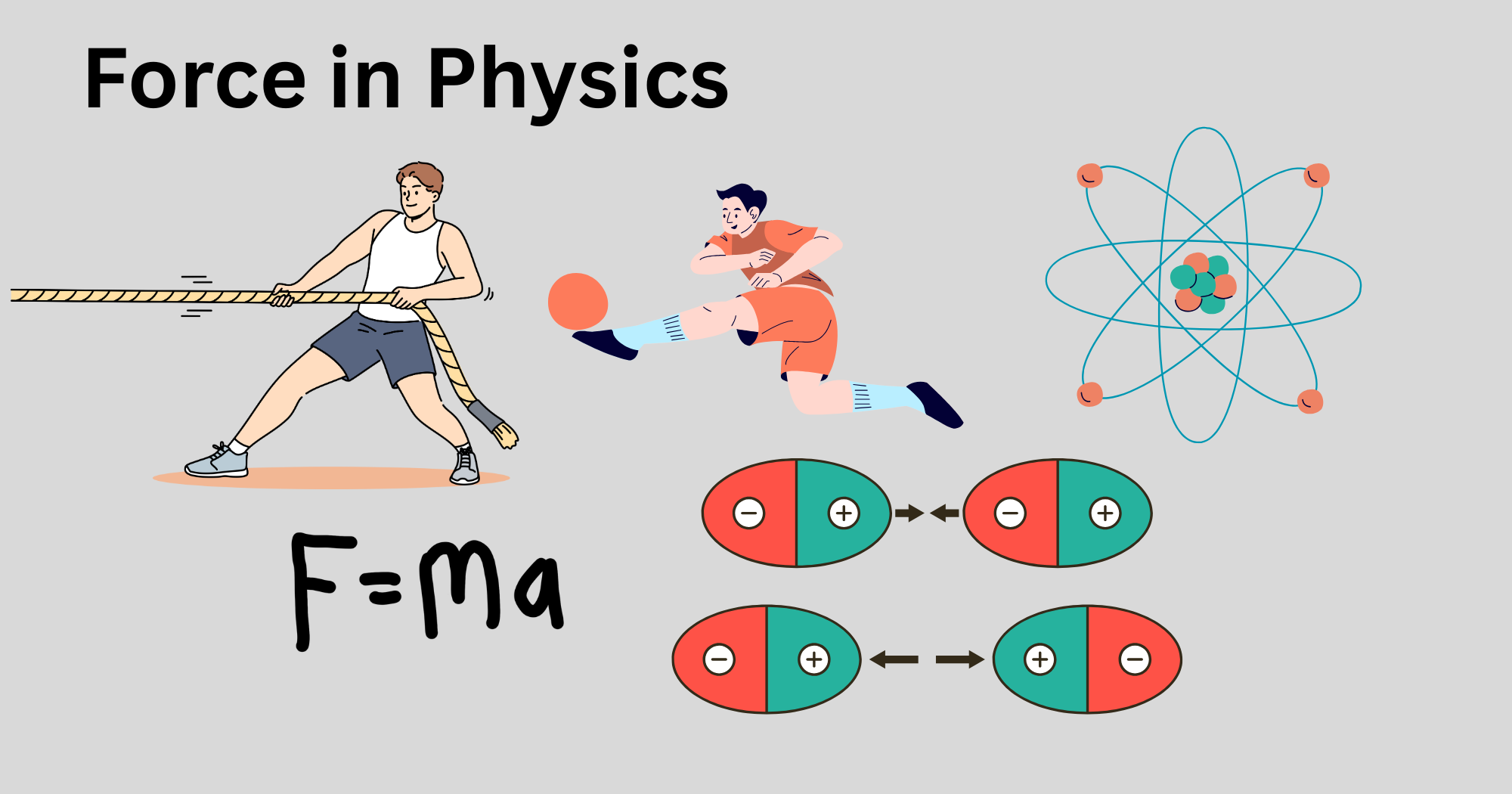
The SI Unit of Force: Understanding the Newton
As mentioned above, the SI unit of force is the Newton and is denoted by N. Similarly one newton force is defined as the amount of force required to accelerate a mass of 1 kg at a rate of 1 m/s^2. Mathematically,
1 N=1 kg⋅m/s^2
This means that if you apply one Newton force to a mass of one kilogram, it will accelerate with 1 m/s^2. Forces can range from small forces like the forces between the molecules of matter to the gravitational force between different celestial entities.
The idea of a Newton helps us measure the effects of forces in a uniform manner. The unit Newton is used in various daily life measurements of force like, pushing a cart, pulling a rope, carrying a load etc.
Force as a Vector Quantity: Magnitude and Direction
Force is not only an expression with a fixed magnitude but also looks for the direction. Hence, it is a vector quantity. The SI unit of force is to indicate the magnitude of force. Also, there is a line along which the force acts which gives the direction of force.
For example, we experience different forces while pushing the same box on a floor towards eastward and northward. Both may have the same magnitude, suppose 10 N but as they act in different directions, this affects how the box moves.
A number of forces may combinedly act on an object. Therefore, the direction of force is very important in physics. Hence, the vector nature of force is an important concept in physics. Understanding both magnitude and direction helps to predict its net effect on that object accurately.
Newton’s Three Laws of Motion Explained
The idea of force was first given by Galileo Galilei. However, the mathematical explanation was given by Sir Isaac Newton. Newton’s three laws of motion are the foundation of classical mechanics which talk about inertia, force and the reaction of force.
- First Law (Law of Inertia)
Newton’s first law introduces a property of anybody called inertia. The body continues to be in its position by the virtue of inertia. The body changes its rest or motion position only under the influence of some external force. This is the explanation of the first law of motion.
For example, an object at rest tends to be at rest and a body at motion tends to be at motion until a force act on them. This explains why a leaf on a tree doesn’t fall unless shaken.
- Second Law
The second law of motion is the mathematical formulation of force. It states that the force applied on a body is directly proportional to the acceleration produced by that object.
Mathematically:
F ∝ a [Equation 1]
Or F = ma [Equation 2]
Here, F is the net force, m is the mass, and a is the acceleration.
In other words, it is also stated that the rate of change of momentum is equal to the product of the mass and acceleration of the body. Hence, Newton was the first person to define the term force and the momentum (quantify the motion of that mass).
Thus, from equation 2 we can say that pushing a car requires greater force than pushing a bicycle as the car has a greater mass than that of the bicycle.
This law is most famous among the three laws which states that, “For every action, there is an equal and opposite reaction”. The action and reaction forces are opposite in nature but are of the same magnitude. For example, while walking our foot pushes the ground which is the action, while the ground makes us able to walk by applying friction as the reaction force to our foot.
Newton’s laws are the backbone of classical mechanics which is also called Newtonian mechanics. For basic everyday activities, we find Newton’s laws everywhere but are only valid for non-relativistic cases.
Contact Forces: Tension, Friction, and Normal Force
Contact forces occur when two objects are physically touching. Some of the most common contact forces are
- Tension
Tension is the force that creates a pull on an object. It occurs due to the tied string, rope, or cable. For example, when you tie a rope on a mass and pull it, an upward tension is created which is equal to the weight of the mass. This tension will keep it in equilibrium. - Friction
Friction is the type of force that tries to block the motion between two surfaces which are in contact. The types of friction are:
- Static friction: This friction is a stopping force. It objects the motion of two solid objects from sliding or rolling over each. The condition is that these two objects are not moving relative to each other.
- Rolling Friction: Rolling friction is responsible for stopping an object moving on a surface, like a ball or wheel.
- Kinetic friction: Kinetic friction is the force that stops something from moving along a surface. It happens when two surfaces are moving relative to each other but in opposing nature of movement.
We can calculate the ratio of frictional force resisting motion between two surfaces in contact to normal force forcing them together. This ratio is known as coefficient of friction (μ). Mathematically, it is written as μ = F / N, where F is frictional force and N is normal force. From the expression we can conclude that a larger coefficient means greater opposition to the motion and vice-versa. The coefficient value depends on the materials in contact and the conditions in which they interact.
- Normal Force
The normal force is the force acting perpendicularly on a weight that is lying on any surface, so that the object is at rest. For example, a book on a table, a car resting on the road etc.
Non-Contact Forces: Gravity, Magnetic, and Electrostatic Forces
Non-contact forces arise without any physical interaction of the objects. Some important non-contact forces are given below:
- Gravitational Force
This is an attractive force that counts due to the two masses. Its expression is given by Newton’s universal law of gravitation:
F=Gm1m2/r^2 [Equation 3]
It explains that a smaller mass comes easily under the action of gravity of heavier mass under its gravitational field. It accounts for masses of the celestial objects. However, the force is undetectable for smaller objects. It is an important concept in physics that governs the movement of planets, galaxies, even the black holes and dark matters. - Magnetic Force
When the electrically charged particles are in motion, they produce a force around them which is called magnetic force. It is the concept of electromagnetism in physics. These magnetic forces arise in poles, and two magnets either attract or repel each other depending upon their direction or orientation. The magnet always suspends in a north-south direction and hence the same poles repel but opposite poles attract. Thus,
- Electrostatic Force
Electrostatic force on the other hand is the force between two charged particles that are at stationary condition. Here also charges are of two types i.e. positive and negative. The same charges repel whereas opposite charges attract themselves. According to Coulomb, if two charges q1 and q2 are at a distance r then,
F=k∣q1q2∣/r^2 [Equation 4]
Here, k is the proportionality constant.
The Four Fundamental Forces of Nature
According to the nature of forces, the natural (non-contact) forces are classified into four fundamental types:
- Gravitational Force: It is the result of the masses of objects and is negligible in everyday practices but actually, it is dominant in celestial scales. All universal facts are based on gravity and gravitational force. Only a few parts of this force are revealed, and huge secrets are under study. Hence, it is still confusing.
- Electromagnetic Force: It is the result of the charges of particles. It describes how electricity and magnetism are correlated to each other and also the phenomenon of light.
- Strong Nuclear Force: It comes into account at the atomic and sub-atomic level where the interaction becomes rigorous. It binds protons and neutrons inside atomic nuclei. This force is extremely strong but has very short-range.
- Weak Nuclear Force: This nuclear force is responsible for radioactive decay and certain nuclear fusion reactions.
Calculating Net Force and Resultant Vectors
When multiple forces are acting on an object, the sum of all these forces gives the net force. The net force is the vector sum of all individual forces, i.e.
Fnet=F1+F2+⋯+Fn [Equation 5]
- If forces are acting along the same line, they are added algebraically.
- If forces are acting at various angles, we use the vector sum of the forces. The forces are resolved to the constituent components and summed accordingly.
Example:
A box experiences a force of 10 N due east and 6 N north. The resultant force is solved as:
Fres=102+62=136≈11.66N
The direction (angle with east):
θ=tan−1(106) ≈ 31° north of east
The net force must be calculated for the correct prediction of motion, calculating acceleration, and analyzing mechanical systems.
Understanding Equilibrium: Balanced vs. Unbalanced Forces
Equilibrium is the condition when the effect of all the forces cancel out each other.
- Balanced Forces
Here, the forces cancel out each other. A balanced force acting on an object at rest will keep it at rest. Similarly, a balanced force acting on a moving object at constant velocity will keep its velocity uniform. For example: a simple pendulum at rest has equal tension upward and weight acting downward so that net force is zero.
- Unbalanced Forces
The net force is not zero and hence the object keeps on accelerating according to Newton’s second law. For example, pushing a sled with greater force in one direction while the friction opposes the motion.
Recognizing equilibrium helps understand static structures, stability, and motion analysis.
How to Draw and Interpret Free Body Diagrams (FBDs)
Free body diagrams (FBDs) are visual tools to represent all forces acting on an object.
Steps to draw an FBD:
- Represent the object as a dot or box.
- Point each force in the correct direction.
- Label each force.
- Resolve all forces into its components ( if needed).
Example:
A box on a slope:
- Weight W=mg acts downward
- Normal force perpendicular to the slope
- Friction force opposing motion along the slope
FBDs simplify calculations of net force, acceleration, and equilibrium.
Conclusion
Force is what holds the universe. Every object existing in nature is somewhere being acted by an unseen force. All the daily life activities also involve forces of some kind. Contact forces are what we perform during our activities while the non-contact forces are driving nature. As force is a vector quantity, it always comes with a direction. It is an important tool in physics. There are also other types of forces in dynamics, like the impulse, torque etc. which have their own significance. Either it is a motion or rest, it is actually the action of force.
Force is the building block of the theory of the tiniest particles. It is also the secret behind the evolution of the universe and hence the expansion of the universe as suggested by the big bang. The study of force has a magnificent importance in physics. Also, physics is not worth studying without the study of forces.
References
Jammer, M. (2012). Concepts of force. Courier Corporation.
Hesse, M. B. (2005). Forces and fields: The concept of action at a distance in the history of physics. Courier Corporation.
Barber, J. R., & Ciavarella, M. (2000). Contact mechanics. International Journal of solids and structures, 37(1-2), 29-43.
Tabor, D. (1977). Surface forces and surface interactions. In Plenary and invited lectures (pp. 3-14). Academic Press.
https://www.problemsphysics.com/forces/forces.html
https://www.physicsclassroom.com/class/newtlaws/Lesson-2/Types-of-Forces
https://en.wikipedia.org/wiki/Force
https://byjus.com/physics/force
