
Introduction to Harmonic Oscillator
From classical to quantum mechanics, a harmonic oscillator has established a special place in physics. As previously, we have studied about simple harmonic motion, a harmonic oscillator is also a system that has back and forth motion when displaced from mean position. A restoring force also exists here that is responsible to make the object bring back to mean position. In classical mechanics, for small oscillations given, any classical object displaced by the force from equilibrium condition acts as a harmonic oscillator. Common examples of harmonic oscillators may be, mass attached to a spring either horizontally or vertically, simple pendulum, torsional pendulum, atomic and molecular vibration, circuit vibrations in electric circuits etc.
The above mentioned systems may be from different dimensions of physics but their analysis and mathematics is similar. This makes harmonic oscillators powerful tools for explaining every natural system. By studying harmonic oscillators, we can understand the mechanism of molecular vibration, waves propagation and also the mechanism of energy distributed in oscillating systems. Thus, this system is dynamic and is important for every realm of physics.
Harmonic oscillators can represent the simplest form of oscillations, to complex motions. In contemporary advancements in physics like quantum mechanics, the harmonic oscillator is a basic concept to study more complicated theories like barrier potentials and wavefunction nature.
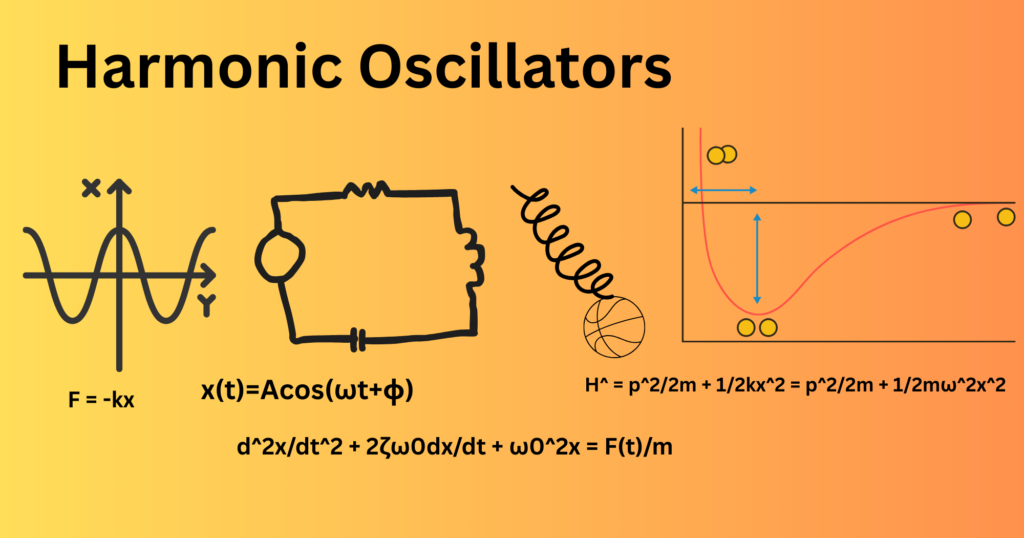
Restoring Force and Equilibrium Condition
Two main points required to crack harmonic oscillators are about understanding equilibrium position and the restoring force.
- Equilibrium Position
The equilibrium position is the initial rest position of the object. This is the position of the system before providing the displacement. Here the system is at its natural resting condition. For example, the equilibrium position for a simple pendulum is its point of suspension before displacing or touching it.
- Restoring Force
After the system is displaced from its equilibrium condition, it starts to vibrate back and forth. Thus, it tries to come to its position of ease i.e. mean position. This force that tries to drag the system to equilibrium is called the restoring force. For elastic system like mass-spring system, Hooke’s law provides the required restoring force as:
F=−kx [Equation 1]
- F = restoring force
- k = spring constant (stiffness of the spring)
- x = displacement from equilibrium
- The negative sign means the force is always directed opposite to displacement.
This simple relation is the basis of harmonic motion. This restoring force is the most important feature for harmonic oscillators. Without it, no back and forth motion is possible and hence there will be no harmonic motion. The nature of force and displacement also describes the type of harmonic motion attained by the system. For example, if only restoring force acts on the system then for a simple harmonic motion (SHM), it is directly proportional to displacement. For a system where other forces are also present like frictional force, the oscillation is called damped oscillation.
Simple Harmonic Oscillator: Definition and Conditions
A simple harmonic oscillator (SHO) is an oscillating system which has linear nature of force with the displacement. Thus the acceleration is also linear in nature with the displacement. The acceleration is also in the direction of restoring force i.e. dragging the oscillation to mean position.
The features of SHM are:
- Restoring force F is proportional to displacement x.
- Force acts in the opposite direction to displacement.
- Motion repeats itself in a periodic manner.
Mathematically, F ∝ x
Or, F = -kx
From Newton’s second law we have F = ma
Therefore, ma = -kx
Or, a = -k/m x [Equation 2]
Or a = – ⍵^2 x [Equation 3]
Where ⍵ = √k/m [Equation 4]
The negative sign in equation (2) means the acceleration is always pointing toward equilibrium.
In other words, a simple harmonic oscillator is the system that is never damped or driven. The force depends on only one variable i.e. displacement. The displacement can also be written in the form,
x = Asin(⍵t+ϕ) [Equation 5] (Here, A is the amplitude of vibration and ϕ is the phase.)
Hence in a simple harmonic oscillator,
- Motion is periodic, sinusoidal and of constant amplitude
- Velocity and acceleration continually change
- Time period of vibration is given by T = 2𝜋/⍵
- Frequency of vibration: f = 1/T
- Phase angle describes the position of vibration from mean position
- The system oscillates between maximum positive and negative displacement
- Total energy remains constant (in ideal cases)
Some typical simple harmonic oscillators are, simple pendulum, LC circuits, molecular vibrations and mass-spring systems.
Mathematical Formulation of SHM
According to Newton’s second law,
F=ma
From Hooke’s law we have F = -kx. Thus,
ma=−kx
∴ a=−k/mx
We know, acceleration is the rate of change of velocity and hence a second derivative of displacement. Therefore, we can express it as:
d^2x/dt^2 = −ω^2x
Where,
ω = k/m (is the angular frequency.)
Hence, we get a second-order differential equation:
d^2x/dt^2+ω^2x=0 and its general solution is,
x(t)=Acos(ωt+ϕ)
To obtain velocity and acceleration
For velocity,
v(t) = dx(t)/dt = −Aωsin(ωt+ϕ) [Equation 6]
For acceleration:
a(t) = dv(t)/dt = −Aω^2cos(ωt+ϕ)=−ω^2x(t)a(t) [Equation 7]
Energy in Harmonic Oscillators
In SHO, there is a continuous energy shift between kinetic energy (KE) and potential energy (PE). This makes the motion periodic.
- Potential Energy: Potential energy comes into account when energy is stored in the oscillator after being displaced from the mean position.
For a spring-mass system,
PE = 1/2kx^2 [Equation 8]
- Kinetic Energy: Kinetic energy is obtained when the system is moving to and fro, crossing the mean position.
The kinetic energy of the same system is:
KE=1/2mv^2 [Equation 9]
- Total Mechanical Energy: The addition of kinetic and potential energy gives the total energy of the system. It should be noted that whatever is the change in potential and kinetic energy, the total energy is always conserved for the ideal oscillator.
It is given by,
E = 1/2kA^2 [Equation 10]
Note:
- Total energy is always conserved.
- KE = 0 at maximum displacement and PE = maximum at this point
- PE = 0 when the system is passing through mean position and KE = maximum.
Energy shows nature just like displacement, but is always conserved in ideal oscillations.
Damped Harmonic Oscillators
It is mentioned above that the total energy of the system is always conserved. However in practice, some amount of energy is always lost due to certain factors like friction, air resistance, and internal resistance. Such an oscillator whose nature of energy is continuously decreasing with time is known as a damped oscillator. Hence, in such oscillators amplitude also gradually decreases.
Types of Damping
- Underdamping
When the oscillator is displaced from the mean position and if the amplitude of oscillation starts decreasing continuously, then the type of oscillator is called damped harmonic oscillator.
- Critical damping
After displacement, if the oscillation stops in a shortest period of time and it returns to equilibrium without oscillating, then the oscillator is critically damped.
- Overdamping
When the system returns to mean position without showing any oscillation, such a case is called overdamping.
For damped harmonic oscillator, the equation is given by:
md^2x/dt^2+cdx/dt+kx=0 [Equation 11]
Where:
c = damping coefficient
Some common examples of damped oscillators are:
- Car shock absorbers
- Building vibration absorbers
- Pendulum in air
- Oscillations in electronics with resistors
Damping is critical in oscillators because without damping the system would oscillate forever. Thus it plays a major role in designing certain systems and instruments in engineering..
Driven (Forced) Harmonic Oscillators
A driven harmonic oscillator is a type of harmonic oscillator which is acted upon by an external force that is varying with time. This force may be periodic or of sinusoidal nature. It shows a direct influence on the motion of the oscillator. The general equation of motion for a driven harmonic oscillator can be expressed as:
d^2x/dt^2 + 2ζω0dx/dt + ω0^2x = F(t)/m [Equation 12]
Here, x
- x is the displacement from the equilibrium position,
- ζ is the damping ratio,
- ω0 is the natural frequency of the oscillator,
- F(t) is the external driving force,
- m is the mass of the oscillator.
External force is responsible for providing continuous energy to the oscillator. This causes the system to vibrate at the driving frequency.
Driven harmonic oscillators are applied in various physical systems, electronics and also in acoustics. For example, pendulums, springs, RLC circuits and also in musical instruments like guitar, violin etc. They are essential to study the behavior of external forces to the oscillating systems. The interrelationship of damping, driving forces, and resonance have leading theoretical and practical applications in physics and engineering.
Resonance
When the frequency of the driving force becomes equivalent to the natural frequency of the oscillator the condition is called resonance. This increases the amplitude of oscillation. This concept is widely used in physical systems like musical instruments, tuning forks and also to determine the velocity of sound at a given temperature in labs.
At resonance:
- Amplitude becomes very large
- Energy transfer is maximum
In a variety of systems we can obtain resonance. Systems like mechanical, electrical, and acoustic systems operate on resonance condition. It is also frequently applied in musical instruments or radio receivers. Molecular vibrations are often happening at a natural frequency which is determined by their structure. We can recognize the resonating frequency when the system responds with maximum amplitude, providing external vibration. Even small periodic forces around that frequency can cause significant amplitude oscillations. This is of course due to the storage of vibrational energy.
Nonlinear Harmonic Oscillators
It is not sure that in every oscillator the restoring force is directly proportional to the displacement. Those oscillators having the force not proportional to the displacement are called nonlinear harmonic oscillators.
Some examples of non-linear harmonic oscillators are: large-angle pendulum, duffing oscillator, systems with stiffening or softening springs etc. These systems can have amplitude that is depending on frequency, a chaotic motion and also sudden jumps in amplitude
The behavior of nonlinear oscillators are equally important in complex phenomena like fluid dynamics, biological rhythms, and climate models.
Quantum Harmonic Oscillator
Oscillating systems can also be found in quantum scales. The quantum harmonic oscillator is simply the quantum-mechanical treatment and analysis of the classical harmonic oscillator. One of the most significant hypothetical systems in quantum mechanics is the arbitrary smooth potential. This can be characterized as a harmonic potential near a stable equilibrium point. Furthermore, it is one of the few quantum-mechanical systems with a highly accurate analytical solution.
One-dimensional harmonic oscillator:
The Hamiltonian of the particle is:
H^ = p^2/2m + 1/2kx^2 = p^2/2m + 1/2mω^2x^2 [Equation 13]
- where m is the mass
- k is the force constant
- ω is the angular frequency
- x^ is the position operator and
- p^ is the momentum operator (given by p^=−iℏ∂/∂x)
The Hamiltonian in the equation (13) is the combination of the kinetic energy (first term in the equation) and the potential energy (second term) and is in accordance with Hooke’s law.
The time-independent Schrödinger equation (TISE) is,
H^|ψ⟩=E|ψ⟩ [Equation 14]
In equation (14) E is a real number specified by a time-independent energy level, or eigenvalue. The solution is given by the ket |ψ⟩ the energy eigenstate of the energy level.
Features of Quantum Harmonic Oscillator:
- Energy is quantized and discrete
- Allowed energy levels are:
En=(n+1/2)ℏω
- There also exists energy for n=0 or a zero-point energy, which means the oscillator is never in a zero energy condition.
Quantum harmonic oscillators are the basis of atomic spectra, molecular vibrations and also for quantum field theory. Hence, every particles show wave properties and behave like harmonic oscillators.
Applications of Harmonic Oscillators in Physics and Engineering
Harmonic oscillators are used in almost every branch of science:
Mechanical Applications
- Spring-mass systems
- Shock absorbers
- Seismic vibration absorbers
- Pendulum clocks
Electrical Applications
- LC circuits (electromagnetic oscillators)
- Radio tuning
- Filters and signal processing
Acoustics
- Musical instruments
- Sound wave modeling
Optics
- Laser resonance cavities
- Light wave oscillations
Solid-state Physics
- Vibrations of atoms
- Lattice vibrations (phonons)
Quantum Physics
- Quantum field theory
- Simple atomic models
Biology
- Heartbeat rhythms
- Neuronal oscillations
- Biological clocks
Engineering
- Structural resonance analysis
- Aircraft vibration control
- Machinery vibration prediction
Conclusion
Harmonic oscillators are the building blocks of physics (both classical and quantum). They are simple to complex systems like simple pendulums to quantum potential wells. They are equally important in mechanics, electrical circuits, waves, solid structures, quantum mechanics, particle physics and other advanced engineering fields.
The formulation of harmonic oscillators shows the importance of Hooke’s law and restoring forces in oscillating systems. The kinetic and potential energies play a major role for oscillations. Similarly the concept of damped, driven oscillators and resonance show major applications in the practical world. It is a natural system that can be obtained even in non-linear complex form. We may also acquire an oscillating form which is described by quantum mechanics. Hence, harmonic oscillators and harmonic motions are the root of physical systems.
References
Fowles, Grant R.; Cassiday, George L. (1986), Analytic Mechanics (5th ed.), Fort Worth: Saunders College Publishing, ISBN 0-03-089725-4, LCCN 93085193
Hayek, Sabih I. (15 Apr 2003). “Mechanical Vibration and Damping”. Encyclopedia of Applied Physics. Wiley. doi:10.1002/3527600434.eap231. ISBN 9783527600434.
Kreyszig, Erwin (1972), Advanced Engineering Mathematics (3rd ed.), New York: Wiley, ISBN 0-471-50728-8
Serway, Raymond A.; Jewett, John W. (2003). Physics for Scientists and Engineers. Brooks/Cole. ISBN 0-534-40842-7.
Tipler, Paul (1998). Physics for Scientists and Engineers: Vol. 1 (4th ed.). W. H. Freeman. ISBN 1-57259-492-6.
Wylie, C. R. (1975). Advanced Engineering Mathematics (4th ed.). McGraw-Hill. ISBN 0-07-072180-7.
https://en.wikipedia.org/wiki/Harmonic_oscillator#Simple_harmonic_oscillator
