
Introduction to Inclined Plane (Simple Machine)
An inclined plane is also a type of simple machine, used to move heavy loads with a small effort. It is also the simplest design for performing tasks. In an inclined plane, a flat surface is tilted at an angle. Thus, a horizontal plane forms an inclined surface.
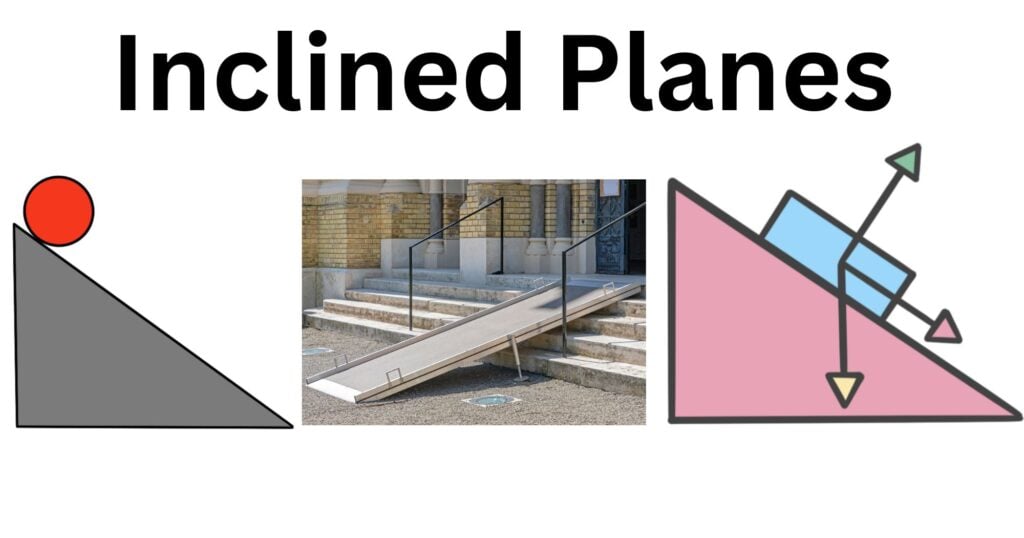
This simple change on a surface helps to slide or roll heavy objects more easily from one level to another. Manually, it is difficult to lift a heavy load and move it up or down, as it is time-consuming and requires greater force. This difficulty is overcome by the inclined plane. Generally, less force is required to push the objects over the inclined plane than to carry them.
An inclined plane is a very practical system. When we increase the distance of the effort to be applied, the effort automatically gets reduced. This means that a heavy load can be moved easily if we apply a smaller force, increasing the distance. This maintenance of the distance and effort will make the inclined plane effective to use.
Inclined planes are also conventional concepts. Ancient constructions like the temples, monuments, pyramids, etc., were made by using long ramps, taking the full advantage of inclined planes. Even today, we can see inclined planes everywhere around us. Ramps in construction sites, roads in mountainous regions, and even slides in swimming and kids’ playing zones are examples of inclined planes in different forms.
Understanding the inclined plane and applying it in our everyday life makes us work easily. Thus, we can rely on a basic idea of a simple machine to solve our daily problems.
Principle and Working of an Inclined Plane
The inclined plane relies on the mechanism of force and distance. To reduce the effort required to lift a load, the distance of the effort is increased. The relation between the effort and the distance is such that, as one is increased, the other quantity relatively decreases. This is also closely related to the conservation of energy, which states that energy cannot be created or destroyed but can only be transformed from one form to another.
When we lift an object vertically, the weight acts on the object, and hence it becomes difficult to carry it. This becomes more difficult if the object is heavier. When using an inclined plane, we do not have to perform the work manually. The load is moved slowly along a sloping surface. This reduces the amount of force required at any moment.
The working of an inclined plane is listed below:
- Firstly, the object or load is placed at the lower end of the slope.
- Effort is applied parallel to the surface of the plane, either by pushing or pulling.
- As the object moves upward along the plane, instead of going up all of a sudden, it gradually climbs up.
- As the movement is gradual, less force is required to lift the load.
However, it is important to note that the inclined plane does not reduce the total work done. The amount of work done is the same whether it is lifted vertically or moved along a slope. The only change is that the force to be applied is reduced, and the work becomes distributed along the distance. This makes us feel quite relieved and less tired.
Efficiency and Velocity Ratio of an Inclined Plane
Efficiency and velocity ratio are the mathematical terms to be understood to perform the work with the desired effort. They also help to measure the performance of the system.
The velocity ratio in the inclined plane is calculated as the ratio of the length of the plane to its vertical height. It measures the distance moved by the effort as compared to that of the load. A longer plane with the same height has a relatively greater value of velocity ratio than a shorter plane. A greater value means less effort to be applied. Hence, a machine with a greater velocity ratio is preferred.
Velocity ratio (V.R.) = Length of inclined plane / Height of inclined plane [Equation 1]
Mechanical advantage is the ratio of the load lifted to the effort applied. A higher mechanical advantage means that less effort is required to lift a given load.
Mechanical advantage (M.A.) = Load / Effort [Equation 2]
Efficiency is the ratio of output work to the input work. It gives the measure of the effective performance of the inclined plane and tells us what applied effort is converted to useful work. It is also calculated as the ratio of mechanical advantage to velocity ratio and often expressed as a percentage by multiplying the value by 100. In an ideal situation, the efficiency 100% (or the ratio of output/input would be 1). However, in real life, friction and other factors reduce efficiency, and no machine is perfectly efficient. Even though efficiency is never perfect, we can obtain maximum efficiency (nearly equal to 1) by reducing the external effects.
Efficiency (η) = Output work/Input work x 100% [Equation 3]
Or
η = M.A. / V.R. X 100% [Equation 4]
Relationship Between Force, Load, and Length of the Inclined Plane
The effort applied, the load, and the length of the inclined plane are closely related to each other. Their proper understanding and measurement can help us to do our work efficiently.
From equation [1], we can clearly see that the velocity ratio is directly proportional to the length of the inclined plane and inversely proportional to the height of the inclined plane. Therefore, the greater the length of the plane, the greater will be the velocity ratio. Also, a greater velocity ratio means less effort is required.
Again, from equation [2], we can see that the mechanical advantage is inversely proportional to the effort. For a constant load, if the effort applied is smaller, the M.A. of the machine increases. Similarly, equation [4] says that the efficiency of a machine is directly proportional to the mechanical advantage. Hence, as the mechanical advantage increases, the efficiency increases.
The load also plays an important role here. A heavier load naturally requires more effort, even on an inclined plane. However, the inclined plane parts the work and reduces the effort. It is easier to lift a smaller load than a heavier one.
Hence, the length of the plane and the load type play a major role in the effort to be applied.
Examples of Inclined Planes in Everyday Life
Inclined planes are present in many forms in our daily lives. Some common examples are given below:
- Ramps are used in public places, hospitals, and homes to help people move heavy objects like furniture, wheelchairs, hospital beds, etc., easily.
- Staircases are also examples of inclined planes, which help to go up easily without using more effort. They are actually a series of inclined planes.
- Roads in hilly or mountainous areas are also designed as inclined planes. Instead of going straight up, roads are curved to allow the vehicles to climb more easily and safely.
- Slides are also made in playgrounds and swimming pools for fun purposes.
- Loading ramps are used in trucks and warehouses to move heavy goods without lifting.
Applications of Inclined Planes
Inclined planes are common in various working fields. Some of the applications are given below:
- In construction sites, they are used to move heavy loads of bricks, cement, and stones to higher levels. Workers can directly push the loads up by using a ramp instead of carrying them. This reduces the effort and also increases the efficiency in working.
- In transportation, flyovers, bridges, roads, etc., are also designed with the technique of inclined planes. They help vehicles move smoothly at different heights.
- In public infrastructure, inclined planes are used to create ramps for elderly and disabled people. This availability makes buildings more accessible and inclusive.
- In industries, the technique of inclined planes is used in conveyor belts. They help move goods easily from one level to another.
- In agriculture, inclined planes are used to transport crops, tools, and equipment. Farmers can move heavy loads easily using ramps.
- In household purposes, inclined planes are used for moving furniture or heavy objects. A wooden plank can be inclined to perform our work.
- The floors or roofs of many buildings and infrastructures are also made slightly inclined, such that the steady water can easily flow down.
Advantages of an Inclined Plane
An inclined plane has always remained a useful technique for our daily tasks. Some of the advantages of inclined planes are given below:
- It reduces the effort required to lift heavy objects. Thus, we can easily complete the work by using less force and feeling less tired.
- It is simple to design and construct. It can be made by using easily available materials like wood, metal, or concrete. Hence, it can be attained easily.
- As it is simple in nature and easily available, it is also affordable. Its maintenance and handling are also simple and easy.
- It is easy to use, hence no complicated mechanism is required to be learnt and can be easily used by any common individual.
- It is flexible in nature and can be used in many situations, such as construction sites and household usage.
- The use of an inclined plane is less risky, and hence it ensures safety. This property makes the inclined plane reliable.
- It allows for better control and gradual movement.
Limitations of Inclined Planes
Inclined planes also have some restrictions and limitations, which are listed below:
- They require a longer distance and hence require a large area. This may not be possible in every situation, particularly for some limited spaces.
- As the distance increases, the time required to complete the task also increases. Therefore, this technique becomes time-consuming.
- Friction becomes a problem while performing a task. The rough slope can disturb the sliding/rolling process. Moreover, extra effort should be made to overcome the friction that becomes difficult.
- For a greater inclination angle of the slope, or the steeper slopes, the transport system becomes difficult. It is also difficult to use cranes and elevators.
All these limitations can decrease the efficiency of our task. Hence, it is suitable for only specific tasks. Also, to increase the efficiency of our work, proper lubricating agents or a surface with less friction can be used.
Conclusion
An inclined plane has always remained incredible in terms of moving heavy loads. It reduces our effort and makes our work easier, more comfortable, and hence less time-consuming. When the distance between the load and effort is increased, our task becomes smoother and more manageable. It is also one of the oldest techniques used in solving various weight-lifting chores. Still today, it is applied frequently in an advanced manner. Ramps, inclined roads, and even staircases imply the idea of an inclined plane. Thus, from household purposes to industrial purposes, it has a huge impact on our daily lives.
Every concept and technique has its own value and significance. Hence, an inclined plane also has its own fixed purpose and is not suitable for other tasks, such as multiplying force or changing its direction. Friction also arises as a problem for rolling or sliding objects, affecting their motion. Other things, like distance management and the inclination angles, should also be considered in practice.
Keeping the limitations aside, it is the most affordable, efficient, and reliable way to manage our tasks. Considering the limitations and by trying to resolve them, we can obtain maximum efficiency from this technique.
References
- Patterson, J. (2025). Simple Machines. Publifye AS.
- Pryce, R. (2022). 8.5 Simple Machines. Introduction to Biomechanics.
- Dotger, S. First-class levers illustrate the principles of work.
- https://www.sciencefacts.net/simple-machines.html
- https://en.wikipedia.org/wiki/Simple_machine
- https://www.bing.com/search?q=simple+machine&form=ANNTH1&refig=69be07bd4c0740269d0c000df8ea1d91&pc=U531
- https://www.sciencefacts.net/inclined-plane.html
- https://en.wikipedia.org/wiki/Inclined_plane
- https://www.geeksforgeeks.org/physics/inclined-plane/
