
What is Inertia of Motion?
The word ‘Inertia’ and hence the inertia of motion was first used by Newton in his laws of motion. As stated by him, inertia is the property which keeps the object in the same state unless an external force acts on it. Every object tries to keep its position unless it is compelled to leave it. This behavior of the body is known as inertia. Similarly, the property which keeps the uniform motion state of a body until a force act on it is known as the inertia of motion. Moreover, a body in uniform motion if brought suddenly to rest, it tries to oppose the rest state and wants to continue in motion. Such behavior of the state is known as inertia of motion.
It is the most common phenomena around us. In our daily lives we have experienced these situations frequently. For example, while stirring coffee with a spoon, it moves in a circular motion. After removing the stirring force too, the coffee keeps continuing in the circular motion. A rolling ball also takes time to come to rest. Similarly, a man sitting in a moving bus feels a forward push when it braked suddenly. These are all due to the reason that the moving body always wants to be in motion and hence takes a time to accept the next position.
“Inertia” is a Latin word which means “laziness” or “idleness.” However, this actually doesn’t mean the laziness of a body. Instead, it means that an object tries to oppose any change in its state of motion. If an object is moving, it tends to keep moving in the same direction and with the same speed. There will always be factors like a little friction or air resistance which tries to keep the same state of the body even after changing the state. Hence, we can say that it is the property of matter that makes a moving object keep moving or is the resistance to change in the state of motion.
Newton’s First Law: The Physics Behind Keeping Things Moving
Aristotle was the first person to talk about the reason behind the motion of an object. He stated that the object will continue in motion as long as a force acts on it. He completely denied the existence of inertia and said that the object would automatically come to rest due to the factors like air resistance and friction. His law was accepted for years. After several years, philosophers started thinking of it as a false statement.
Galileo Galilei continued to study about motion and found out the concept of inertia. He proposed that the motion of any object would continue in motion with the same velocity, unless some force interacts with its motion. This was in opposition to the Aristotelian hypothesis. He focused on the experimental observations and found out to be true. However, something was missing in his theory.
Later, Newton studied Galileo’s concept of motion and derived the laws of motion mathematically, giving a robust theory about motion. He officially stated the word ‘inertia’ for the property to continue in constant motion, as stated by Galileo. Hence, the laws of motion got theoretically and experimentally recognized.
Newton’s First Law is also called the law of inertia as it introduces the property to hold the object in its state and also introduces force that changes the state of the object. In simple form it means that an object not moving will stay as it is and if the object is already moving, it will keep moving. Force plays an important role to change the state of motion or state of rest. Here, the change in state also means the change in direction. Without force, the object itself cannot change its direction and keeps moving in the straight line. The tendency of the object to be at rest is called inertia of motion and the tendency to be in motion is called inertia of motion.
A force can:
- start motion (make a resting object move),
- stop motion (make a moving object come to rest),
- change speed (make it faster or slower),
- change direction (make it turn).
Newton’s first law can clearly define inertia for both rest and motion and hence is called the law of inertia.
To understand it better, let’s take an example of a book lying on the table. The book cannot move itself until some kinetic friction acts on it or another body lifts it. This is the example of inertia of rest. Similarly, a rolling body like a ball, will not itself come to rest. A limiting friction is responsible for stopping it. This is because of the inertia of motion.
Newton’s First Law helps us understand that motion does not need a force to continue. A force is needed only to make a change.
The Relationship Between Mass and Inertia
The nature of motion for each object is different. They also change the state in their own way. This happens due to the physical property of the body known as mass. Thus, in classical or Newtonian mechanics, mass is also known as the measure of inertia. Inertia directly depends on the body’s mass. Therefore, simply we can say that lighter objects are easier to move or change their state than heavier ones. In addition to further statements, lighter bodies are also easier to stop than heavier ones.
For example, it is easier to move an empty cart than a loaded cart. It is also easier to kick a football than a rock. Hence, a body’s inertia is pre-determined by its mass. Mass is the important physical property of a body that determines the inertia, speed, velocity or force of a body. The quantity of motion carried by a moving body i.e. momentum is also determined by its mass.
The relationship between mass and inertia is always important in real-life situations. During collisions, the interaction with moving heavier bodies would be deadly than that with lighter bodies. Thus, in safety during travels to design engineering structures, mass and inertia are examined properly.
Inertia of Motion vs. Inertia of Rest: Key Differences
The two types of inertia are inertia of rest and inertia of motion. Both are the concepts brought by the changes in states while they act uniquely.
Inertia of Rest
It is the property of an object by virtue of which an object at rest always tries to be at rest. For example, a leaf on a tree tries to be hanging on the tree without moving, unless it is affected by an air resistance or is shaken. Similarly, a glass on a table continues to be at rest unless moved or displaced by an external factor.
In all these examples, the body at rest tries to oppose its motion which is called the inertia of rest.
Inertia of Motion
It is the property of an object by virtue of which an object in motion always tries to be in motion, also not changing its direction. For example, a sliding block in a wooden inclined plane would continue its motion unless restricted by friction. A running person cannot stop instantly at one point. Hence, a body in motion opposes any kinds of changes in its condition which is called the inertia of motion.
Key Differences
In simple language, inertia of rest is the opposition created by the mass from starting to move while the inertia of motion is the opposition created by the mass from stopping itself or changing its direction. However, they are dependent on the same physical property called mass. Mass is the key factor to determine the body’s inertia of rest or motion. These two things are the same concepts for a body but viewed from two different sides.
Real-Life Example: Why Passengers Fall Forward When a Bus Stops
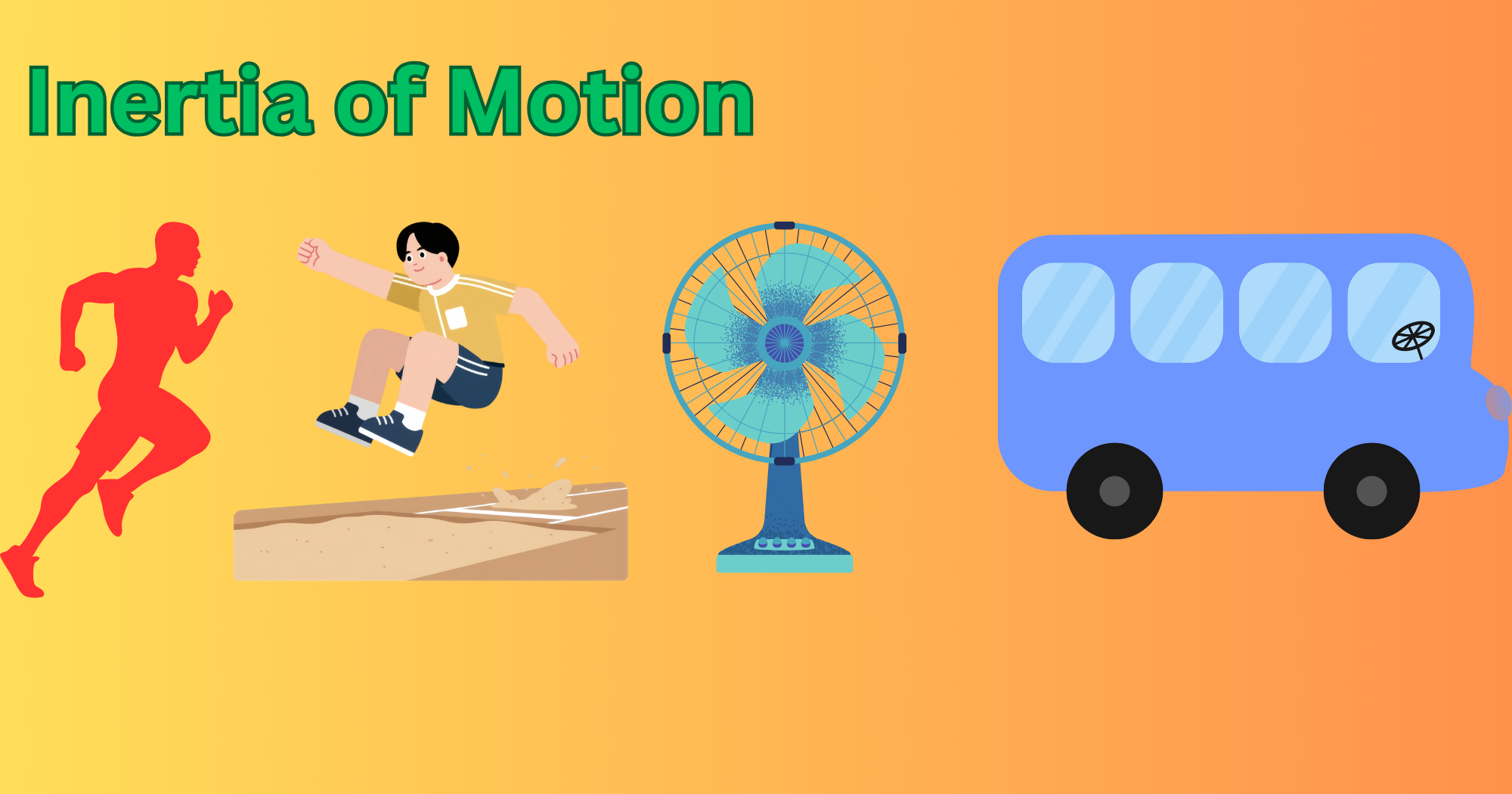
To understand the concept of inertia, we can take some examples that happen frequently around us. The most common instance is a person sitting or standing in a bus. As the bus is moving forward at a certain speed, we are also supposed to be moving along with it, with the same speed. If it is suddenly braked, the bus will stop quickly. At this instant we feel like our body is falling forward. We can also lose our balanced condition if we do not hold on to something at the moment. This is because of the inertia of motion.
When the bus is moving at the same speed, our body also adjusts at the same speed as the bus. Now, to apply brakes suddenly means force is applied on the bus to stop it immediately. However, our body is not ready to stop immediately and wants to keep moving forward. Because of this tendency, our lower half tries to stop but the upper half moves forward, and we feel like our body is being pushed forward.
Actually some other factors like,
- The seat in front of us,
- Our own muscles,
- Or something we are holding,
Apply force on our body to stop.
That is why seatbelts are important traffic rules to be followed to maintain safety in traveling with buses or cars.
Sports Physics: Why Athletes Cannot Stop Instantly
Inertia of motion is also very important in sports. We can notice that for all athletes, cyclists or skaters, no one stops at an instant. Runners or cyclists often go forward for some distance. These are also the examples of inertia of motion.
When an athlete is running, their body has a certain speed and direction. The inertia of motion doesn’t let them stop as soon as they want. The body muscles of the athlete first apply force to stop the motion in the opposite direction. However, due to inertia of motion, their body still wants to keep running, which pulls them forward. Thus, to maintain their inertia they gradually slow down their speed. In addition, greater inertia is developed in the athletes who have greater mass. Thus, training is given in each sport to control their speeds also.
In other sports like long jump, high jump, relay races etc. players come running from a longer distance then the starting point to cover a little longer distance due to the inertia of motion. Safety is also taken priority in sports and hence, in games like football, volleyball, hockey, basketball etc., players take control in their speeds to stay away from injury.
So, inertia of motion is not just a problem to overcome; it is also something that can be used in a smart way in sports.
Rotational Inertia: Why Electric Fans Continue to Spin After Power Cut
In all forms of motion i.e. linear to rotational, inertia always exists. The inertia of motion in rotational or spinning objects is known as the rotational inertia. In rotating objects also, the object in motion tries to keep its motion after a stopping force is applied. Hence, the concept of linear and rotational inertia is the same. The most familiar example is a rotating fan. When we switch off an electric fan, you may notice that the fan takes time to come to rest. Its speed decreases slowly after turning it off and the blades continue to spin for some time.
In this case, the motor stops providing energy, but the blades are still in motion. Because of inertia of motion, the rotating blades resist the change from motion to rest. They “want” to keep rotating. Of course, they do not keep rotating forever because:
- Air resistance acts against the blades.
- Friction in the bearings and the motor also acts against the motion.
These forces slowly reduce the speed of the blades, and after some time, the fan comes to rest. This is a perfect example of inertia of motion in rotational form.
Other examples are spinning bicycle wheels, toy spinors etc. If held freely and spined, they keep rotating for a while before coming to rest. They come to rest due to friction and air resistance. This also happens due to the inertia of motion.
The idea of rotational inertia is very important in machines, engines, flywheels, and many mechanical systems. Engineers often use heavy rotating parts to store rotational energy and to keep motion smooth and steady. Once again, inertia of motion is not just something we observe—it is something we use in technology.
Safety Engineering: How Seatbelts Counteract Inertia of Motion
Inertia is a natural property, so a body in motion will certainly experience this property. This may be harmful or injurious if the condition is not handled carefully. This becomes more dangerous when it is the topic about transportation.
While moving in vehicles, seatbelt is the foremost need for both the driver and the passenger because inertia can create an imbalance in the body when brakes are applied. a car is moving, both the car and the passengers inside it are moving with the same speed.
When the brakes are applied to stop the vehicle, the wheels slow down but the passengers’ bodies still try to keep moving forward due to inertia of motion. If seatbelts are not used, the passengers would continue moving forward and could:
- Hit the dashboard,
- Hit the windshield,
- Or be thrown out of their seats.
Hence, seatbelts are provided for the safety reasons of the traveler. Wearing a seatbelt:
- Holds our body firmly in a place,
- Applies a force to our body when the car slows down,
- Gradually we reduce our speed along with the car.
Without a seatbelt:
- Our body would keep moving forward due to inertia.
- We would stop only when you hit something hard.
- That sudden stop could be very harmful.
With a seatbelt:
- Our body is stopped more slowly and safely.
- The force is spread over a longer time.
- The risk of injury is greatly reduced.
Airbags also work on a similar idea. They provide a soft surface that increases the time over which your body comes to rest, reducing the force on your body.
So, in safety engineering, inertia of motion is not ignored—it is carefully considered. Engineers design vehicles, seatbelts, and safety systems by keeping inertia in mind, so that people can travel more safely.
Experimental Demonstrations of Inertia of Motion
Inertia of motion is not just a theory written in books. It can be demonstrated easily with simple experiments, even in a classroom or at home (with proper care). Some easy demonstrations are given below:
- The Rolling Ball Experiment
Kick a football on the ground.
- The ball moves forward and travels some distance.
- Slowly, it comes to rest because of friction of the ground and the air resistance.
This clearly shows inertia of motion in action. If you take a heavier ball, it stops slower than the lighter ball as inertia acts more on the heavier objects.
Similarly, if the ball is rolled on a smooth surface with lesser friction, the stopping force would be minimum, and the ball would keep moving for a longer time as stated by Newton’s first law.
- A Toy Car on a Table
Take a toy car on a plane surface like a table, pull it backward in speed and release it. You will see that,
- The car keeps moving for some time after the release, gradually decreasing the speed and coming to rest.
- Its inertia of motion keeps it moving forward for a while
- Later friction overcomes the inertia and makes it stop.
Also, you can place a small object coin on the top of the toy car. When the suddenly hits a wall or any obstacle,
- The small object continues moving forward and may fall off.
- This happens because the object has inertia of motion.
- Spinning Wheel or Fan
As discussed before, spin a wheel or observe a fan after switching it off.
- It continues rotating for some time.
- This shows inertia of motion in rotational motion.
All these simple experiments help us see and understand inertia of motion in a clear
Conclusion
Inertia is a natural property for all existing objects. It shows its impact on both moving and rest objects. Being mathematically proven by Newton and experimentally observed by Galileo, it is the fundamental aspect of motion. A force can come into action only by overcoming this inertia property of the moving object. It is the most familiar concept being observed in our daily lives.
Inertia has both its advantages and harmful aspects. It is most common in sports and transportations. A runner can take a long run by inertia while getting an injury if not taken control over its speed in the right time. A passenger can get an injurious hit if the body is not properly balanced while braking a vehicle. Similarly, in our locality, there is also a trend of hitting a carpet with a stick to blow away dust particles which by the way follows the law of inertia of rest.
Rotational motion also equally holds inertia as linear motion. Hence, a body can never be untouched by the property of inertia. We can demonstrate it easily in a classroom to make it easily understandable by the learners. Understanding inertia would build a strong base about motion.
References
Tait, P. G. (1899). Newton’s laws of motion. A. & C. Black.
Mahajan, S. (2020). A Student’s Guide to Newton’s Laws of Motion. Cambridge University Press.
Newton, I. (2017). Laws of Motion. Law of Gravitation.
Ciufolini, I., & Wheeler, J. A. (1995). Gravitation and inertia. Princeton university press.
Halliday, D., Resnick, R., & Walker, J. (2013). Fundamentals of physics (10th ed.). Wiley.
Galili, I., & Tseitlin, M. (2003). Newton’s First Law: Text, translations, interpretations and physics education. Science & Education, 12(1), 45-73.
Isaac Newton, The Principia, translated by I. Bernard Cohen and Anne Whitman (University of California Press, Berkeley, CA, 1999), p. 100.
https://en.wikipedia.org/wiki/Inertia
https://byjus.com/physics/law-of-inertia
