
Introduction to Lever (Simple Machine)
A lever is the first simple machine tool designed in ancient times. Since simple machines are used to finish our work easily and use less manual force, they were designed by the ancestors during the civilization periods to lift loads and perform other various tasks. Gradually, they become more famous for moving heavy objects, building structures, and doing other daily activities. Hence, levers are the most common simple machines that make our work easier. They multiply the force and make sure that we do not have to directly apply force on the load. Even our small effort can perform heavier work within a few seconds. This feature of a lever is very useful.
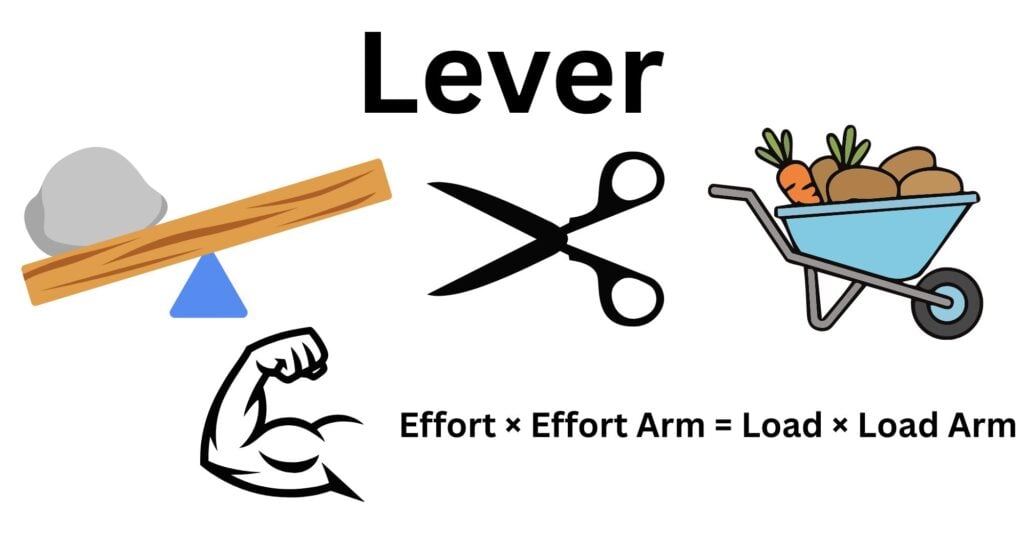
We find levers everywhere around us. A crowbar is the simplest tool used in lifting heavy loads, whereas a seesaw is the commonly seen play tool in the kids’ playing zone. Most of the tools in mechanics are applications of the lever. Since the subject is about force and direction, levers and simple machines are an important topic in physics. Also, instrument designing and structural buildings are important topics in engineering, which are based on lever.
Parts of a Lever (Fulcrum, Effort, and Load)
The three main parts of the lever are the load, effort, and fulcrum. The force applied on one part helps to overcome the load on the other side while having a fixed pivot. Hence, all three parts are equally important to make our work easier, faster, and more convenient.
The fulcrum is a central point and is always a fixed point. The lever is directed toward this pivotal point. It keeps supporting the lever. The lever cannot move or perform its work properly if there is no fixed central point.
The effort is the force that we apply to the lever. This is the input force that we use to move or lift an object. The effort is usually applied at one end of the lever, depending on its type.
The load is the object or weight that needs to be moved or lifted. It is the output force that the lever helps to overcome. The load is usually located on the opposite side of the effort.
The distance of the load from the fulcrum and the distance of effort from the fulcrum are the two important quantities to determine the input and output of the work. A greater load distance means less effort required to lift the load. Hence, the arrangement of these three parts in a lever is the efficiency-determining characteristic for a lever.
Principle and Working of a Lever
The working principle of a lever the principle of work. This principle is also related to the law of moments. A moment is produced by the action of a force lying at a certain distance from the fulcrum.
The principle of moment states that in an equilibrium condition, the net clockwise moment must be equal to the anticlockwise moment. Hence, in the case of a lever, the equilibrium position lies at the fulcrum. Here, the product of the force and distance from the fulcrum on one side (load x load distance) must be equal to the product of force and distance on the other side (effort x effort distance).
This can be understood as:
Effort × Effort Arm = Load × Load Arm [Equation 1]
From equation (1) it is seen that effort and effort distance are inversely proportional. Therefore, a greater distance of force to be applied from the fulcrum will lessen the force to be applied. It means to lift a larger load, a greater distance of effort is required, and vice versa. We find that our effort to lift the load is multiplied by our distance from the fulcrum. Hence, it is said that a lever multiples the force and makes our work easier. This is the working principle of many machines around us.
Classes of Levers (First-Class, Second-Class, and Third-Class)
The classification of levers is done by looking at the positions of load, effort, and fulcrum on them. Levers are divided into three classes:
First-CLass Lever
In a first-class lever, the fulcrum lies between the effort and the load. It can change the direction of the applied force, and hence, when we push down on one side, the other side moves up.
Examples of first-class levers are a seesaw, scissors, and a crowbar. They can multiply force and also change the speed or direction as required.
Second-Class Lever
In a second-class lever, the load lies between the fulcrum and the effort. This type of lever always increases force. Hence, a smaller effort can overcome the heavy load.
Examples of the second-class levers are: wheelbarrow, a bottle opener, and a nutcracker. In these levers, the effort arm is always longer than the load arm. This makes them suitable for lifting heavy objects.
Third-Class Lever
In a third-class lever, the effort lies between the fulcrum and the load. They can imply faster speeds in our tasks and also provide a quick movement. However, they don’t multiply the force applied.
Examples of the third-class levers are: tweezers, lemon squeezers, a fishing rod, etc. A human arm can also be regarded as a third-class lever. More effort is required in these levers, but it is easier to do our work more quickly and increase the speed of movements.
Differences Between the Three Classes of Levers
The three classes of levers are clearly different because the position of the fulcrum, effort, and load are different. The major differences are tabulated below:
load are different. The major differences are tabulated below:
| First-class lever | Second-class lever | Third-class lever |
| -The fulcrum lies between the effort and the load. -They can be used to increase force or change direction. -They are flexible and can perform several tasks efficiently. -They are used to obtain balance and control in the tasks. | -The load is between the fulcrum and the effort. -They can be used to multiply force and reduce effort. -They provide a good mechanical advantage by reducing the effort. -They are used for heavy lifting. | -The effort is between the fulcrum and the load. -They do not reduce effort but increase speed and range of motion. -They are useful when quick movement is needed. -They are used for faster speeds and precision. |
The uses of all three types depend upon the nature and requirements of our task. Hence, we use them as per our requirements.
Examples of Levers in Everyday Life
Levers are being used unnoticeably in our daily circumstances. Some examples are given below:
- A seesaw (first-class lever) is used in a playground. When one person goes down, the other goes up. This shows the balance maintained by the lever.
- A bottle (second-class lever) helps to open a bottle cap with very little effort by applying force at a greater distance.
- In the human arm (third-class lever), the elbow acts as the fulcrum, the muscles as the effort, and the hand acts as a load.
- Other examples like scissors, pliers, crowbars, wheelbarrows, and staplers are the daily usable tools from households to offices and construction sites.
Hence, we are carrying levers in our daily activities and even in our bodies themselves.
Applications of Levers
Levers have many practical applications in different fields.
- In construction, levers are used to lift heavy materials and break objects. Tools like crowbars, wheelbarrows, and hammers are mostly used in those sites.
- In agriculture, farmers use tools like hoes and plows, sickles, axes, spades, etc., which work on the principle of levers.
- In the human body, bones and muscles act as levers and make the movement and flexibility of the arms possible. The act of running, eating, and lifting everything is possible due to the application of the lever.
- In industries, machines often use levers to transmit force and motion. This helps in increasing efficiency and reducing human effort.
Levers are also used in medical instruments, mechanical devices, and even in transportation systems.
Advantages of Levers
The use of a lever in our tasks is always found to be useful. Some advantages of using levers are as follows:
- They multiply our effort such that a small effort can lift a heavy load.
- Levers help in changing the direction of force and make us do our work more conveniently.
- They are simple in nature and hence easier to use.
- Levers have a simple working mechanism that can be easily understood by a normal person, and they are also reliable and cost-effective.
- Levers can also increase speed and range of motion (mainly the third-class levers). This is useful in activities that require quick movement.
To sum up, levers increase the efficiency of work and make work easier for any task.
Limitations of Levers
Despite their usefulness, levers also have some limitations.
- One limitation is that not all levers reduce effort. In third-class levers, more effort is required to move a load, even though they increase speed.
- The position of the load, effort, and the fulcrum must be appropriate; otherwise, our lever cannot function well.
- Another limitation is that levers cannot multiply force indefinitely. The multiplication is limited and depends upon the type of load and the length of the lever.
- In some small spaces or restricted areas, large levers are inappropriate to use as they are not portable and cannot be compact.
Moreover, no machines or tools are 100% efficient; friction should also be considered. Thus, the friction and the nature or strength of the load highly affect the efficiency of a lever.
Conclusion
Levers are very simple designs of human minds. They are not the recent tools but the art of ancient technology. They have played an important role in making our daily tasks easier. We always keep ourselves touched by levers whenever heavy manual tasks are to be performed. From daily circumstances to the development of new technologies, like in weight lifting and transportation, they are always considered the roots of the design.
The key note for a lever is the load, effort, and fulcrum. Without their proper arrangement, we are unable to use our lever in a convenient way. Thus, the working principle must be well-studied before using it. The law of moments should also be clearly understood to utilize less effort for a heavy task and get greater efficiency. The arrangement of load, effort, and fulcrum can be different for different classes of levers, which may cause confusion regarding the device. Hence, classes of levers are also important to study.
Although levers have some limitations, their benefits are praiseworthy, and the limitations seem smaller in front of the benefits. They are one of the most fundamental concepts in physics and engineering. In conclusion, understanding levers is not just a physics thing but also a problem solver in everyday life.
References
- Patterson, J. (2025). Simple Machines. Publifye AS.
- Pryce, R. (2022). 8.5 Simple Machines. Introduction to Biomechanics.
- Dotger, S. First-class levers illustrate the principles of work.
- https://en.wikipedia.org/wiki/Lever
- https://www.engineeringchoice.org/what-is-lever/
- https://www.geeksforgeeks.org/physics/types-of-lever/
- https://www.sciencefacts.net/lever.html
