
Introduction to the Pendulum
A pendulum in physics is specially designed to study periodic motion. By the concept of periodic motion and the nature of velocity and acceleration, one can find the time period of the pendulum. It is a very simple system that has fascinating applications in physics. The system is generally made up of a mass and a string. The mass is called the bob which is tied in the string at one end and suspended at another end to a fixed point like wall or a stand. The assumption is that the string is massless and it is inextensible. This allows the system to swing freely back and forth. The weight of the bob continuously applies in the vertical downward direction and makes the bob swing under the influence of gravity. The concepts of force, motion, energy and oscillations can be extracted by studying this system.
Pendulums have been studied for centuries because their motion is regular and predictable under ideal conditions. This regular motion makes them extremely useful in clocks, scientific experiments, and the study of periodic motion. By analyzing a pendulum, students can understand how forces produce motion and how nature often follows simple mathematical laws.
In this article, we explore the physics of a pendulum in a simple and explanatory manner. We discuss its types, the forces involved, the equations governing its motion, energy changes, and its practical applications. Special emphasis is placed on the simple pendulum, which is commonly studied at school and undergraduate levels.
Historical Development of Pendulum Motion
Before the 1930s, the most accurate way to keep track of time was with pendulums, which moved in a steady circle.Christiaan Huygens invented the pendulum clock in 1656. It was the world’s standard timekeeper for 270 years and was used in homes and offices. It was consistent to about one second per year until the quartz clock took its place in the 1930s. In the past, they were used to measure the moment of gravity in geology. The special device used for this were gravimeters.
Chinese scientist Zhang Heng was the first person to use a simple pendulum in history. He used a seismometer on the basis of a pendulum. The seismometer used to tilt when it felt the shaking of an earthquake far away. A button would let go of a small ball inside an urn-shaped device, which would land in one of eight metal toads’ mouths below. These toads’ mouths were placed at the eight points of the compass to show which way the earthquake was happening.
In 1602, Galileo officially used pendulums for the measurement of time. He wrote his findings about pendulums in his notes called ‘On Motion’, released in around 1588. He wrote that the heavier objects would swing for a longer time than lighter ones. Later, in the 17th century, Christiaan Huygens discovered the first pendulum clock with accuracy in time measurement. It was based on Galileo’s ideas. Huygens also gave the mathematical expression for the time period of a simple pendulum. This made a huge effort in classical mechanics.
After a certain interval of time, scientists like Newton came up with his laws of motion to explain the motion of the pendulum. He also used his universal gravitation to show the effect of gravity on the pendulum. Gradually, there were advancements in pendulums and the types like temperature compensated pendulums, Foucault’s pendulum etc. came into account.
Types of Pendulums
Pendulums can also vary according to the mass variation, structure and the motion. Some major types of pendulum are given below:
Simple Pendulum
A simple pendulum is very simple in structure. It is constructed by using a mass called bob that is freely suspended to the string. The string is generally considered as massless. The string’s other end is clamped in a stand or wall. Now displacing the bob from its position makes the bob move back and forth. It makes an angle with the mean position and acquires a simple harmonic motion. The restoring force tries to keep it in a mean position and hence the motion is periodic.
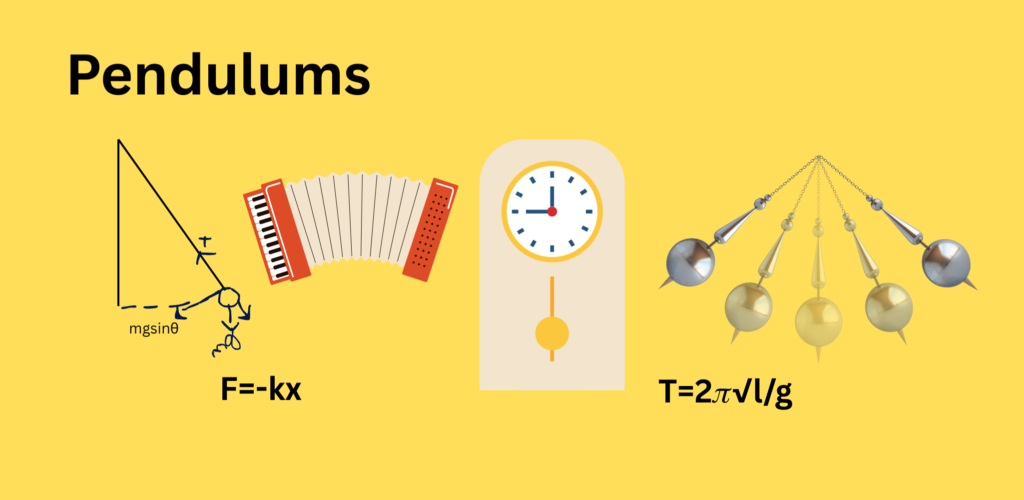
The time period of simple pendulum is given by T = 2𝜋√l/g [Equation 1]
where l is the length of the string and g is the acceleration due to gravity. Thus the time period of a simple pendulum depends only on the length of string and not on the mass of the bob.
Foucault’s Pendulum
Foucault’s pendulum is also a type of simple pendulum. It was discovered to show the rotation of Earth. It has a big weight (the bob) that is attached to a long wire. This allows the pendulum to swing freely in any direction. The plane of its oscillation seems to spin in accordance with the Earth’s surface as it oscillates. This shows that the Earth is rotating below it. This effect is most noticeable near the poles and decreases as we move closer to the equator. At the equator the pendulum’s axis of oscillation is fixed and appears to be not spinning at all. Now as latitude increases the precession rate also keeps increasing and remains maximum at the poles.
The precession rate of the Foucault’s pendulum is given as ꭥp = ꭥ sin𝜑 [Equation 2]
Here, ꭥ is the angular rotation of earth and 𝜑 is the latitude.
The time period of the pendulum is now calculated as: Tp = 2𝜋/ꭥp [Equation 3]
Double Pendulum
It is named so because it has two simple pendulums. The one is suspended on the other pendulum and both act like inseparable systems. Thus it becomes more complex to balance two pendulums. The equilibrium condition can also be difficult to achieve for larger oscillations. However, for smaller motion, the double pendulum also behaves like a simple pendulum. The forward motion of the first pendulum regularly throws the second one in random directions. Double pendulums are generally used for mathematical simulations.
Torsional Pendulum
A torsional pendulum is a system of pendulum that shows rotational motion and oscillation. A torsional pendulum rotates around a vertical axis due to the twisting of a wire or rod where it is suspended.
A torsional pendulum also consists of a mass attached to a wire or rod. This rod is able to twist around its axis. When the mass is twisted and then released, the restoring torque makes it oscillate around the mean position. The rod or the twisted wire provides the required restoring torque here. The motion is also periodic and is similar to that of the spring-mass system.
The time period of torsional pendulum is given by T = 2𝜋/⍵ [Equation 4]
Here, ⍵ is the angular velocity and given by ⍵ = √k/I. Here I is the moment of inertia (I = mr^2 and k is the torsional constant.)
Compound Pendulum
A compound pendulum oscillates around a fixed point under gravity. A rod or bar is bent at a position (beyond centre of mass) which is called the pivot point. The motion is both the translational and rotational type. Now the pendulum rotates around that pivot point.
The pendulum clock is the best example of compound pendulums. The pendulum in the clock is made up of certain metal. A weight is given to the bottom and is allowed to move back and forth. The motion of the pendulum is affected by factors like length, weight, position of the pendulum and the amplitude of oscillation. The time period depends on the length of the rod and acceleration due to gravity.
T = 2𝜋 √(K^2+ l^2)/g [Equation 5] (Here K is the radius of gyration.)
Forces Acting on a Pendulum
The motion of a pendulum is the result of two factors i.e. gravity and tension on the string.
Gravitational Force
As the bob is suspended freely, its weight acts vertically downward. This is certainly due to gravity. This force is further resolved into two components: vertical component along the string and the horizontal component to the path of motion. This horizontal component is responsible for the oscillatory motion of the string.
Tension in the String
The tension arises due to the string that suspends the mass. It acts in an upward direction towards the point of suspension. Tension doesn’t create any motion but making sure that the motion is circular.
As the pendulum is displaced from its mean position, gravity produces a restoring force and pulls the system to equilibrium. This restoring force makes the motion of the pendulum periodic.
Restoring Force and Angular Displacement
When a pendulum is displaced through a small angle from its vertical position, it tends to come back to its initial equilibrium condition. This force that tries to bring the pendulum in a mean position is called the restoring force. This restoring force is in accordance with the Hooke’s law i.e. F ∝ x (where x is the displacement)
Or, F = -kx (where k is the proportionality constant). The negative sign here is to show that this restoring force is directed opposite to the displacement.
Now, if our displacement is angular then the force is also proportional to the sine of the angular displacement. If we take smaller angles for the displacement, we find the value of the sine of the angle nearly equal to the angle itself in radians. This approximation makes the simple calculation for the motion of the pendulum and results in simple harmonic motion.
Angular displacement is the angle through which the pendulum is displaced from its mean position. The restoring torque acting on the pendulum is proportional to this angular displacement.
Derivation of the Equation of Motion
The equation of motion of a simple pendulum is based on Newton’s laws of motion. Suppose we have a pendulum of length (l) and bob of mass (m). Let us displace them by making a small angle θ . Then,
The vertical component of gravitational force acting on the bob is:
F = -mgsinθ [Equation 6]
For small angles, (sinθ≈θ ). Therefore:
F = -mgθ
Using Newton’s second law for rotational motion:
mld^2θ/dt^2 = -mgθ
On simplifying we get,
d^2θ/dt^2 + g/l θ = 0 [Equation 7]
This is the standard equation of simple harmonic motion. It shows that the motion of the simple pendulum is SHM if the displacements are made in small angles.
Time Period of a Simple Pendulum
The time period of a pendulum is the time taken to complete one full oscillation. From the equation of motion, the angular frequency ⍵ is given by:
⍵ = √g/l
The time period (T) is:
T = 2𝜋√l/g
This expression shows that the time period is directly affected by the length of the pendulum and inversely by the acceleration due to gravity. Also, time is independent of the mass of the bob.
This property makes pendulums highly useful for timekeeping and gravity measurement.
Energy Transformation in Pendulum Motion
When the topic arises about periodic motion there is always an exchange of energy between motion and rest. The rest energy is the potential energy which is attained in the maximum displacement point. Similarly, while crossing over the mean position, the system will attain the kinetic energy. This rapid cycle of potential and kinetic energy will provide the energy for simple harmonic motion.
- At the extreme positions, the pendulum will have final velocity zero. Thus, the potential energy is maximum and kinetic energy is minimum.
- At the mean position, the pendulum has maximum velocity. Here, the potential energy is minimum, and the kinetic energy is maximum.
At last, whatever be the change in kinetic and potential energies, the total mechanical energy of the system is always conserved (in the absence of air resistance or friction). Thus, also a pendulum follows the law of conservation of energy.
Effect of Length, Mass, and Gravity
The time period of a pendulum has various relations with the quantities like length, mass and the gravity.:
Length
Increasing the length of the pendulum also results in the increase in the time period of the pendulum. Hence, longer pendulums oscillate more slowly.
Mass
Mathematically and experimentally, the mass of the bob shows no effect on the time period. This factor was first observed by Galileo.
Gravity
The time period is inversely proportional to the value of acceleration due to gravity at a certain region. Pendulums swing more slowly on the places with lower gravity than on Earth.
Applications of Pendulum Physics
Pendulums are equally used in practical life and technological applications. Some important uses and applications are given below:
- Time-Keeping Clocks: From historical evidence and the period of discovery they are being used to record time periods. Their consistent motion around the fixed position gives accurate and precise time measurement.
- Seismometers: The movement of tectonic plates during earthquakes and normal days also behave like periodic motion. Thus, these motions can be tracked by pendulum clocks. The ground motion makes the clock move like the ground. Thus it helps to determine seismic activities and warn before destructive earthquakes.
- Metronomes: They are used in musical devices. The rhythm and beat of the instrument can be controlled by using pendulum clocks. It helps for the perfect timing of rhythm and to maintain consistent beats.
- Gravimeters: The concept of pendulums arose from gravimeters. They are used to detect small gravitational fields. A small sphere suspended in a strong magnetic field acts like a pendulum. It suspends the sphere proportional to the earth’s magnetic field. They are used in aircrafts, ships etc. where gravity has a high effect on the system.
- Engineering: As pendulums can help to study the motions, oscillations, vibrations and damping, they are very useful to design oscillating devices like control systems and dynamic analysis.
- Geology: In geology, pendulums are used to study the ground motion, the rotational motion of earth etc. generally, gravimeters, seismometers, torsional pendulums are frequently used in geology.
Conclusion
Pendulum is a simple way to show what periodic motions are like. They may be as simple as a simple pendulum and more complex like Foucault’s pendulum or compound pendulum. The simple laws of nature can be unfolded with the help of pendulums. All types have their equal importance in various fields of physics, engineering, geology etc. Force, amplitudes, displacements, acceleration, angular quantities etc. can be visibly understood with the help of a pendulum. Therefore, they are always important topics to deal with in mechanics.
a vital role in understanding nature. By studying pendulum motion, one gains insight into forces, energy, time, and the mathematical beauty of physics.
References
Marrison, W. A. (1948). The evolution of the quartz crystal clock. The Bell System Technical Journal, 27(3), 510-588.
Morris, W. (1980). American Heritage Dictionary (New College ed.).
Baker, G. L., & Blackburn, J. A. (2008). The pendulum: a case study in physics. OUP Oxford.
Gillies, G. T., & Ritter, R. C. (1993). Torsion balances, torsion pendulums, and related devices. Review of scientific instruments, 64(2), 283-309.
Matthews, M., Gauld, C. F., & Stinner, A. (Eds.). (2006). The pendulum: Scientific, historical, philosophical and educational perspectives. Springer Science & Business Media.
https://en.wikipedia.org/wiki/Pendulum
https://www.geeksforgeeks.org/physics/real-life-applications-of-pendulums
