
Introduction to Pulley (Simple Machine)
A pulley is a simple machine that has been around for a long time and is used to make our work easier. They have a simple and small construction, but they play a big role in lifting and moving heavy objects. In general, a pulley helps us by reducing our effort and making it more comfortable. From ancient bucket lifting from a well to recent gym activities, the pulley is very famous. These systems help us apply force in a more convenient way.
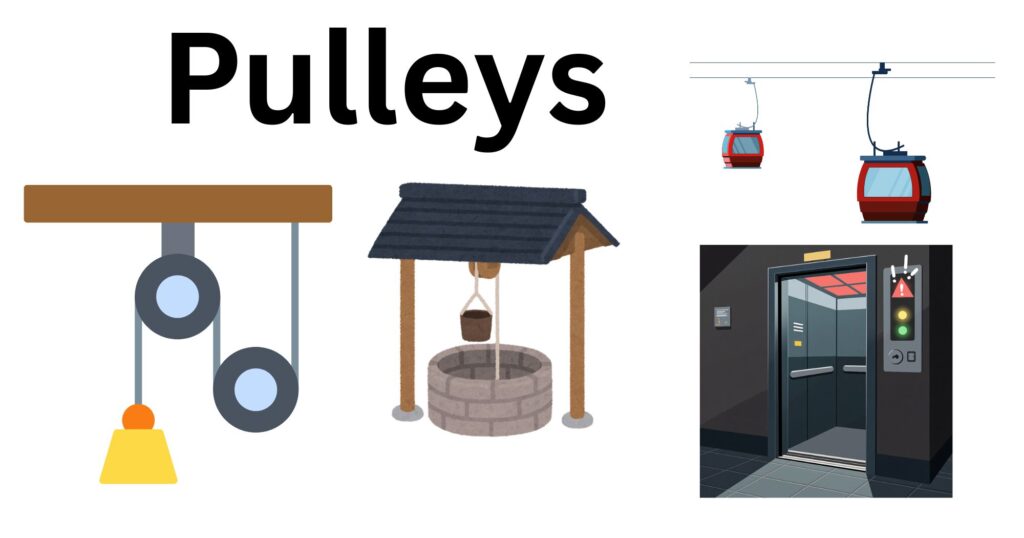
A pulley consists of a wheel that has a grooved rim through which a rope is passed. The rope can move over the wheel, making lifting tasks simple. A pulley can be used as needed because it can change the direction of a force or reduce the effort required. Some pulleys can also perform both tasks at the same time.
Before, pulleys were widely used for construction work. Their use is highly associated with the construction of large monuments and structures. Today, the latest technologies and modern machines still use the concept of pulleys even more simply.
In physics, a pulley is called a simple machine because it makes work easier. Without reducing the total work done, it changes the process of doing it in a simpler manner. Understanding pulleys helps us understand many machines we use in daily life.
Parts of a Pulley System
A pulley has six main parts. All of them have their own function for performing a work. The parts are given below:
- A wheel is the most visible part of the pulley. It is circular and has a groove at the edge. This groove helps to keep the rope fixed while the wheel is moving.
- A rope or cable is the part we pull to lift the load. It must be strong enough and flexible to carry the load.
- An axle lies at the centre of the wheel. It must be designed in the pulley such that the friction between the rope and the wheel is not large, and hence the rope can move smoothly around the edge of the wheel.
- Next is the load. It is the object we need to lift. The load may be heavier or lighter.
- The effort is the force we apply to lift the load. In most cases, this is done by pulling the rope downward.
- A support or frame holds the pulley in its place. It helps to keep the entire pulley to remain stable during operation.
Principle and Working of a Pulley
Pulley is based on the concept of force and motion. The work is made easier by changing the working pattern. Hence, the total work done is not reduced, but the working process is slightly modified.
When we pull the rope of a pulley, the wheel starts rotating. This creates a motion in the rope. This movement of the rope lifts the load. A simple fixed pulley helps us do our work by changing the direction of force. Hence, instead of lifting the load upward, we can easily lift it by pulling the rope downward. This feels more natural and easier.
In other types of pulleys, especially movable or compound ones, the effort required can actually be reduced. This happens because the load is supported by more than one segment of rope. So, the weight gets distributed.
For example, if two segments of rope are supporting a load, the effort required becomes roughly half of the load. This is what we call mechanical advantage.
The concept of energy conservation also applies here. Since a greater distance is to be maintained to apply a small force. Therefore, one has to pull the rope over a longer distance. So, the total work done remains the same.
In real situations, friction always exists. The efficiency can be affected by it. So, to minimize its effect, the machine should be designed well, and proper lubrication should also be done.
Types of Pulleys (Fixed, Movable, and Compound Pulleys)
Pulleys are also available in different types. The three main types of pulleys are: fixed, movable, and compound pulleys.
A fixed pulley has one end fixed to a point, like a ceiling or beam. It remains fixed while moving the load. It is mainly used to change the direction of force. For example, in a flagpole, the rope is pulled downward to raise the flag upward. It doesn’t reduce the effort but changes the direction of force to be applied and makes the task easier.
In a movable pulley, the load is attached to the pulley itself. The pulley also moves when the load is lifted. In this case, the load gets divided among the rope segments, and hence we have to apply less effort. It is used mainly to lift heavy loads.
A compound pulley contains both the fixed and the movable pulleys. It is quite complex system than the other two. But in the case of lifting, it changes the direction of force and also reduces the effort significantly. It is used in machines like cranes and elevators.
All these types are used according to the needs of our work.
Velocity Ratio and Efficiency of Pulleys
Velocity ratio and efficiency are the two important calculations made in simple machines. Simply, it is the ratio of the output velocity and the input velocity.
For a pulley, the measurement of the velocity ratio tells us the difference in the load distance when the effort distance is increased. For example, if we pull the rope of a pulley by 2 meters, the load rises by 1 meter. Thus, the velocity ratio of that pulley will be 2.
The efficiency of a pulley means how our input work is changed into meaningful output work. It is the ratio of useful output work to the input work. A perfect simple machine has efficiency =1. However, it is impossible to attain as friction always comes in any machine, and some of our work is driven to overcome it.
Even though we can get nearly 100% efficiency by using good materials in the machine and using lubricating agents to overcome friction and improve our working performance.
Block and Tackle Pulley System
A block and tackle system is a more advanced type of pulley arrangement. Multiple pulleys are arranged in this system to obtain greater efficiency and the mechanical advantage.
The pulley is grouped into two sets, or blocks. One block is fixed, while the other moves with the load. The rope passes through several pulleys such that the load is divided among multiple supporting segments. Hence, we have to apply less effort to lift heavy loads.
The addition of more pulleys makes our task easier. However, we need to pull more rope, and the system becomes a bit complicated.
A block and tackle pulley system is mainly used in ships, cranes, etc., where we have to deal with extremely heavy loads.
Examples of Pulleys in Everyday Life
Due to the reliability and comfort of pulleys, they have been used in daily life practices. Some pulleys used in our daily lives are given below:
- A Well: It is the simplest and classic example of a pulley. It is used to lift the bucket of water.
- Flagpole: It is used to raise or lower a flag.
- Elevators: They help to easily climb up or down, without using the staircase.
- Window Blinds: They are used as adjusters while covering the windows.
- Gym instruments: Many gym instruments are used to provide resistance to the muscles while exercising.
- Theatres: In theatres, pulleys are used to control the curtains, i.e., raising or lowering them.
Applications of Pulleys
Pulleys are used in many fields, from simple household tasks to complex industrial work. Some applications are given below:
- Cranes and hoists are used in construction sites. They help to lift heavy materials easily with the use of compound pulleys.
- Elevators are used to move heavy loads up and down.
- Cable cars are also an application of the pulley, used for transportation in those places where roads are difficult.
- Zip flying is another application of the pulley used for entertainment and thrilling experiences.
- In industries, pulleys are used in machines to transfer motion and power. They are also found in conveyor systems.
- At home, pulleys are used in systems like garage doors, curtains, and washing lines.
Advantages of Pulley Systems
Pulley systems have many benefits, which is why they are widely used.
- They reduce the effort needed to lift heavy loads, making work easier. They also allow us to change the direction of force, which can be more convenient.
- Pulleys are simple to use and do not require complicated mechanisms. They are also quite flexible and can be used in different ways depending on the need.
- Another advantage is safety. Using a pulley system can reduce the risk of injury when lifting heavy objects.
Limitations of Pulley Systems
Pulleys also have some restrictions and limitations based on their uses and nature. Some of the limitations are given below:
- One major limitation is friction, which reduces efficiency. Some of the input energy is always lost to overcome the friction between the rope and the wheel.
- Another problem is that complex pulleys are much more efficient, but they are quite complex to use, set up, or maintain. They are also space-consuming.
- A simple pulley can only change the direction of force and does not reduce the effort.
- A pulley cannot be used for other appliances like cutting, pressing, or welding. So, this simple machine is specific to weight-lifting.
- Moreover, regular maintenance and servicing are required to make our system work perfectly.
- Complicated pulleys are also costly and require high-maintenance.
Conclusion
Though they are simple in nature, they can do more complex tasks than we imagine. For example, tons of loads are lifted by the cranes due to the use of various types of pulleys. Hence, a pulley is a powerful machine in the case of load lifting. It has been used for centuries to make work easier.
Different types of pulleys have their own importance. Some are used just to change the direction, while others are used to reduce the effort. More complicated pulleys are used to perform even heavier work. So, according to our workload, we can use a single pulley or a system of multiple pulleys.
All pulleys are based on the basic principle of a simple machine. However, all simple machines are designed for a specific purpose of work. From a simple task of lifting well water to the difficult construction works, are made simpler under the working of pulleys. Transportation systems are also made easier with the help of pulley systems.
Pulleys also have some limitations, as only fixed types of work can be done by them. Also, we have to count the friction while lifting the load, which might increase the effort or reduce the efficiency of the system. The whole effort will go in vain if the materials, like ropes, are not good enough to carry the load. Hence, all these things should be considered to work smoothly with the pulley.
Considering the limitations and improving our system, we can get the maximum advantage of the simple machine. It has a good impact on the technological world. Thus, studying the basic idea of a pulley can bring a greater change in our conventional working methods.
References
- Patterson, J. (2025). Simple Machines. Publifye AS.
- Pryce, R. (2022). 8.5 Simple Machines. Introduction to Biomechanics.
- https://en.wikipedia.org/wiki/Simple_machine
- https://www.bing.com/search?q=simple+machine&form=ANNTH1&refig=69be07bd4c0740269d0c000df8ea1d91&pc=U531
- https://en.wikipedia.org/wiki/Pulley
- https://www.sciencefacts.net/pulley.html
- https://www.geeksforgeeks.org/physics/pulley/
