
What is the Restoring Force? Definition and Physical Concept
Restoring force is the force accumulated by a body itself from its internal molecular structure or surface layers. For any object displaced from its initial position or forced to change its shape, restoring force plays a major role to bring it back to its originality. This generation of restoring force is caused by the regular interchange of kinetic and potential energy of the body. Some examples may include the periodic motions of pendulums, mass-spring systems etc. In these conditions when a body is displaced from the mean position or is stretched, the body is pulled back to the mean position. This pulling force is called the restoring force.
Restoring force doesn’t originate without any disturbance on the object or a system. Thus, for this to occur, first an external force must be applied on the system. After removing the external force, if the object tries to come to its original point or finally comes to its equilibrium, this is due to the restoring force. Since it opposes the external force applied, it is always in the opposite direction to the displacement created by the external force. For example, if the object is moved upward, the restoring force pulls it downward and hence always acts opposingly.
Restoring forces are the reason behind periodic motions and elastic properties of the materials. As stated by Newton, an object cannot change its state without an external force and hence the displaced object can also not come to initial position without applying the restoring force by itself. Hence it is a core concept for understanding many important topics in mechanics, like simple harmonic motion, elasticity, energy in oscillating systems, and many daily activities.
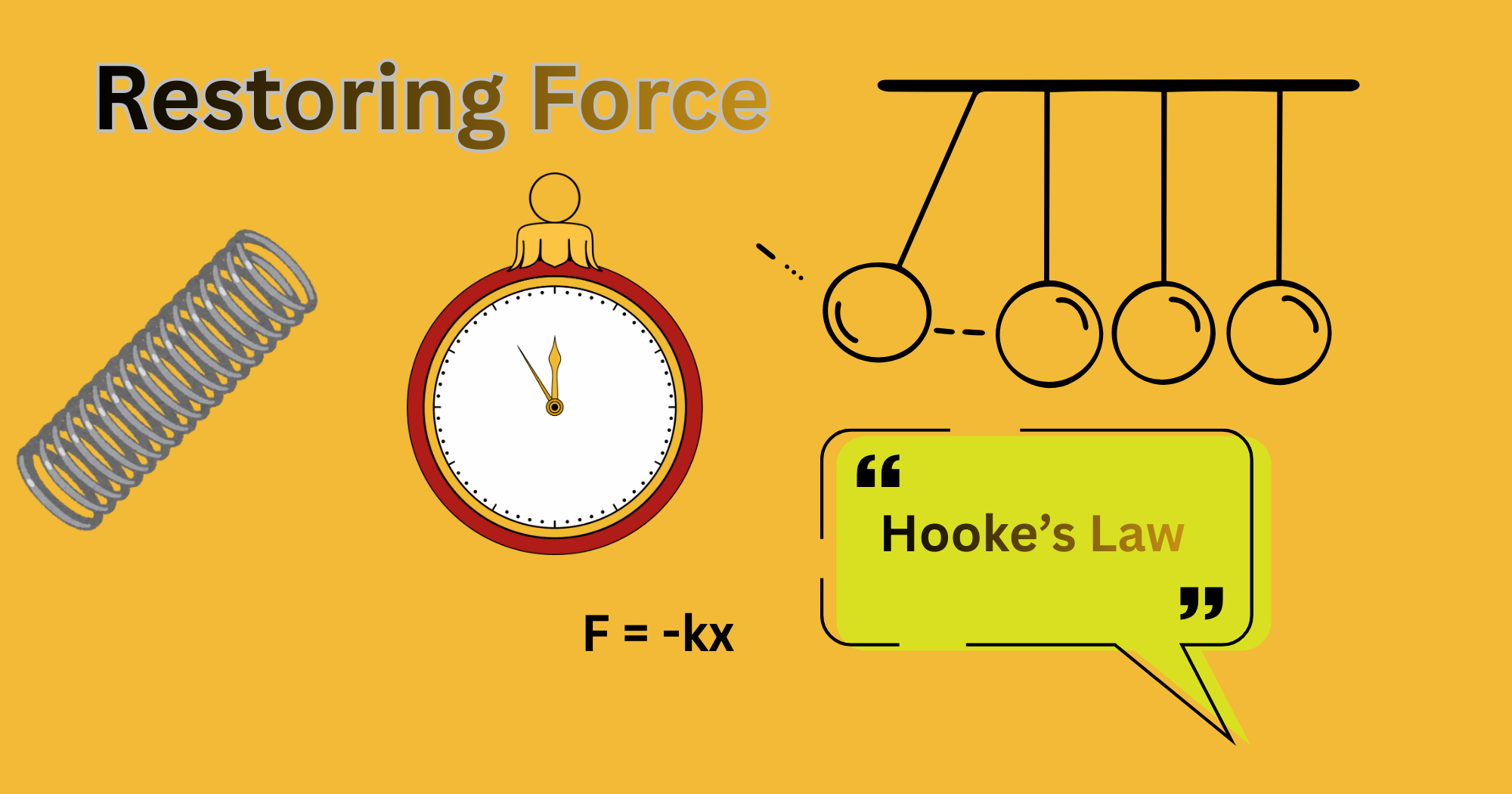
The Origin of Restoring Force: Equilibrium and Displacement
Restoring force includes two important topics: displacement and equilibrium in its definition. So before studying it, these two topics are very important to understand.
An equilibrium condition is defined as a state where the body is in balanced condition, no matter what forces act on it. So, it can be called as the condition when all forces acting on a body cancel out each other and keep a body in a balanced state. Balanced conditions may indicate two conditions: either the body is at rest or keeps moving with a uniform velocity. For many systems, there is a particular position where this balance naturally occurs which is called the equilibrium position.
For example: a meter scale suspended is a stand with an inextensible string in a balanced position. Here, the string applies tension on the scale which acts in upward direction and gravity on the mass (weight of the scale) acts in the downward direction. Both forces act equal but oppositely and hence keep the scale balanced.
Displacement means moving a body. In equilibrium condition, displacement means disturbing the body from its balanced state and bringing motion in it. In the above example, if the meter scale is touched or moved, it makes a displacement away from its equilibrium position. So, when a system is displaced from equilibrium, their balanced state is disturbed. The disturbance occurs due to the imbalance in the forces acting on it (tension and weight). As a result, a net force appears. If the system after disturbance comes easily to its initial condition, then the object is in stable equilibrium. In opposition, if the object cannot gain its initial position or falls or break, then the condition is called an unstable equilibrium. This seeks for stable equilibrium gives rise to the concept of restoring force. Hence, restoring force is supposed to exist due to the major consequences like:
- The system has an equilibrium position where forces are balanced.
- The system is displaced from that position by some external action.
- Because of internal physical properties (like elasticity or gravity), a net force appears that tries to bring the system back to equilibrium.
The size of the restoring force usually depends on how far the system is displaced. For small displacements in many systems, the restoring force is proportional to the displacement. Also restoring forces do not come out themselves. They come from fundamental interactions such as:
- Elastic forces between atoms in a stretched or compressed object
- Gravitational forces in systems like pendulums
- Electric forces in some microscopic or electronic oscillators
In everyday terms, whenever a system “does not like” being displaced from its normal position and tries to return, it is because of restoring forces acting inside it.
Hooke’s Law: The Mathematical Formula (F = -kx)
One of the most famous and useful descriptions of restoring force is given by Hooke’s Law. It is basically applied to all elastic objects and those not following Hooke’s law are called plastic materials.
Hooke’s Law states that the restoring force produced by an elastic object (a spring) is directly proportional to the displacement from its equilibrium position. The direction of this force will be opposite to that of the displacement. Mathematically, it is expressed as:
F = -kx [Equation 1]
Here:
- F is the restoring force
- k is the spring constant (a measure of how stiff the spring is)
- x is the displacement from the equilibrium position (either stretched or compressed from the mean position)
- The negative sign is assigned to show the opposite direction of force with respect to the displacement.
This simple proportional relationship is what makes many spring systems easy to analyze. The minus sign is very important. Moreover, Hooke’s law also has its boundary which is called elastic limit. If an object has been applied too much force, the object will deform permanently, and no Hooke’s law applied on it.
This law is not only important for springs. It also helps us understand many other systems where a restoring force is proportional to displacement, such as:
- Vibrations of atoms in a solid
- Oscillations of certain mechanical structures
- Small oscillations in many physical systems
Because of Hooke’s Law, we can describe restoring forces in a clear and simple mathematical way, which makes it easier to study motion, energy, and oscillations.
Restoring Force vs. Deforming Force: A Comparison
Restoring and deforming forces exist parallelly in nature. A deforming force is applied externally for changing the shape, size or dimension of an object and hence any actions like push, pull, tension or load applied on an object causes deformation of that object. For example, when we bend a stick, it can extend, stretch or break.
Restoring force is an internal force produced by the object itself. It is responsible to bring an object back to the mean position after removing the deforming force causing changes. In all cases, deforming force is one that makes restoring force come into action. In the above example, if we stop applying force on the stick, then if the stick reaches its initial position rather than breaking down or permanently deforming, it is due to the restoring force.
Simple Comparison
| Deforming Force | Restoring Force |
| Applied externally | Produced internally |
| Causes deformation | Causes reformation of the initial condition |
| Changes shape or size | Brings object back to original shape |
| Acts in the direction of displacement | Acts opposite to the displacement |
These forces are like two parts of a coin but inversely related to each other. It means that if the deforming force is greater, the object cannot come back to equilibrium after removing the deforming force. In reverse, if the deforming force is smaller, the object can quickly get back to its position due to the defeating restoring force.
Simple Harmonic Motion (SHM): The Role of Linear Restoring Force
Simple harmonic motion holds an important physics existing due to the restoring force. To produce a simple harmonic motion, a restoring force must act on the system which is directly proportional to the displacement of the motion from the equilibrium. The force pulls the object again towards the mean position and hence directed towards the center. Therefore, an object in simple harmonic motion:
- Always has an equilibrium position.
- When it is displaced from that position, a restoring force acts on it.
- That force is directly proportional to the displacement but is in the opposite direction to the displacement.
The mathematical description of SHM is in accordance with Hooke’s law. Hence, Hooke’s law is the foundation of SHM. The object moves periodically, back and forth of the mean position in this type of motion. For example,
- A mass oscillating on a spring
- A pendulum swinging through small angles
- Vibrations of tuning forks or guitar strings
In SHM the force and displacement produced are linear and hence, the motion becomes periodic and predictable. Also, the acceleration produced by this force becomes linear. The motion has different cases for extreme and equilibrium conditions.
At the extreme positions,
- The displacement is maximum.
- The restoring force is maximum.
- The speed is zero.
Therefore, the object speeds up as it approaches equilibrium.
At the equilibrium position,
- The displacement is zero
- The restoring force is zero
- The speed is maximum.
Therefore, the object slows down as it moves away from the equilibrium
This continuous exchange between motion and force gives a periodic pattern to the motion.
Time period and frequency are other two important factors in SHM. The time taken for one complete oscillation is called the time period while the number of oscillations per second is called the frequency. They depend on the nature of the system, such as the mass and the stiffness of the spring.
SHM is frequently seen in real-world practices like:
- Clocks and watches
- Musical instruments
- Seismic waves
All of these are based on restoring force that is simple and linear.
Examples in Action: The Simple Pendulum and Spring-Mass Systems
The most famous SHM and the cases of restoring force are the simple pendulum and the spring-mass system. Below is given the brief physics lying within them.
Spring-Mass System
In a spring-mass system, a mass is attached to a spring whose other end is fixed on a rigid support. The rest condition of the system while being suspended freely is its equilibrium position. Now, if the mass is stretched down and released, the spring goes back to its equilibrium. It keeps moving to and fro for some time about its mean position. Hence, the restoring force of the spring remains active and pulls the system again to the initial position. As the mass moves upward and passes through the equilibrium position, it has some speed, so it continues moving upward and compresses the spring.
This back-and-forth motion creates oscillations in the system. The restoring force also decides how far the spring will be displaced. For small forces, Hooke’s Law acts on the system and gives the restoring force opposite to that displacement.
Simple Pendulum
A simple pendulum has a small but heavy mass or a bob that is suspended on a string whose one end is fixed on a rigid support. The string used here is very light such that its mass is negligible. The string is also inextensible. When the pendulum is at rest, it is called its equilibrium position. In this position the tension of the string and the weight of the body keeps it balanced.
Now if the bob is displaced from the mean position it starts to move back and forth. The weight acts in the mass and tries to pull it again towards the center. Hence, in a simple pendulum the weight of the bob provides the restoring force. It also displaces according to the Hooke’s law for small angles. However, for larger angles, the elastic limit may break.
The things in common for both examples are:
- There is an equilibrium position.
- There is a displacement from that position.
- A restoring force appears that tries to bring the system back.
- The system oscillates because of this force.
Energy Transformations: Potential Energy and Restoring Force
The continuous shift in energy of the body after applying external force is also responsible to produce restoring force. When a body is applied a force, there is regular change of kinetic and potential energy. Since work is done while applying external force, the work will be in opposition to the restoring force. This work is stored in the system as potential energy. If the external force is now removed the restoring force comes into action and makes the body move. The stored potential energy now changed into kinetic energy.
When the body is moving toward the mean position:
- Potential energy decreases.
- Kinetic energy increases.
At the equilibrium position:
- Potential energy is minimum.
- Kinetic energy is maximum.
As the object moves past the equilibrium position toward the other side:
- Kinetic energy decreases.
- Potential energy increases again.
At the extreme position on the other side:
- Kinetic energy becomes zero.
- Potential energy becomes maximum again.
Because of this continuous cycle of energy change, the body keeps shifting its position in a repeated cycle. Hence, restoring force is what makes the body move and exchange energy. In an ideal system this chain of exchanging energy never breaks, and the body keeps moving back and forth forever. However, in real life, some energy is always lost due to friction or other resistive forces. This gradually makes the motion slow down and come to rest.
Elasticity: Why Materials Return to Their Original Shape
After overcoming the external force by its restoring force, the body gains an important property of itself called elasticity. It is concerned with the behavior of objects which return to their original form or condition after the external force is removed. This external force is the deforming force. So, when this force is applied the internal bonding of the objects is disturbed and hence the object gets displaced. However, the same internal forces give rise to a restoring force to gain the original position.
This is the reason why a stretched rubber tube snaps back and a bent ruler straightens when released (if force is not very large).
Elasticity of any material is also determined by Hooke’s law by giving a certain range called the elastic limit. If the deforming force is within this limit, the material can gain its original shape after removing the force otherwise the deformation becomes permanent.
The elasticity of a material depends on the nature of the material. If the material is very stiff it has a high spring constant and hence high restoring force which makes it elastic. In contradiction, a soft or flexible object has a very low value of spring constant and is more likely to get deformed permanently.
This concept of elasticity is widely useful in advanced applications of physics and engineering. Without elasticity many useful objects—such as springs, shock absorbers, and even building materials—would not work properly.
Real-World Applications: Shock Absorbers and Mechanical Watches
Restoring forces are not just ideas from textbooks. They are used in many practical devices that we depend on every day.
Shock Absorbers
Shock absorbers are often used in vehicles. When we are travelling on rough roads by car, we can have an uneasy up and down motion. Hence, springs are used to support the car and provide restoring force to it. This brings the car to normal position after each bounce.
Dampers are also used in the vehicles so that the vehicle can slow down gradually and need not suffer too much bounce. The concept behind shock absorbers is also the restoring force that brings the vehicles in the initial position. In the absence of shock absorbers, the travel cannot be that safe and comfortable.
Mechanical Watches and Clocks
In many mechanical watches and clocks, a small spring or a pendulum is used to keep time. The regular oscillation of these parts is controlled by restoring forces.
In a pendulum clock small springs are also used and gravity provides the restoring force which pulls the pendulum back to equilibrium. Thus the regular oscillation of the spring and the pendulum is controlled by the restoring force. Because restoring forces can produce very regular and predictable motion, they are perfect for timekeeping devices.
Other Applications
Restoring forces also appear in:
- Musical instruments to produce sound
- Buildings and bridges, which can resist earthquakes
- Sensors and measuring devices, used to detect changes in pressure, weight, or acceleration
Conclusion
Restoring force is the central idea of any force showing its effects on any object. The concept of elasticity and plasticity lies on it. The reason behind seeking a restoring force is the deforming force. It is always responsible to bring back the object to its initial position and hence can be called as a center directing force. Hooke’s law is the basic law for the proposal of restoring force. It defines the force mathematically and shows its relationship with the displacement.
In addition, for any object to apply a restoring force, firstly it must be acted by an external force to displace it. This key reason makes it an important law behind the simple to complex motions like harmonic motions and repeating oscillations. Elasticity is also an important property of a material and hence makes them usable in various devices and circuits. This force is also noticed in daily lives like shock absorbers, watches, musical instruments etc.
To conclude, we can call restoring force as the natural force and the technique of advanced technology. By understanding restoring force, we can get deeper knowledge about motion, energy transformation and the nature of materials in the physical world.
References
Thompson, J. O. (1926). Hooke’s law. Science, 64(1656), 298-299.
Williams, E. (1956). Hooke’s Law and the Concept of the Elastic Limit. Annals of Science, 12(1), 74-83.
Motion, S. H. (2006). Simple Harmonic Motion. A A, 4(2), 2.
Baker, G. L., & Blackburn, J. A. (2008). The pendulum: a case study in physics. OUP Oxford.
Jones, R. M. (2009). Deformation theory of plasticity. Bull Ridge Corporation.
https://en.wikipedia.org/wiki/Restoring_force
