
Introduction to the Screw (Simple Machine)
A screw is one of the simplest tools used in daily life and is considered a simple machine. It is simple in structure but can perform difficult tasks like holding things together, lifting heavy loads, and moving things easily. Also, it is used in assembling furniture and operating large industrial machines.
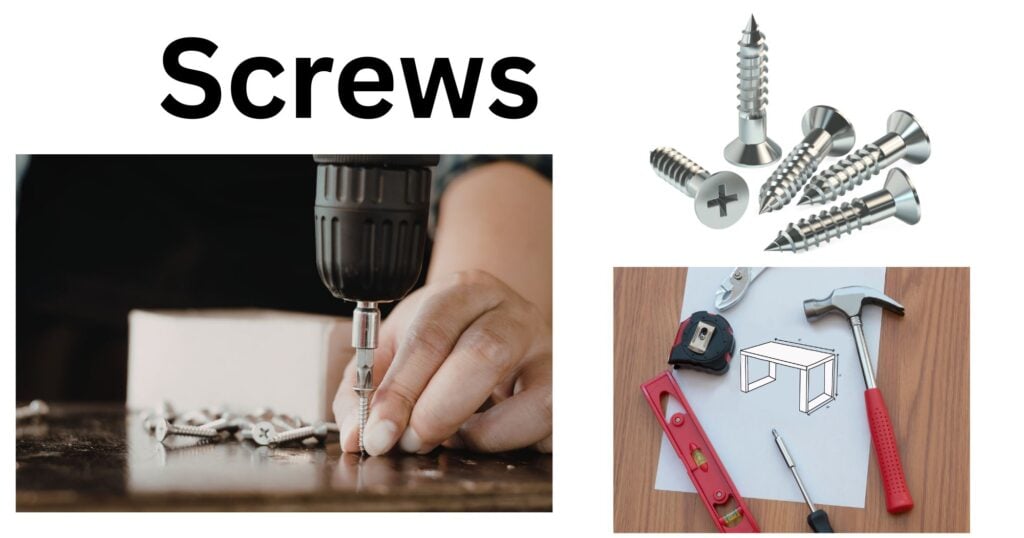
A screw is a simple machine that converts rotational motion into linear motion. It consists of an inclined plane that is wrapped around a cylindrical rod. This design produces a large linear force from a small rotational force. This makes work easier and more efficient.
They have also been in use since ancient times. Before screw-like mechanisms were used in devices like water lifts and presses. With the evolving technologies, crews have also advanced into different shapes and sizes, which are made for particular purposes.
To sum up, we can say that a simple device like a screw also has a significant role in making our work easier, faster, and more convenient. Thus, they are termed simple machines. Its proper study helps in learning the mechanisms of simple tools and complex machinery.
Structure and Parts of a Screw (Thread, Pitch, and Axis)
A screw also has several parts that function together to complete a task. The different parts of the screw are given below:
Thread
The thread is the most noticeable part of a screw. It is a spiral or helical ridge around the cylindrical body of the screw. The thread is the principal part of the screw. It acts as an inclined plane through which the rotational motion is converted to linear motion. The design of the thread determines the efficiency and strength provided by the screw.
Threads can vary in shape, size, and spacing. It depends on the purpose the screw is being used for. Some threads are sharp and deep, which provide strong gripping, while some are fine and smooth, which give precision in working.
Pitch
Pitch is the distance between two consecutive threads of a screw. It is usually measured along the axis of the screw.
The pitch helps to determine the speed of motion of the screw when rotation is done. A larger pitch means the screw will move forward more quickly with each turn and vice versa. A smaller pitch is also required in many tasks where precision is important.
For example:
- Screws with large pitch are used where speed is important.
- Screws with a small pitch are needed in special purposes where precision is needed.
Axis
The axis lies in the centre of the screw. It is a line equal to the length of the screw. It acts as the reference line around which the thread is wrapped.
The axis ensures that the screw rotates smoothly and moves in a straight line. It also helps maintain the stability of the screw during operation.
Head (Additional Part)
Most screws have a top part called the head (it is an optional part). Generally, we apply effort to the head by using tools like screwdrivers or wrenches.
Tip
The tip of the screw lies at the end, which is generally made sharp. A sharp tip can drive the screw into wood, plastic, or other materials.
Principle and Working of a Screw
The screw functions according to the principle of the inclined plane. A screw is an inclined plane that is wrapped around a cylinder.
Basic Principle
When the screw is rotated, the effort is applied to the screw, and this effort travels through the thread or the inclined surface and moves forward. Thus, a rotational motion gets transformed into a linear motion with the help of a screw. Therefore, a screw goes inside a material, and either helps to fix it or lifts a load.
Working Mechanism
The working mechanism of the screw can also be understood in certain steps, which are given below:
- An effort is applied to rotate the screw.
- The thread acts as an inclined plane and moves the force forward.
- The force reaches the tip, and with each rotation, the screw penetrates the material.
- The friction between the thread and the material holds the screw fixed.
This process generates a large force with just a small effort. Hence, screws are regarded as very effective in fastening and lifting tasks.
Role of Friction
As we aim to fix or lift a material, friction plays a very important role in this work. Without friction, the screw can slip or not hold the material. Hence, to use a screw as a fixator, friction has great importance.
Pitch, Lead, and Velocity Ratio of a Screw
The efficiency and performance of a screw are based on the three important terms: pitch, lead, and velocity ratio.
Pitch
Pitch is the distance between two consecutive threads. It determines how far the screw moves forward in one complete rotation.
Lead
Lead is the distance the screw advances in one complete turn.
- In a single-threaded screw, lead is equal to pitch.
- In a multi-threaded screw, the lead is greater than the pitch.
For example:
- Single thread: Lead = Pitch
- Double thread: Lead = 2 × Pitch
Velocity Ratio (VR)
The velocity ratio of a screw is defined as the ratio of the distance moved by the effort to the distance moved by the load.
For a screw:
- Distance moved by effort = circumference of the circle (2πr)
- Distance moved by load = pitch
So, the velocity ratio is:
Velocity Ratio = (2πr) / Pitch
Where:
r = radius of the handle or head of the screw
- A higher velocity ratio means less effort is needed.
- A smaller pitch increases the velocity ratio, making the screw more efficient.
This is the reason for using fine-thread screws in applications requiring high precision and force.
Examples of Screws in Everyday Life
Some common examples of screws are given below:
Wood Screws
Screws are used in furniture and carpentry work. They help in holding wooden pieces together firmly.
Bolts and Nuts
These are commonly used in construction and machinery. A bolt is a type of screw used with a nut to fasten objects.
Jar Lids
The lid of a jar uses a screw mechanism. When we rotate the lid, it either tightens or loosens.
Light Bulbs
The base of light bulbs has a threaded base. This helps to fit the bulb into a socket. It also uses screw motion.
Screw Jack
A screw jack is used to lift heavy loads, such as cars. The heavy objects are raised or lifted using the screw principle. It requires minimal effort to perform heavy work.
Vices and Clamps
These tools use screws to hold objects tightly in place during work.
Bottle Caps
Many bottle caps are designed using screw threads for easy opening and closing.
Applications of Screws
Screws are used in a wide range of fields due to their versatility and efficiency.
Construction
Screws are widely used in building structures, assembling furniture, and fixing materials together.
Mechanical Engineering
In machines, screws are used for fastening parts and converting motion.
Lifting Devices
Devices like screw jacks and presses use screws to lift or compress heavy loads.
Medical Equipment
Screws are used in surgical instruments and implants. For example, bone screws.
Electrical Applications
Screws are used to secure wires and components in electrical devices.
Transportation
Vehicles use screws in engines, wheels, and body parts for assembly and maintenance.
Household Uses
In household purposes, we find screws from kitchen jars to door hinges. Nuts are also used in pressure cookers and other kitchen objects. Hence, they are essential parts of daily lives.
Advantages of Screws
Screws offer many benefits, which is why they are widely used.
High Mechanical Advantage
A small effort can produce a large force, making work easier.
Strong Fastening
Screws hold objects tightly and securely.
Precision
Fine threads allow precise control of movement.
Reusability
Screws can be removed and reused multiple times.
Versatility
They can be used in a variety of materials and applications.
Simple Design
Screws are easy to manufacture and use.
Limitations of Screws
Despite their advantages, screws also have some limitations.
Friction Loss
Friction reduces efficiency and may cause wear and tear.
Time-Consuming
Screwing and unscrewing can take more time compared to other fastening methods.
Limited Speed
Screws are not suitable for tasks requiring quick movement.
Wear of Threads
Repeated use can damage the threads, reducing effectiveness.
Not Suitable for Heavy Dynamic Loads
Screws may loosen under vibrations or dynamic forces.
Conclusion
From a pressure cooker to transportation and construction, all function efficiently due to a screw. Hence, from the kitchen to industries and medicine to engineering, a screw has countless applications. To convert a rotational motion into linear motion is a huge mechanism that makes our complex work easier. Moreover, its simple design has left everyone surprised and praising.
The force applied in the circular part and transferred through the inclined part shows the complete use of mechanics in a practical manner. Also, its components, like pitch, axis, thread, etc., give precision to the tool. The screw balance and strength are also obtained from these components.
Screws also have some limitations as they are made for a specific purpose. They cannot perform all kinds of tasks, but are able to fasten, maintaining precise control and giving greater mechanical advantage. Therefore, they are basic requirements in some tasks.
To sum up, the screw supports many fundamental aspects of daily activities and is also a major part of technology. Hence, a better understanding of this simple machine is always important not only for professionals but also for ordinary people.
References
- Patterson, J. (2025). Simple Machines. Publifye AS.
- Pryce, R. (2022). 8.5 Simple Machines. Introduction to Biomechanics.
- Dotger, S. First-class levers illustrate the principles of work.
- https://www.sciencefacts.net/simple-machines.html
- https://en.wikipedia.org/wiki/Simple_machine
- https://www.bing.com/search?q=simple+machine&form=ANNTH1&refig=69be07bd4c0740269d0c000df8ea1d91&pc=U531
- https://www.theengineerspost.com/types-of-screws/
- https://en.wikipedia.org/wiki/Screw
- https://www.britannica.com/technology/screw
