
Introduction to Simple Machines in Physics
Simple machines are those tools that make our tasks easier, smoother, and more comfortable. They are our daily hands-on practices in real-life situations. In everyday cases, we deal with cases like lifting loads, cutting vegetables, or something very simple like opening a bottle cap.
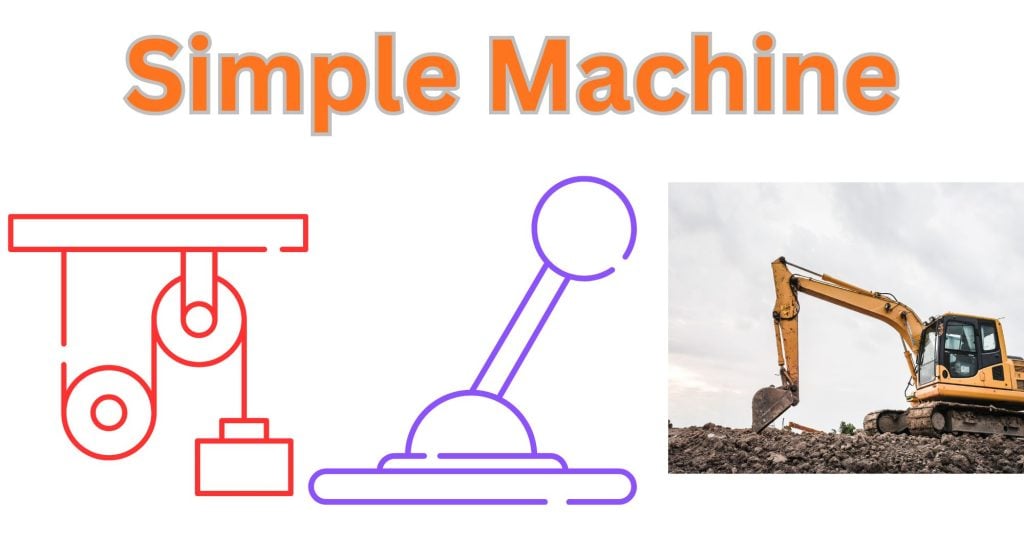
These tasks may be harder if we depend only on our bodies or hands. This is where simple machines come into play. Thus, simple machines are built to provide effort to our work. In physics, a simple machine is defined as a mechanical device that helps us to do our tasks more easily by reducing the effort we apply or by changing the direction of the applied force.
The physics of a simple machine is simple. These machines multiply the force applied, so we can perform our work more easily. It does not reduce the total work done; instead, it allows us to apply effort in a more convenient way. Simple machines are not modern concepts but were developed in the era of civilization. Before humans used tools like sticks, stones, and ramps to move heavy objects and perform daily tasks. However, the concepts of machines are modernized with technology, and the tasks are even easier and faster today.
Simple machines form the foundation of all complex machines. Every advanced machine, no matter how complicated it seems, is made up of combinations of simple machines. There are six main types of simple machines, and each of them helps us uniquely with its unique mechanism and working principle.
Principle and Working of Simple Machines
A simple machine is based on the “principle of work” in physics, which is given by:
Work = Force × Distance [Equation 1]
A simple machine does the same work but in a different manner. It changes the process of doing the work. For example, it becomes more time-consuming and exhausting to reach the top floor with stairs in tall buildings, but using a lift makes the process no longer exhausting and time-consuming. Here lift is a simple machine. Thus, machines reduce the amount of force needed to do a task.
Load x Load Distance = Effort x Effort Distance [Equation 2]
The work principle can also be looked at in this way:
- If we apply a lesser force, we must move the object over a greater distance.
- If we apply more force, the same object should be moved for a greater distance.
Simple machines operate mainly on two principles:
- Multiplying Force (Mechanical Advantage)
Some machines help us lift heavy loads by reducing the effort required. This is called mechanical advantage. - Changing the Direction of Force
Some simple machines change the direction of force applied, and hence, the work becomes easier to perform. For example, a pulley. When we use a pulley to lift a bucket from a well, we pull the rope of the pulley downward. On doing so without using a pulley, we have to pull the bucket upward. This change in direction makes the task more convenient. Thus, simple machines are the managers of performing work in our daily lives.
Types of Simple Machines
Classically, simple machines are divided into six major types. The categories are made according to the functioning of each class. The types of simple machines are given below:
Lever
A lever pivots around a fixed point. It is a rigid bar whose rotating point is called the fulcrum. It is the most common simple machine used for lifting loads. It multiplies the force to be applied and can lift the load easily. Here, the force applied is called the effort. A lever is also further classified into three different forms:
First-class lever: In this class, the fulcrum or the pivoting point lies in the middle of the load and the effort. A suitable example is the see-saw.
Second-class lever: In this class, the load lies between the fulcrum and the effort. A common example of this class is a wheelbarrow.
Third-class lever: In this class, the effort lies between the fulcrum and the load. The common examples are a lemon squeezer, a tong, or a tweezer.
Pulley
A pulley is a simple machine with a wheel and a rope. The rope is adjusted such that it passes through the grooved rim of the wheel. It makes our tasks easier by changing the direction of the force to be applied. Pulleys are also of different types, having simple to multiple uses.
There are different types of pulleys:
- Single fixed pulley: It is used to change the direction of force and make our work convenient.
- Movable pulley: It multiplies the force to be applied and makes us work easily.
- Compound pulley: Both of the above advantages, like changing the direction of force and multiplying the force, can be done with a compound pulley.
Examples include wells and cranes.
Inclined Plane
An inclined plane is a plane of a surface that is tilted at some angle to move objects easily. Thus, the tasks of lifting heavier loads are made simple by an inclined plane, by rolling or sliding any object required to move up or down. For example, the sloping of roads.
Wheel and Axle
This machine consists of a large wheel attached to a smaller axle. The axle rotates when we turn the wheel, and hence the force can be reduced. As the principle of work, when the distance over the effort is increased, our effort reduces. The various examples are doorknobs, bicycle wheels, etc.
Wedge
When two inclined planes are joined, a wedge is formed. It is used to split, cut, or break objects. When force is applied to the wide end, it gets concentrated at the sharp edge. For example, a knife, an axe, etc.
Screw
A screw is a simple machine wrapped around a cylinder. It is used to fasten objects together or lift loads. It helps to change the rotational motion into linear motion. For example, bolts, jar lids, screw jacks, etc.
Efficiency and Velocity Ratio of Simple Machines
When studying simple machines, two important concepts are efficiency and velocity ratio.
Efficiency
Efficiency is the calculation of the reliability and proper functioning of a simple machine. Thus, we can say efficiency means the amount of input work converted into useful output work. It is given by:
Efficiency = (Output Work / Input Work) × 100%
In real life, no machine is 100% efficient because some energy is always lost due to friction, heat, or other factors.
Velocity Ratio (VR)
Velocity ratio is the ratio of the distance moved by the effort to the distance moved by the load.
VR = Distance moved by effort / Distance moved by load
It helps us understand how much a machine multiplies movement.
Mechanical Advantage (MA)
Mechanical advantage is the ratio of load to effort:
MA = Load / Effort
Efficiency can also be written as:
Efficiency = (MA / VR) × 100%
These concepts help us measure the performance of simple machines.
Examples of Simple Machines in Everyday Life
Simple machines are like our helping hands in daily lives. The most common simple machines are:
- A knife is commonly used in kitchens for cutting vegetables.
- Scissors are used to cut paper, clothes, fabrics, etc.
- A tong is used to take out hot items from the fire.
- A slope or a ramp is used to load heavy goods, such as in trucks.
- A wheelbarrow is also called a load-carrying vehicle, as it is easier to carry heavy loads on it.
- A single pulley is used in wells to take out water. Compound pulleys are used in industries for various functions.
- A screwdriver is used to tighten screws.
- Ladders are used to climb on poles or upper surfaces.
- Elevators are used to move up or down more easily than going through longer stairs.
Simple machines are found in every corner of the world and used accordingly.
Applications of Simple Machines
Simple machines are widely used in many fields. Some important applications include:
Construction Work
Machines like cranes, pulleys, and inclined planes are used to lift and move heavy materials.
Transportation
Wheel and axle systems are used in vehicles to make them move smoothly.
Agriculture
Farmers use tools like ploughs, sickles, and carts, which are based on simple machines.
Household Activities
Simple machines are used in daily tasks such as cooking, cleaning, and repairing.
Industry
Factories use complex machines based on simple machines to increase their production.
These applications show how important simple machines are in making our work easier and more efficient.
Advantages of Simple Machines
Simple machines have countless applications and advantages. Some of them are given below:
- Reduce effort: They help in lifting or moving heavy objects easily.
- Save time: Work can be less time-consuming and can be completed faster.
- Change direction of force: Makes work more convenient.
- Increase efficiency of work: Helps us do our work more effectively.
- Easy to use: Simple machines are easy to operate and understand.
- Low cost: Most of the simple machines are inexpensive.
Because of these advantages, simple machines are widely used in everyday life.
Limitations of Simple Machines
Despite their usefulness, simple machines also have some limitations:
- Cannot reduce total work: They only make work easier, not less.
- Energy loss: Some energy is lost due to friction.
- Limited function: One machine cannot be used for all kinds of work, and hence, the use is limited.
- Maintenance required: Some machines need regular maintenance and care, which can also be expensive.
- Not always efficient: Efficiency is less than 100%.
These limitations remind us that while simple machines are helpful, they are not perfect.
Conclusion
Besides the fact that simple machines can do work faster, easier, and in a more convenient way than the manual way, they also have specific limitations. We need to be clear that they can only make the work easier, but not lessen it. They also might be sensitive, and we have to be more careful while using them. The techniques of using them should also be learnt properly because simple machines have a huge ranges lying from very simple to complex forms.
Keeping limitations aside, simple machines have also become a part of our lives. From a lemon squeezer to industries and transportation purposes, we heavily rely on machines. The various types of simple machines have also become the building blocks of complex machines and technologies. The work of lifting very heavy loads is also made easier with appliances like hydraulic lifts. Simple machines are ancient inventions and just passing with time, being more modernized as per the demands of time.
The working principle of simple machines should be understood properly to know the mechanism of every machine. Thus, we can use them smoothly in our daily lives. The limitations seem to be smaller when we come to the advantageous sides of them. Hence, we can rely on simple machines to meet our life standards with easy functioning of work.
References
- Patterson, J. (2025). Simple Machines. Publifye AS.
- Pryce, R. (2022). 8.5 Simple Machines. Introduction to Biomechanics.
- Dotger, S. First-class levers illustrate the principles of work.
- https://www.sciencefacts.net/simple-machines.html
- https://en.wikipedia.org/wiki/Simple_machine
- https://www.bing.com/search?q=simple+machine&form=ANNTH1&refig=69be07bd4c0740269d0c000df8ea1d91&pc=U531
