
What is Speed in Physics?
Speed is what we take the measurement of distance with respect to time. Whenever we talk about motion, we are interested to see the rate at which the object covers a certain distance. This rate is known as “speed” in physics. It quantifies motion according to time. Since, time related calculations are the most fundamental approaches in physics, it becomes a building block of mechanics. For example, the maximum speed of a runner in comparison with another makes him the fastest. When we buy a car or a bike, we check its mileage which means the distance travelled by car/bike in kilometers per unit time period.
Newton’s second law was for the calculation of motion contained by a moving body i.e. momentum. It also talks about the rate of change of momentum which is zero for constant speed. Hence, the concept for the speed calculation was also given by Newton. All the three laws are the laws of motion hence speed is the root of Newton’s law. For an object moving with uniform speed, we can also conclude that the object is acted upon by no force (as per Newton’s first law).
Speed is a scalar quantity. It solely depends upon the distance travelled and time but not the displacement. Hence, it doesn’t consider the direction of a moving object. Therefore, it is the normal magnitude calculation of the rate at which a body travels.
SI Units of Speed and Common Conversions (m/s, km/h, mph)
The SI system (International System of Units) has also assigned a respective unit to speed. The worldwide used unit in common is meter per second (m/s). However, according to usage, other units like km/h, mph etc. are also used in practice.
SI Unit: Metre per Second (m/s)
When speed is calculated with the help of distance measured in meters and time in seconds, the unit is called meter per second (m/s). Similarly, if the object covers 1 meter distance in 1 second, the object’s speed is said to be 1 m/s.
1 m/s=1 meter/1 second
Other Common Units of Speed
- Kilometer per hour (km/h)
It is most famous in transportations. The speed of buses, cars or motorcycles are calculated in km/h. It takes distance in kilometers and time in hours. Therefore, it denotes how many kilometers a transport system travels in an hour. - Miles per hour (mph)
It is generally used in European countries and the United States. Here distance is measured in miles and time in an hour. So, the speed is obtained in miles per hour (mph). It indicates how many miles a transport system travels in one hour.
Conversion Between Units
The basic idea of inter-conversion of speed units is required to figure out many data, problems or indications correctly.
1 km = 1000 m
1 mile = 1609 m
1 mile = 1.61 km
1 h = 60×60 = 3600 s
- 1 m/s = 3600/1000 = 3.6 km/h
- Similarly, 1 km/h = 1×1000/3600 = 0.2778 m/s
- 1 mph = 1609/3600 = 0.447 m/s
- 1 mph = 1.61/1 = 1.61 km/s
The Speed Formula: How to Calculate Rate of Motion
We have a simple calculation of speed, based on the formula:
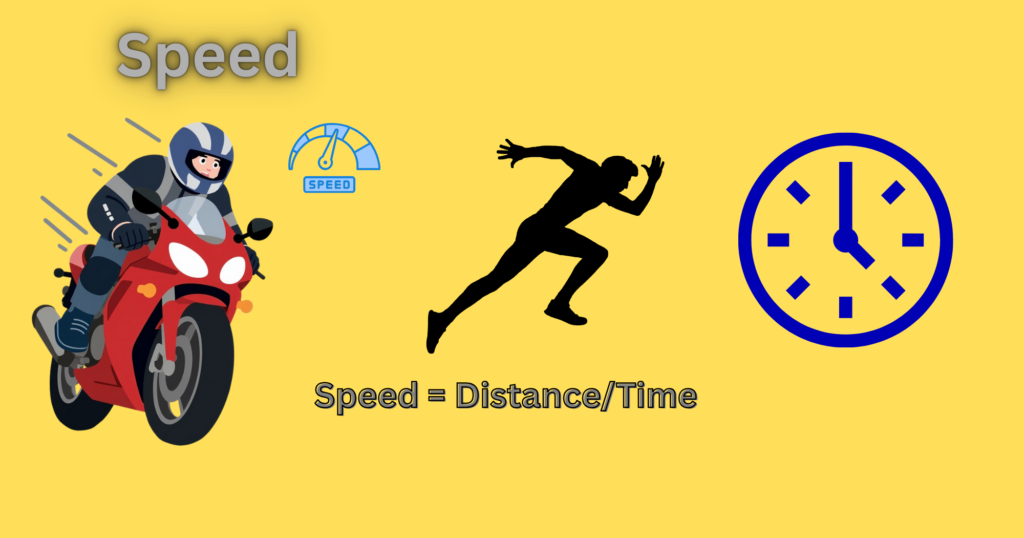
Speed = Distance/Time [Equation 1]
Here, distance means the total length of a path covered by the moving object and time means the time taken by the object to move through that path.
Equation (1) shows that speed is directly proportional to the distance travelled and inversely proportional to the time. Therefore, an object covering a larger distance in a short time interval means the speed is greater and vice-versa.
Speed vs. Velocity: Understanding the Difference
Speed depends on distance for calculation. Hence, speed is a scalar quantity. It doesn’t give the direction of the object moving. Wherever the object goes, the total distance is added, hence the speed becomes always positive. It only gives the magnitude of the object, and we cannot know the position of that object on looking at that magnitude.
Velocity depends on displacement for calculation. Therefore, it becomes a vector quantity. Wherever the object moves, it only considers the initial and final position of the distance travelled. Therefore, velocity gives magnitude as well as tells the position of that object at the given time period. Thus, it covers detailed information about the router taken by an object during a motion. Thus, it gives both the magnitude and direction. Some key differences between speed and velocity are given below:
| Speed | Velocity |
| Scalar quantity Takes distance travelled and time for calculation Has magnitude only, direction not required Denoted simply by magnitude The value is positive for any motion | Vector quantity Takes displacement and time taken for calculation Has both magnitude and direction Denoted by an arrow sign on top of the magnitude It can be positive, negative or zero |
Average Speed vs. Instantaneous Speed: What Defines Them?
If an object is moving, it may have the same speed for all paths it takes or may have different speed at different time intervals. Therefore, the speed is also of two types: average speed and instantaneous speed.
- Average Speed
Average speed means the total speed where the distance covered is the net distance covered by the object and the time is the total time taken to cover that distance. For example, if a car first travels 20 m in 2 s and 30 m in another 2 s then the average speed will be,
Average speed = 20+30 / 2+2 = 50/4 = 12.5 m/s
Thus, whatever the changes be in the speed during a motion, average speed gives that one magnitude in average of all motion throughout.
Instantaneous Speed
If an object is moving with various speeds at different time intervals, then taking a particular speed at a particular instant of time gives the instantaneous speed. In the above example, if we take only 20 m distance travelled at the instant of 2 s then it is called its instantaneous speed. The speedometer works on the concept of instantaneous speed and shows the right speed at that moment.
Uniform and Non-Uniform Speed Explained
Uniform Speed
If an object has the same speed throughout the motion i.e. the speed doesn’t change with time, then the speed is called the uniform speed. For example, the minute hand of a clock moves at a constant speed. The earth also rotates around the sun with a uniform speed. For uniform speed, the object travels equal distance for an equal interval of time.
Non-Uniform Speed
If the speed of an object fluctuates during a motion i.e. it doesn’t remain the same, then the speed is called non-uniform speed. Here, the speed of the object keeps changing and hence, different magnitudes of distances may be travelled at same or different time intervals. Most of the motions in daily lives are non-uniform. For example, the speed of a vehicle, speed of a walking or a running man etc.
Interpreting Distance-Time Graphs: Calculating Speed from Slope
The speed of an object can also be calculated by its constituent variables. Therefore, we can represent the motion of an object with the help of distance and time. Such a graph is called the distance-time graph. Here, distance is kept along the y-axis and time is kept along the x-axis. Hence, we can picturize the motion with the help of this graph. One can clearly understand the motion with the help of this graph.
Slope of the Graph
The slope of the graph is calculated as.
Slope = Change in y/ Change in x
I.e. change in distance/change in time
Therefore, the slope of the distance-time graph gives the speed.
Types of Graphs
- If the graph is obtained as a straight line, we can say that the speed is uniform. This type of graph has a constant slope.
- If the graph shows ups and downs or gives a curved graph, then we say that the speed is non-uniform. Here, the slope will also be varying.
- If the graph is a horizontal straight line, then we say that the object is not showing any motion.
Relative Speed: Motion Considerations Between Two Objects
When two objects are moving, they can also view their speeds with respect to their motion. Such speed is known as relative speed. The technique to calculate their relative speed is given below:
- For objects moving in the same direction we have,
Relative Speed=∣v1−v2∣ [Equation 2]
- For objects moving in opposite directions we have,
Relative Speed=v1+v2
It is a very important concept of speed as every object is found to be somewhat in motion. This helps to analyze two motions like in collisions, overtakes and other reference frames.
Measuring Speed: Speedometers, Radar Guns, and Technology
- Speedometers
Speedometers are commonly used in vehicles to measure instantaneous speed. They work using mechanical, electrical, or digital systems. It helps to guide the driver by displaying his speed and imply safety measures at that speed.
- Radar Guns
Radar guns measure speed by using the Doppler effect, commonly used by traffic police and in sports.
- Modern Technology
- GPS systems calculate speed using satellite data
- Smartphone apps track speed during travel
- Sensors and cameras are used in scientific experiments
Advances in technology have made speed measurement more accurate and reliable.
Conclusion
Speed may look like a simple calculation, but it has a huge concept to describe any motion. The principle of physics lies on motion and hence on speed of the objects. It simply describes a motion with its magnitude. Being a scalar quantity, unfortunately it cannot say anything about the object’s direction. The unit and inter-conversions are also important not only for numerical solutions but also to tackle daily circumstances. Hence, it is a basic concept lying behind the walking of a man to the rotation of planets.
In physics, the graphical analysis of motion has also a lot of importance. Not only in physics but also in other realms like engineering, chemistry, medical science etc. all require dealing with general knowledge of motion and speed. The measurement of speed and speed comparisons are done generally from creatures to machines. Hence, it covers all the universe with its simple calculation nature.
References
Duffy, E. (2009). The speed handbook: Velocity, pleasure, modernism. Duke University Press.
Pinney, C. P., Baker, W. E., Webster, J. G., & Eren, H. (1999). Velocity measurement. Boca Raton, FL: CRC Press.
Hauer, E. (2009). Speed and safety. Transportation research record, 2103(1), 10-17.
https://en.wikipedia.org/wiki/Speed
https://www.aakash.ac.in/blog/what-is-speed-definition-types-applications-formulas
