
What is Velocity?
Velocity is a concept of speed but adding direction in it. Hence, it is more precise and actual information about a motion. In physics, velocity is the variable depending upon displacement and is defined as the rate of change of displacement of an object in motion, with respect to time. Since, displacement is a vector quantity, velocity is also a vector not only giving the magnitude of the rate of motion but also describing, in what direction the object is going. It is denoted by ‘v→’, or the arrow sign is mostly given just above the magnitude. This is done to show that the given quantity is a vector. All other important physical quantities like acceleration, force, work done, power, energy etc. are derived from a single physical quantity i.e. velocity. Hence, this is the fundamental term in physics.
The numerical value of velocity also includes direction mentioned in it. Hence, velocity gives the complete information about any motion. From one statement we will be clear about any motion. Direction is essential in velocity as it makes velocity a vector quantity.
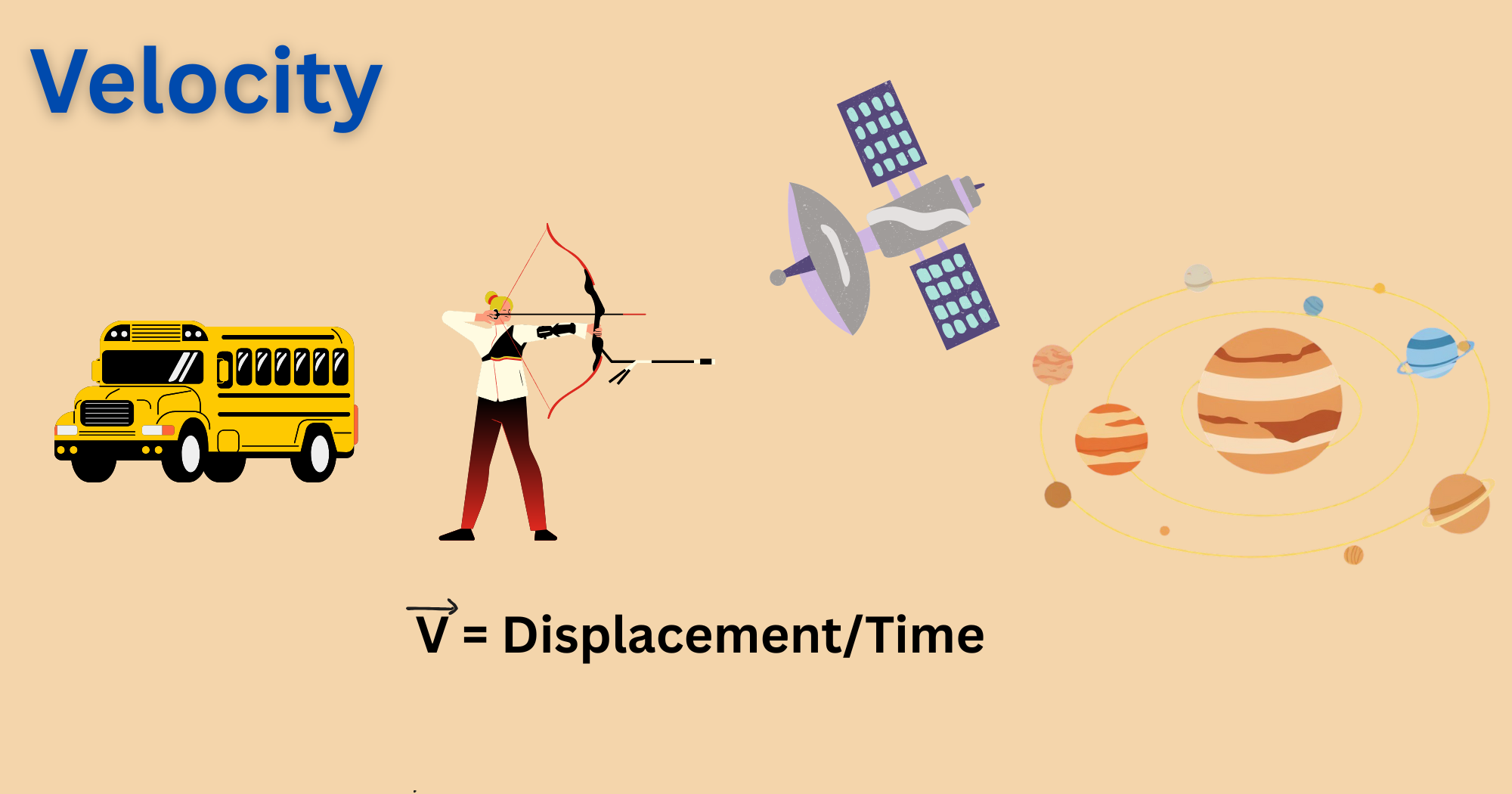
Various real life experiences to complex scientific applications are based on velocity. For example, daily activity like a walking man, a moving vehicle to complex gravitational phenomena like velocity of satellite, angular velocity, orbital velocity, escape velocity etc. are the calculation of the simple term “velocity”. Hence, the position of an object, prediction of its motion, momentum gained by the body everything can be calculated by using this concept.
SI Units of Velocity and Dimensional Formula
The globally accepted unit i.e. the SI unit of velocity is meter per second (m/s). Simply the 1m/s velocity of an object in a fixed direction is the 1 meter of displacement made by the object in that particular direction. There are also other beneficial units of velocity which are kilometer per hour (km/h), centimeter per second (cm/s), meter per minute (m/min), miles per hour (mph) etc. However, in physics and other technical subjects, the SI system is usually followed to make the information uniform and consistent.
Dimensional Formula of Velocity
As per the definition, velocity is given as:
Velocity = Displacement/Time [Equation 1].
Dimensional formula means to express the given variables only in terms of mass, length and time as [M], [L] and [T] respectively. From the formula as distance is measured in meters, we can write it as [L] and time as [T]. Since [L] is in numerator we write it with positive power and [T] being in denominator, we write it with negative power. Finally, the dimensional formula for velocity becomes, [LT−1].
This dimensional representation is extremely useful in physics. It helps in:
- Checking the correctness of equations
- Converting units
- Deriving relationships between physical quantities
However, by looking at this dimensional formula we cannot know the direction followed by the motion.
Speed vs. Velocity: Key Differences and Similarities
Speed and velocity terms are confusing topics as they look similar. However, one is a vector and another is a vector. So, huge differences lie in both concepts.
Speed is related with the distance while velocity is related with the displacement. Since distance being a scalar and displacement being a vector, speed is a scalar quantity while the velocity is a vector quantity. Speed doesn’t care about the position of that object and just keeps adding the path. Hence, velocity becomes more accurate by adding direction in it.
Some key differences are pointed below:
| Speed | Velocity |
| Depends on distanceDoesn’t take directionScalar quantityAlways positive | Depends on displacement.Takes direction alsoVector quantityCan be negative, positive or zero |
Similarities
- Both describe motion.
- Both have the same units.
- Both can differ with respect to time.
Calculating Velocity: The Formula Using Displacement and Time
From the definition it is clear that velocity is calculated as:
Velocity = displacement / time taken [Equation 1
From equation (1) we can conclude that velocity is directly proportional to the displacement but inversely with the time taken. Therefore velocity increases if the displacement is greater in comparison between two moving objects. Similarly, it is inversely proportional with the time taken and hence slower moving objects will have greater velocity than the faster objects.
Variable Velocity
If displacement changes unequally in equal intervals of time, velocity is said to be variable.
The formula can be used in one-dimensional motion as well as in two-dimensional motion using vector methods. In higher dimensions, displacement and velocity are found by resolving them as vectors, by using horizontal and vertical components of the vector along different axes.
Velocity can also be positive, negative or zero as per the situation and according to the vector rule of addition.
- Positive velocity: when the object is moving in same chosen direction
- Negative velocity: when the object is moving in the opposite direction then the chosen direction
- Zero velocity: if the object is at rest
However, the choice of the direction is made accordingly. It also differs according to the frame of reference.
Types of Velocity: Uniform, Non-Uniform, and Variable
Velocity can be classified into different types based on how it changes with time.
Uniform Velocity
It is the condition when velocity of a moving object remains constant throughout the motion. Both magnitude and direction will be the same during all motion. This is an ideal situation which is difficult to obtain in real life. Due to the contact forces, gravity and also air resistance the magnitude and direction of motion are affected highly.
Non-Uniform Velocity
If displacement changes unequally in equal intervals of time, velocity is said to be variable. This is the case we interact in our everyday circumstances.
Variable Velocity
Variable velocity is a broader term that includes all cases where velocity changes with time. The change can be due to:
- Change in speed
- Change in direction
- Change in both speed and direction
In circular motion, the speed may be constant throughout the motion but the direction keeps changing continuously. This gives the centripetal acceleration to hold the motion.
Average Velocity vs. Instantaneous Velocity Explained
For a motion, it is not necessary to have the same velocity for all paths and directions taken by an object at different time intervals. Therefore the velocity is also of two types: average velocity and instantaneous velocity.
- Average Velocity
Average speed means the total velocity where the displacement is the total displacement of the object and the time is the total time taken for that displacement. Thus, whatever the changes in the speed during a motion, average velocity gives that final magnitude of the motion is the respective direction.
- Instantaneous Velocity
If an object is moving with various velocities at different time intervals then taking a particular velocity at a particular instant of time gives the instantaneous velocity. Thus, we can accurately say in which particular direction and at what instant, the object has a maximum or a minimum velocity, by analyzing a motion.
Mathematically:
Instantaneous Velocity = Δt→lim0 Δx/Δt [Equation 2]
This concept is used widely in advanced physics, real-world applications and various other realms.
Some key differences are:
- Average velocity is calculated over a time interval while instantaneous velocity is the velocity of a specific moment of the whole time interval.
- Instantaneous velocity can change continuously, while average velocity is a constant value.
Interpreting Position-Time Graphs: Slope and Velocity
Position-time graphs are the graphs made by taking different positions of a moving object at various time periods. In graphical methods, time is kept along the x-axis and position (or displacement) is kept along the y-axis.
Slope of the Graph
Slope of the graph is calculated as:
Slope = change in y-axis / change in x-axis
In the position-time graph, as x-axis represents time and y-axis represents position, the magnitude of slope becomes, change in position / change in time. Therefore, the slope of a position-time graph represents velocity of that motion.
The nature of the graph describes the type of motion.
- If the graph is a straight line with positive slope, it means that the velocity is constant and positive.
- If the graph is a straight line with negative slope, it means that the velocity is constant but negative.
- A curved line indicates changing velocity
- If we obtain a horizontal straight line then we conclude that the object is at zero velocity or at rest.
The steeper slope represents the greater magnitude of the velocity.
Thus, it is one method to understand motion visually and more clearly.
Relative Velocity: Motion in Relation to a Moving Frame
When two objects are moving, they can also view their velocities as per their motion. Such velocity is known as relative velocity. Since the frame of reference to view a motion may be different, this concept is very important to describe a motion.
Suppose, two objects A and B are in motion. The velocity of A relative to B is given by:
vAB→ = vA→ − vB→ [Equation 3]
Relative velocity is commonly used in:
- Trains and cars moving on roads
- Boats crossing rivers
- Aircraft flying in wind
- Spacecraft motion
Relative velocity is a daily experienced quantity. As, earth itself is moving continuously around the sun, everything is in motion if viewed from another reference frame. Thus, the concept of relative velocity is important from classical to quantum mechanics or solving the problems of General or Special Theory of Relativity.
Real-World Examples: Velocity in Circular Motion and Projectiles
- Linear Motion
Various linear motions like the motion of us while walking, the motion of transport systems etc. are related to velocity in one-dimensional motion. It is simple to analyze then other complex two-dimensional. Three-dimensional or circular motions.
- Circular Motion
In circular motion, the object in motion has an angular displacement and hence an angular velocity. Hence, although the speed is uniform, the velocity changes due to the change in direction. The motion of clocks, fan blades, motors or even the motion of planets is governed by this concept of velocity along circular motion.
The velocity is always tangential to the circular path. This change in velocity gives rise to centripetal acceleration and hence centripetal force that holds the motion.
- Projectile Motion
Projectile motion means the motion of any object thrown in air and moves only under the effect of gravity. Thus, it is a two-dimensional motion. For two-dimensional motion, vector rules are used and hence the velocity is resolved into vertical and horizontal components. The horizontal velocity is associated with the horizontal range covered by the object and is always constant. However, the vertical velocity arises due to gravity and hence changes accordingly.
The resultant is obtained by the combination of these components. It is found that a projectile always follows a parabolic path. Some examples may include a ball thrown making an angle with the ground, a bullet fired from a gun etc. Hence, velocity plays a great role in finding the range covered, maximum height attained and the time of flight by that object.
Conclusion
Confusion always lies between velocity and speed, but both are different concepts. Velocity and speed can be called the same if the object keeps moving in a straight line without changing its direction. Velocity always gives the true measurement by always stating its position together with the magnitude. It is a fundamental quantity to make further complex calculations of a motion. All other quantities like energy, momentum, force, acceleration etc. depend on velocity. The escape velocity for a satellite or a rocket is a significant application of velocity in physics and engineering. Newton’s laws of motion and Kepler’s laws of planetary motions are the examples which make the use of velocity to describe the velocity of a smaller moving object to the motion of planets.
From real-life to advanced applications velocity is a basic concept. The analysis of velocity is a base for any physical calculations. For the correct calculations, good unit inter-conversion knowledge is also equally important. Graphical analysis is a better method to analyze a motion and interpret for classroom presentations. To sum up, velocity has always become a foundation of mechanics and the core of physics.
References
Duffy, E. (2009). The speed handbook: Velocity, pleasure, modernism. Duke University Press.
Pinney, C. P., Baker, W. E., Webster, J. G., & Eren, H. (1999). Velocity measurement. Boca Raton, FL: CRC Press.
Hauer, E. (2009). Speed and safety. Transportation research record, 2103(1), 10-17.
https://en.wikipedia.org/wiki/Velocity
https://www.geeksforgeeks.org/physics/velocity
https://byjus.com/physics/velocity
