
Introduction to Wedge (Simple Machine)
A wedge is a very common and useful simple machine in everyday life. It has been used as a basic pocket device since ancient times for cutting, splitting, and holding purposes. The simple machine is made by combining two inclined planes back to back. This forms a sharp edge at one end and a blunt face on the other end. Thus, in everyday life, it is a basic requirement either in a kitchen or on construction sites.
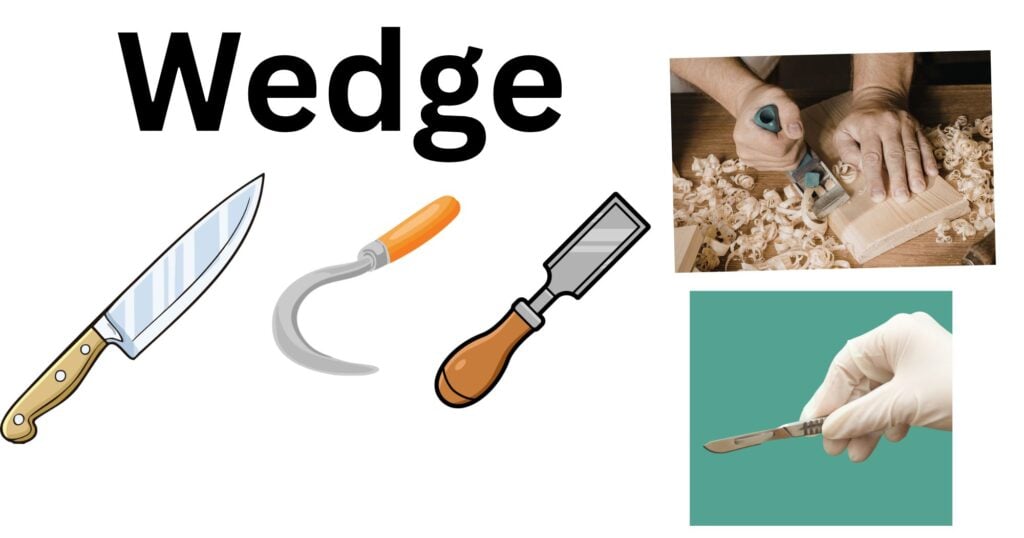
Generally, force is applied to the blunt end of the wedge. This force acts on both the inclined sloping surfaces. Hence, a material can be separated or pushed apart. For example, while using an axe to cut a log, the sharp edge of the axe is the wedge that splits the log into two halves. Hence, it has been used from ancient times to make firewood, clear bushes, build shelters, and hunt prey. Several other uses of the wedge make it a compulsory tool in daily life.
Today, advanced types of wedges are seen around us, like the nails, blades, chisels, etc. However, they all lie under one roof, i.e., a wedge, whose working is the same as that of ancient wedges. These wedges are also termed as simple machines because they make our work easier by reducing the effort to perform a task. It is to note that the load is not reduced here but is made more manageable by changing the direction of force.
Besides household purposes, wedges can also be seen in various fields like construction, agriculture, and medicine. Their simple design, versatility, reliability, and durability make them famous worldwide.
Structure and Parts of a Wedge
To understand the working of a wedge, every part must be studied carefully. The important parts forming a wedge are given below:
Inclined Surfaces
A wedge consists of two inclined planes joined together. These sloping surfaces are responsible for directing the applied force sideways. When force is applied, these surfaces push against the material and create separation.
Sharp Edge (Tip)
The sharp edge is the most important part of a wedge. It is the sharp or pointed end that is kept in physical contact with the material or the load. As the area of this end is kept very small, the force applied becomes highly concentrated. The concentrated force helps in cutting or splitting the materials easily.
For example, a sharp knife can cut or chop the vegetables easily..
Base or Thick End
The base is the blunt part of the wedge. It is the thicker part where we apply the effort. When you hit or push this part, the force spreads through the inclined plane towards the sharp edge, and we can split the material. Hence, it is also an important part of the wedge that cares about how much effort is given.
Length of the Wedge
The length of the wedge is the distance from the blunt part to the sharp part. As in other simple machines, a longer distance is kept between the two edges. Since a greater distance means the effort is divided, this reduces the effort to be applied.
Angle of the Wedge
As a wedge is made by combining two inclined planes, the angle between the two inclined surfaces is called the wedge angle. This angle is the main parameter that determines how sharp or blunt the wedge is. A smaller angle means a sharper wedge, which is more effective for cutting. On the contrary, a larger angle means a blunt wedge and is less effective for cutting.
All these parts function equally to form a wedge and have their own significance. The wedge can be designed as per the requirement by adjusting these parts.
Principle and Working of a Wedge
The principle used in a wedge is the transfer of force. When force is applied to the base or the blunt part of the wedge, the sloping surface spreads the force further. Through these inclined surfaces, the force reaches the pointed edge. These inclined surfaces further cause the materials to separate.
Working Mechanism
- Effort is given to the blunt edge of the wedge.
- The force penetrates downward towards the sharp edge.
- The inclined surfaces exert outward forces on the material.
- The material is pushed apart or cut.
One thing to notice is that the force given not only pushes the material but also makes it move sideways. Hence, the material is split easily.
Force Multiplication
The wedge can multiply force. Maintaining a larger distance between the two edges will make a smaller force seem larger over a small area. This makes wedges essential tools for cutting hard materials like heavy logs, metals, etc.
Mechanical Advantage
The mechanical advantage is the ratio of load to effort, which means the mechanical advantage is directly proportional to the load and inversely proportional to the effort applied. The mechanical advantage of a wedge depends on its shape. Since a small effort applied for a larger distance can lift a heavy load. The ratio of load to effort becomes greater. Hence, to obtain the larger mechanical advantage, a longer and sharper wedge should be used.
Increasing the mechanical advantage also means getting maximum efficiency
(Efficiency = Mechanical Advantage/Velocity Ratio)
However, friction between the edge and the material can reduce the efficiency of the wedge.
Wedges can be made highly effective by reducing this friction.
Relationship Between Force, Length, and Angle of a Wedge
There are certain factors to be concerned about to make the wedge effective, which are given below:
Force
The force applied to the blunt edge determines how easily it can cut or split a material. A greater force results in greater splitting action. However, the design of the wedge can reduce the amount of force required.
Length of the Wedge
The length of the wedge is a major parameter to increase the efficiency of a wedge. A longer wedge allows the force to act over a greater distance, which reduces the effort needed.
- Longer wedge → Less effort required
- Shorter wedge → More effort required
This is why tools like axes are designed with a longer wedge shape.
Angle of the Wedge
The angle between the inclined surfaces affects both sharpness and strength.
- Small angle → Sharper wedge, easier cutting
- Large angle → Stronger wedge, harder cutting
Combined Effect
All three factors work together:
- A long wedge with a small angle requires less force but may be weaker.
- A short wedge with a large angle is stronger but needs more force.
Therefore, wedges are designed based on their specific use. A balance between sharpness and strength is necessary for efficiency.
Examples of Wedges in Everyday Life
Some common examples of wedges are given below:
Knife
A knife is one of the most common examples of a wedge. It is used for cutting food, paper, and other materials. The sharp edge easily slices through objects.
Axe
An axe is used to chop wood. It has a thicker wedge shape compared to a knife, which helps in splitting logs.
Chisel
A chisel is used in woodworking and carving. It allows precise cutting and shaping of materials.
Nail
A nail acts as a wedge when driven into wood. It pushes the wood fibers apart to create space for itself.
Needle
A needle has a pointed tip that helps it pass through fabric easily. It is a fine example of a wedge used in sewing.
Doorstop
A doorstop is used to hold a door in place. It prevents movement by creating friction between the door and the floor.
Blade
Blades used in razors, scissors, and machines are wedges designed for cutting.
Applications of Wedges
Wedges are used in many fields due to their versatility and efficiency.
Construction
In construction, wedges are used for cutting materials like wood, stone, and metal. Tools like axes and chisels are essential for building structures.
Agriculture
Farmers use tools like ploughs and hoes to prepare soil and harvest crops.
Medical Field
In surgery, sharp instruments like scalpels are used to make precise cuts.
Household Uses
In homes, wedges are used in kitchen tools, doorstops, and cutting instruments.
Industrial Applications
Machines use wedge-shaped components for cutting, splitting, and shaping materials.
Safety and Rescue
Wedges are used to break doors, cut through debris, and rescue people during emergencies.
Advantages of Wedges
Wedges offer many benefits that make them widely used.
Simple Design
Wedges are simple and portable. Hence, they are easy to design and use.
Efficient Cutting Tool
They can cut and split materials easily, and hence less effort is required than doing the work manually.
Versatile
Wedges are versatile in nature as they can perform multiple tasks like cutting, splitting, lifting, and holding.
Durable
Wedges are mostly made up of steel, which is a very strong material, and make them durable.
Cost-Effective
They are affordable and can be easily repaired.
Time-Saving
Wedges help us to complete a task quickly, which helps to save time.
The helpful nature of wedges makes them a basic requirement of everyday life and evolving applications
Limitations of Wedges
Despite their usefulness, wedges also have some limitations.
Friction Loss
Friction between the wedge and the material reduces efficiency and requires extra force.
Wear and Tear
Frequent use of the tool can make it blunt, and it cannot work efficiently as before. Rust can also decrease the effectiveness of the tool.
Limited Precision
Some wedges are not suitable for tasks requiring high precision.
Material Dependency
Very hard materials may require stronger wedges and more force.
Risk of Damage
Improper use of the tool can damage or break the simple machine.
Safety Concerns
Mishandling of the wedge can create a cut or a serious injury. It must be placed out of reach of children and non-professionals.
Conclusion
The wedge is a simple yet powerful machine for performing tasks. It has played a vital role from the day of civilization to recent advancements. From ancient stone tools to modern, precise instruments, wedges have remained a basic hand tool to reduce effort and do work easily. The basic and simple structure with just two inclined planes attached back-to-back can do a huge amount of cutting and splitting. The efficiency and reliability of a wedge are given by certain factors, such as its length, angle, and the effort applied.
From sewing needles to kitchen knives and construction tools to medical instruments, all rely on the principle of wedges. This wide range of demands and applications of wedges makes them a basic requirement for a house in some specialized fields.
Having some limitations, the advantageous side is far more weighty, and hence, the lagging points can be minimized. With proper handling, reducing friction, and effectively designing it, the simple machine can be very efficient to use.
To sum up, the wedge is a perfect example of a simple human concept that has an impactful usefulness. The nature and use of a wedge prove that it will last forever in its uses and applications.
Reference
- Patterson, J. (2025). Simple Machines. Publifye AS.
- Pryce, R. (2022). 8.5 Simple Machines. Introduction to Biomechanics.
- Dotger, S. First-class levers illustrate the principles of work.
- https://www.sciencefacts.net/simple-machines.html
- https://en.wikipedia.org/wiki/Simple_machine
- https://www.bing.com/search?q=simple+machine&form=ANNTH1&refig=69be07bd4c0740269d0c000df8ea1d91&pc=U531
- https://www.sciencefacts.net/wedge.html
- https://en.wikipedia.org/wiki/Wedge
- https://www.britannica.com/technology/simple-machine
- https://studiousguy.com/wedge-simple-machines-examples/
