
Introduction to Wheel and Axle (Simple Machine)
A wheel and axle, another famous tool around us. It is a simple machine that has a large circular wheel, which is attached to a small cylindrical axle. The wheel and the axle rotate together around a common axis. This technique also helps in reducing the effort of moving the objects. Hence, it makes working efficient.
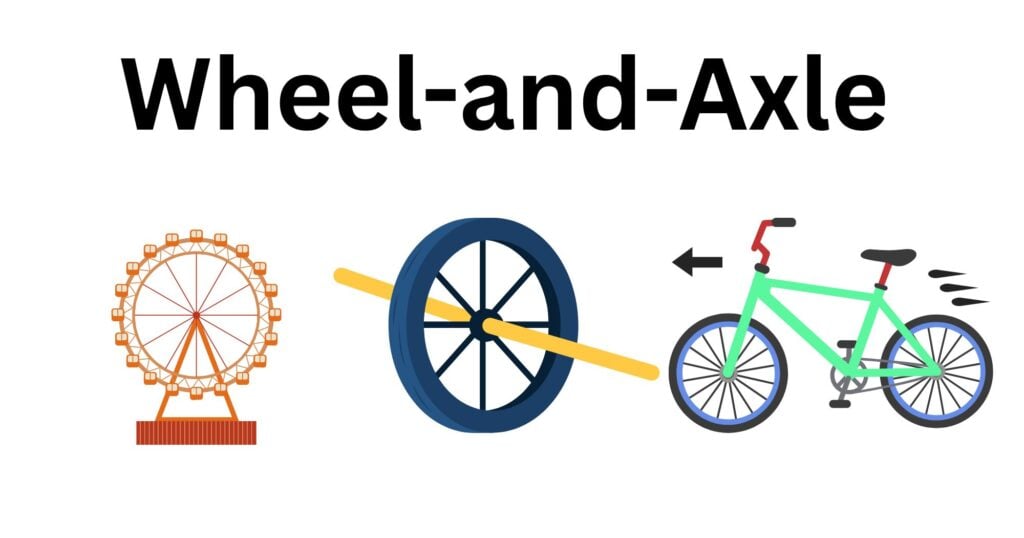
The wheel and axle system has been in practice for many years and is playing an important role in the field of transportation, production, machinery, and tools. It also helps in rotating and lifting objects. This simple machine multiplies the force and performs tasks easily. Hence, their use is done according to the type of work. It can increase the speed of doing work and can also multiply the force. In a wheel and axle, the effort is applied to the wheel and the load to the axle. As the wheel rotates, the axle also rotates. This rotation of the axle helps to move the load.
Ancient carts are simple examples of a traditional wheel and axle. It is a versatile and efficient form of a simple machine. It is also the foundation for many other complex machines. Thus, their understanding is very important in physics, engineering, industries, and everyday circumstances.
Parts of a Wheel and Axle System
A wheel and axle are made up of some important components, which are given below:
- Wheel
The wheel is the larger circular part of the system. It is always made with a larger radius. Since the distance is now increased, the effort will be reduced, and hence it is easier to apply effort to the wheel. For example, a steering wheel in cars or other vehicles. Here, the driver applies force to the wheel to turn the vehicle. - Axle
The axle is a small rod-like structure and cylindrical in shape. It is attached to the center of the wheel. As the wheel rotates, the axle also rotates. This movement helps to transfer the force to the load. The axle can also be connected to other parts of the machine - Shaft or Rod Connection
The shaft is also a type of axle. It connects different parts of a machine. Therefore, it functions like an axle and transfers the force given to all the parts of the machine. - Load
The load is the object on which the force has to be applied, either for moving or lifting. It is usually connected to the axle. The simple machine helps to perform tasks on the load in a simpler, more efficient, and more comfortable manner. - Effort
Effort is the force required to lift or move the object or load. Hence, it is applied to the wheel or the axle in a wheel-and-axle system. In general, if force is to be multiplied, the effort is given to the wheel because of its greater radius, and the force can be distributed. However, if we just want to increase the speed of doing the work, we apply effort to the axle.
Every part is equally important in the system of the wheel and axle. A defect in any one part can reduce the system’s efficiency.
Principle and Working of the Wheel and Axle
The wheel-and-axle system is based on the theory of rotational motion in physics. Its simple mechanism is such that a wheel can move a larger load that is attached to an axle. The greater the radius of the wheel, the more it will be required to overcome the load. Also, for this, the radius of the axle must be very small.
As the wheel and the axle are attached, when the wheel is rotated, the axle also rotates around the central axis of the wheel. Hence, their simultaneous motion creates a force that is able to move the heavy objects.
The main thing to remember is the distance between the load and the effort. The greater distance of effort than that of the load distributes the force along the distance, and hence the manual effort gets reduced.
The operation of the wheel and axle can be described in two ways:
Force Multiplication
When effort is applied to the wheel, the system multiplies the force and makes it easier to lift or move heavy loads. This is commonly seen in devices like windlasses and winches.
Speed Multiplication
When effort is applied to the axle, it allows the wheel to cover a larger distance in less time. This increases speed rather than force. A common example is a bicycle. Here, speed and, hence, motion of the bicycle are more important than load lifting.
To understand the concept of the wheel-and-axle system more clearly, the sizes of the wheel and the axle are very important to understand. Always a greater diameter of the wheel and a smaller diameter of the axle is preferred. This gives greater mechanical advantage and hence a greater efficiency.
Velocity Ratio and Efficiency of the Wheel and Axle
The performance of a wheel and axle system can be understood using two important concepts: velocity ratio and efficiency.
Velocity Ratio (VR)
The velocity ratio in the wheel-and-axle is calculated as the ratio of the radius of its wheel to the radius of its axle. Since effort is applied in the wheel, the effort radius must be very large compared to that of the load or the axle where the load is connected. Thus, the velocity ratio in the wheel-and-axle measures the distance of the effort as compared to that of the load. A larger radius of the wheel and a smaller radius of the axle result in a greater velocity ratio. Mathematically, it is given as:
Velocity ratio (V.R.) = Radius of Wheel / Radius of Axle [Equation 1]
Mechanical Advantage (MA)
Mechanical advantage is the ratio of the load lifted to the effort applied. For an ideal machine, the mechanical advantage is equal to the velocity ratio. However, this cannot be maintained in practice because of the friction and other losses.
Efficiency
Efficiency is the ratio of the output work obtained to the given input. It is generally expressed in percentage and calculated as:
Efficiency = (Mechanical Advantage / Velocity Ratio) × 100
In an ideal system where the mechanical advantage is equal to the velocity ratio, the efficiency would be 100%. However, in practical situations, efficiency is always less than 100% due to friction between moving parts and other factors.
To get maximum efficiency, some practices for reducing friction can be done. This might include using better materials and proper use of lubricating agents.
Examples of Wheel and Axle in Everyday Life
Some daily life examples of the wheel and axle are given below:
Bicycle
A bicycle is a classic example of a wheel and axle system. The wheels rotate around axles, allowing smooth movement. The pedals and gears also use the principle of the wheel and axle to increase speed and efficiency.
Vehicles
All vehicles, including cars, buses, and motorcycles, use wheels and axles for motion. The engine provides power, which is transmitted to the wheels through axles. This enables the vehicle to move.
Door Knob
A doorknob is a simple example where the knob acts as the wheel, and the spindle acts as the axle. On turning the knob, the axle rotates and opens the latch.
Steering Wheel
In a vehicle, the steering wheel helps control direction. The large wheel allows the driver to apply less force to turn the smaller axle connected to the wheels.
Well Bucket
In traditional wells, a wheel is used to wind a rope around an axle to lift a bucket of water. This reduces the effort required to lift heavy loads.
Screwdriver
In a screwdriver, the handle acts as the wheel, and the shaft acts as the axle. Applying effort to the large handle helps to provide torque to the load through the shaft.
Applications of Wheel and Axle
The wheel and axle system is used in various fields. Some of its applications are given below:
Transportation
This simple machine is the most used simple machine in transportation. Vehicles rely on wheels and axles to move efficiently.
Lifting Devices
Machines like cranes, winches, and hoists use wheel and axle systems to lift heavy loads. They are used mostly in construction sites and industries.
Machinery and Engineering
Many machines that have rotating parts involved function according to the principle of the wheel-and-axle. For example, gears, turbines, motors, etc.
Household Tools
Our common household tools, like screwdrivers, faucets, and door handles, use the principle of the wheel and axle to function.
Agriculture
Some agricultural equipment, like carts and irrigation systems, uses wheels and axles to transport goods and water.
Energy Systems
In windmills and water wheels, the wheel and axle convert natural energy into mechanical energy. This energy can be used for generating electricity.
Advantages of the Wheel and Axle
There are several advantages of the wheel and axle in our tasks. Some advantages are given below:
Reduces Effort
It significantly reduces the force required to move or lift heavy objects, making work easier.
Increases Efficiency
With the use of the wheel-and-axle, we can perform our tasks more quickly and with less energy. This increases the working efficiency.
Versatility
It has simple to complex applications and hence can be used for simple household purposes to complex machinery.
Easy to Use
They have a simple design, and hence we can operate them easily even with low skills.
Durable and Reliable
If used carefully and with high maintenance, they can give good service and are durable.
Enables Smooth Motion
It makes movement convenient, smooth, and comfortable. Especially, in the transportation system, we can have motion at desired speeds.
Limitations of the Wheel and Axle
There are also some limitations of the machine, which are given below:
Friction Losses
Friction between the axle and its supports reduces efficiency and requires additional effort.
Wear and Tear
Using the machine continuously without rest can cause wear and tear on the machine. Some machines require high maintenance and repair costs.
Limited Mechanical Advantage
The mechanical advantage depends on the size ratio of the wheel and axle. If the difference is small, the advantage is limited.
Proper Alignment
A slight mistake in the alignment of different parts can reduce the efficiency of the machine. This can cause damage to the system.
Not Suitable for All Tasks
This simple machine is also made for a specific use. Hence, we cannot rely on it for all of our work.
Conclusion
A wheel-and-axle is very famous in today’s situation. It is widely used in transportation in the stirrer. Without transportation, the modern world would be impossible. Even a small screwdriver has the capacity to fix large machinery. From machinery to engineering and household to industries, wheel-and-axle has become an important part in every sector. Also, it is simple, durable, and reliable, which makes it the primary choice for performing any tasks.
To make its proper use, every part, working principle, like caring about the radius of the wheel and the axle, etc., must be well-understood. Thus, we can increase the efficiency of the machine. Some limitations can be maintained by reducing the friction generated in different parts. Taking all these factors into account, we can get maximum advantage from this simple tool. We can use it as per our needs to reduce effort or increase the speed of our task. As simple machines have become an integral part of our lives, we can take their full advantage with proper choice and understanding of them.
References
- Patterson, J. (2025). Simple Machines. Publifye AS.
- Pryce, R. (2022). 8.5 Simple Machines. Introduction to Biomechanics.
- Dotger, S. First-class levers illustrate the principles of work.
- https://www.sciencefacts.net/simple-machines.html
- https://en.wikipedia.org/wiki/Simple_machine
- https://www.bing.com/search?q=simple+machine&form=ANNTH1&refig=69be07bd4c0740269d0c000df8ea1d91&pc=U531
- https://www.sciencefacts.net/wheel-and-axle.html
- https://en.wikipedia.org/wiki/Wheel_and_axle
- https://www.britannica.com/technology/wheel-and-axle
