
Alkali Definition
Alkali is a basic soluble hydroxide of alkali metals or alkaline earth metals.
- These are strong bases that share most of the characteristics of bases like the formation of neutral salts with acids and the conversion of red litmus paper into the blue.
- The term alkali is derived from the Arabic work ‘al qally’ meaning calcined ashes indicating the original source of alkaline substances.
- Alkalis are generally distinguished from other bases on the basis of their solubility in water.
- Alkalis can be considered a subset of bases as these are bases that can be dissolved in water to produce OH– ions.
- Most alkalis are water-soluble, but some chemicals like barium carbonate are only soluble in acidic solutions.
- Different alkalis of industrial importance have been manufactured in industries. The most important ones being soda ash and caustic soda.
- These are essential in the production of glass, soap, and other chemicals used in textiles and metals.
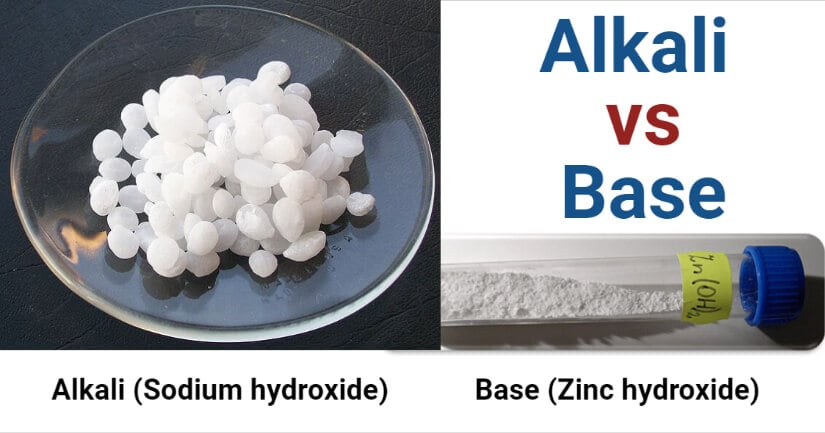
Image Source: Walkerma and Ondřej Mangl.
Base Definition
The base is a chemical compound that reacts with acids to produce salts. The definition of bases differs in different concepts.
- According to the Arrhenius concept, bases are substances that dissociate in an aqueous solution to form hydroxide ions.
- According to the Bronsted-Lowry concept, a base is a compound that can accept hydrogen ions.
- According to the Lewis concept, a base is a donor that can share a pair of electrons with an electron acceptor.
- Bases are defined by a group of characteristics that help differentiate them from acids. The pH of these substances is greater than seven, and these turn red litmus paper into blue.
- The base is a broader category of compounds that consists of alkali as a subset.
- Bases, except alkali, do not dissolve in water and mostly result in white precipitate in water.
- Most of the basic compounds are covalent compounds usually formed between metals and non-metals with similar valencies.
7 Major Differences (Alkali vs Base)
| Characteristics | Alkali | Base |
| Definition | Alkali is a basic soluble hydroxide of alkali metals or alkaline earth metals. | The base is a chemical compound that reacts with acids to produce salts. |
| Solubility | Alkalis dissolve in water to produce OH-. | Bases do not dissolve in water. |
| Relation | All alkalis are bases. Alkali is a subset of the base. | All bases are not alkali. |
| Reaction with acid | Alkali reacts with acids to produce OH- ions and accepts protons. | Bases neutralize the acid to form salt and water. |
| Compounds | Alkalis are carbonates and hydroxides of alkali metals. | Bases mostly are compounds with a hydroxide group or a lone pair of electrons. |
| Chemical category | Alkali is an ionic compound of Group I metals. | Bases can be ionic or covalent of metals from different groups. |
| Examples | Sodium hydroxide and potassium hydroxide are examples of alkali. | Zinc hydroxide and copper oxide are examples of bases. |
Examples of alkali
Sodium hydroxide (NaOH)
- Sodium hydroxide is a white solid ionic compound composed of a single sodium and hydroxide ion.
- Sodium hydroxide (also known as caustic soda) is soluble in water and releases hydroxide ions.
- It is a strong base that decomposed proteins and might even result in corrosion and burns on the skin.
- It neutralizes with acid to produce a significant amount of heat, enough to ignite combustible materials.
- It is used in laboratories and industries as a solid or diluted liquid and is often used to manufacture soaps, paper, and petroleum products.
- Sodium hydroxide has also been approved by FBA as safe for use as it serves as a pH control agent.
Examples of base
Zinc hydroxide (Zn(OH)2)
- Zinc hydroxide is a chemical compound consisting of a single zinc atom and two hydroxide radicals with the molecular formula, Zn(OH)2.
- It can be found naturally in different rocks which are then extracted and purified for industrial purposes.
- Zinc hydroxide is a base but not an alkali as it is insoluble in water. It is a weaker base and thus, can react with other bases.
- It does, however, dissolve in strong acids and reacts to form acidic salt and water molecules.
- It is often used in pharmaceutical products as an adsorbing agent. It also has antiseptic activity.
- Zinc hydroxide is also used as an intermediate compound for the commercial production of pesticides and pigments.
References and Sources
- National Center for Biotechnology Information. “PubChem Compound Summary for CID 14798, Sodium hydroxide” PubChem, https://pubchem.ncbi.nlm.nih.gov/compound/Sodium-hydroxide. Accessed 17 February 2021.
- 4% – https://answers.yahoo.com/question/index?qid=20070704232322AAs0y9b
- 2% – https://en.wikipedia.org/wiki/Sodium-hydroxide
- 1% – https://www.britannica.com/science/base-chemical-compound
- 1% – https://www.britannica.com/science/alkali
- 1% – https://www.aplustopper.com/general-properties-bases/
- 1% – https://simple.wikipedia.org/wiki/Zinc_hydroxide
- 1% – https://pediaa.com/difference-between-acid-and-alkaline/
- 1% – https://gmtacademy.blogspot.com/2016/04/acids-bases-part-ii-preparation.html
- 1% – https://en.wikipedia.org/wiki/Base_(chemistry)
- 1% – https://en.wikipedia.org/wiki/Alkali
- 1% – https://chem1.com/acad/webtext/acid1/abcon-5.html
- 1% – https://chem.libretexts.org/Bookshelves/Physical_and_Theoretical_Chemistry_Textbook_Maps/Supplemental_Modules_(Physical_and_Theoretical_Chemistry)/Acids_and_Bases/Acid/Arrhenius_Concept_of_Acids_and_Bases
- 1% – https://brainly.in/question/18995289
- 1% – https://answers.yahoo.com/question/index?qid=20130822081042AAEgMx5
- 1% – https://answers.yahoo.com/question/index?qid=20061020111826AAT4qcT
