Yes, Bananas are slightly radioactive. Many people get afraid just by hearing the word “radiation.” Is it accurate to say that practically everything in our environment, including the food we eat, is radioactive? Bananas are supposedly somewhat radioactive, but what does it mean? In our daily lives, we are exposed to small amounts of radiation from a variety of sources; the radiation from bananas is negligible in comparison to other sources like cosmic rays or medical operations.
What is Radiation?
Radiation is a type of energy that propagates as waves or particles. The earth is full of different kinds of energy.
Radiation is typically classified into two groups based on the energy of the emitted particles.
- Ionizing radiation – contains more than 10 eV, which is sufficient to ionize atoms and molecules and break chemical bonds. Ionizing radiation consists of alpha particles, beta particles, and gamma rays.
- Non-ionizing radiation – These radiations do not induce ionization. They usually release heat, which can be severe enough to cause burns. Humans can see non-ionizing radiation, such as visible light and infrared radiation.
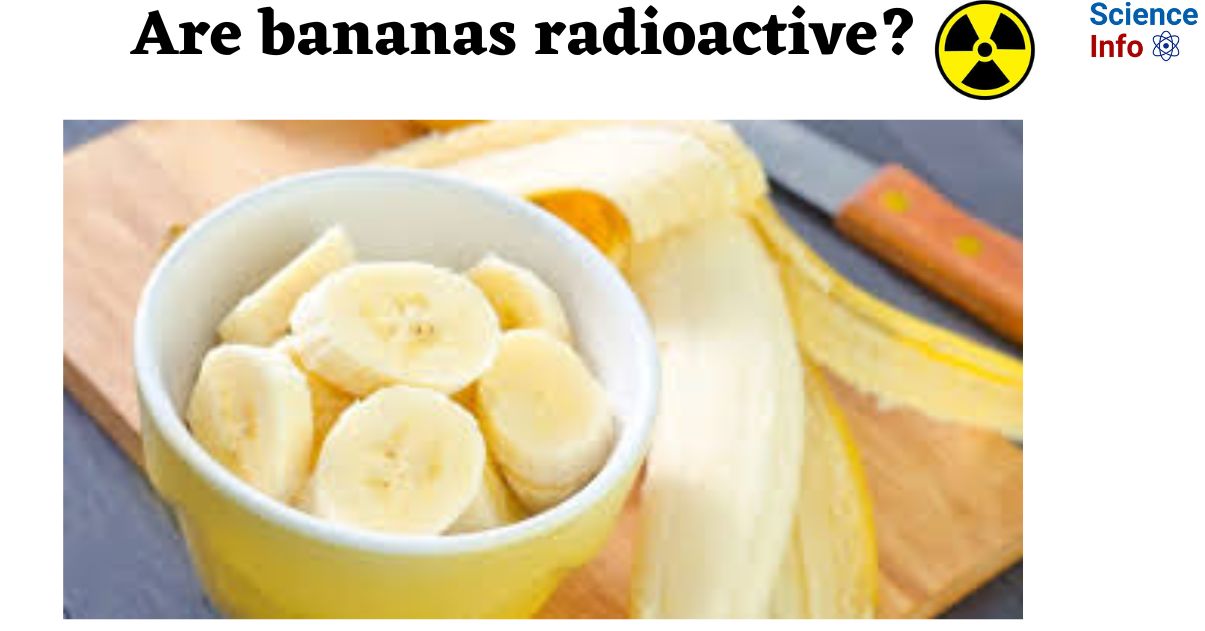
Are bananas radioactive?
Bananas are mildly radioactive due to their high potassium content, and one of their naturally occurring isotopes (variants) is potassium-40, which is radioactive. A truckload of bananas is radioactive enough to cause a false alarm on a radiation detector seeking smuggled nuclear weapons. However, you cannot become radioactive by eating bananas because you are already radioactive!
Everything in the world is built up of elements, which are themselves made up of atoms. Some of these atoms are unstable and will decay or disintegrate. When this happens, they emit “radiation,” which can be subatomic particles like electrons, alpha particles, and neutrons or electromagnetic waves like gamma rays. All of these contain energy and are capable of breaking down, or “ionizing,” molecules they encounter.
An average adult possesses approximately 140g of potassium, 16mg of which is potassium-40, making you 280 times more radioactive than a banana. Eating one raises your total amount of potassium-40 by 0.4%, which is measurable with a sensitive Geiger counter, but the effect is transient since your metabolism closely regulates the quantity of potassium in your body, and you will expel the excess within a few hours.
How Radioactive Is Banana?
Bananas are a good source of potassium. Natural potassium contains 0.0117% of the radioactive isotope 40K, which decays by beta particle emission with a half-life of 1.26 x 10⁹ years. How radioactive are bananas, one may wonder?
First, it’s important to understand that a large banana contains roughly 600 mg of potassium.
Assuming that 40epresents 0.0117% of this, our large banana will possess;
(0.600 g) × (0.000117) = 7.02 × 10⁻⁵ g of 40K present
Let’s find out how much activity one mole of 40K has. A half-life of 1.26 × 10⁹ years corresponds to a t1/2 of 3.97 × 10¹⁶ seconds.
The expression below can then be used to translate this into a rate constant:
k = ln 2/ (t1/2)
This gives us a value of 1.75 × 10⁻¹⁷ s-1 for k. Using the first-order rate expression
∆N/N = −kt
and a time t of 1 s, we can determine the activity of one mole, 6.022 × 10²³ atoms, of 40K per second:
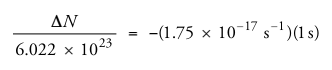
∆N = −1.05 × 10⁷
That is, approximately 10.5 million atoms decay each second in one mole (40.0 g) of 40K. To address our inquiry regarding bananas, we established the subsequent ratio:
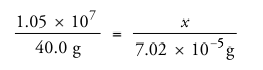
From this we get our answer; x = 18.4
The activity of a large banana is around 18.4 Bq (becquerel), or 0.511 nCi (nanocuries), or one disintegration or nuclear transition per second. In contrast, the activity of the americium in a standard smoke detector is 0.9 µCi, or roughly 1800 bananas.
A single banana will raise your yearly radiation exposure by around 0.035 millisieverts (mSv). Other foods high in radiation include coffee, peanut butter, Brazil nuts, kidney beans, and peanut butter. An average dose of 0.27 mSv annually.
Video on Are bananas radioactive?
References
- How Radioactive Is Your Banana? David W. BallJournal of Chemical Education 2004 81 (10), 1440DOI: 10.1021/ed081p1440
- https://www.mcgill.ca/oss/article/you-asked/it-true-banana-radioactive
- https://www.uow.edu.au/media/2022/are-bananas-really-radioactive-.php
- https://www.sciencefocus.com/science/how-many-bananas-would-i-need-to-eat-to-become-radioactive
- https://www.admnucleartechnologies.com.au/blog/did-you-know-bananas-are-radioactive
- https://www.bbc.com/news/magazine-15288975
