Tyndall Effect: Definition, Causes, Examples

Tyndall Effect

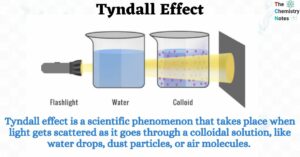
The Tyndall effect is a scientific phenomenon that takes place when light gets scattered as it goes through a colloidal solution, like water drops, dust particles, or air molecules. The phenomenon mentioned in this statement is called the Tyndall effect. … Read more

Water of Crystallization

Water of Crystallization

In chemistry, it’s important to recognize that water molecules can be found in crystalline solids. This is often referred to as water of crystallization or water of hydration. The phenomenon of water crystallization applies to the molecular arrangement of salt … Read more

Importance of Chemistry in Everyday Life

Importance of Chemistry in Everyday Life

When we hear the word chemistry, it often brings to mind images of chemicals, beakers, test tubes, burners, and a scientist working on a powerful potion. Chemistry is all around us, and it’s truly fascinating. The subject we are discussing … Read more

Isoelectronic Species: Definition, Examples

Isoelectronic Species

The term “isoelectronic” is used to describe two atoms, ions, or molecules that share the same electronic structure and have an equal number of valence electrons. The term signifies “equal charge” or “equal electric”. Isoelectronic species are atoms, molecules, or … Read more

5 Important Gas Laws

5 Important Gas Laws

The gas laws are a set of laws that explain how gases behave by showing relationships between the following: Gas Laws to be studied are listed below: Boyle’s Law Boyle’s law states that when temperature and concentration are kept constant, … Read more

Arrhenius Equation: Formula, Graph, Application

Arrhenius Equation

The Arrhenius equation holds significant importance within the field of physical chemistry. The Arrhenius equation is a mathematical expression that elucidates the relationship between temperature and the rate of chemical reactions. The Arrhenius equation is widely utilized for determining the … Read more