
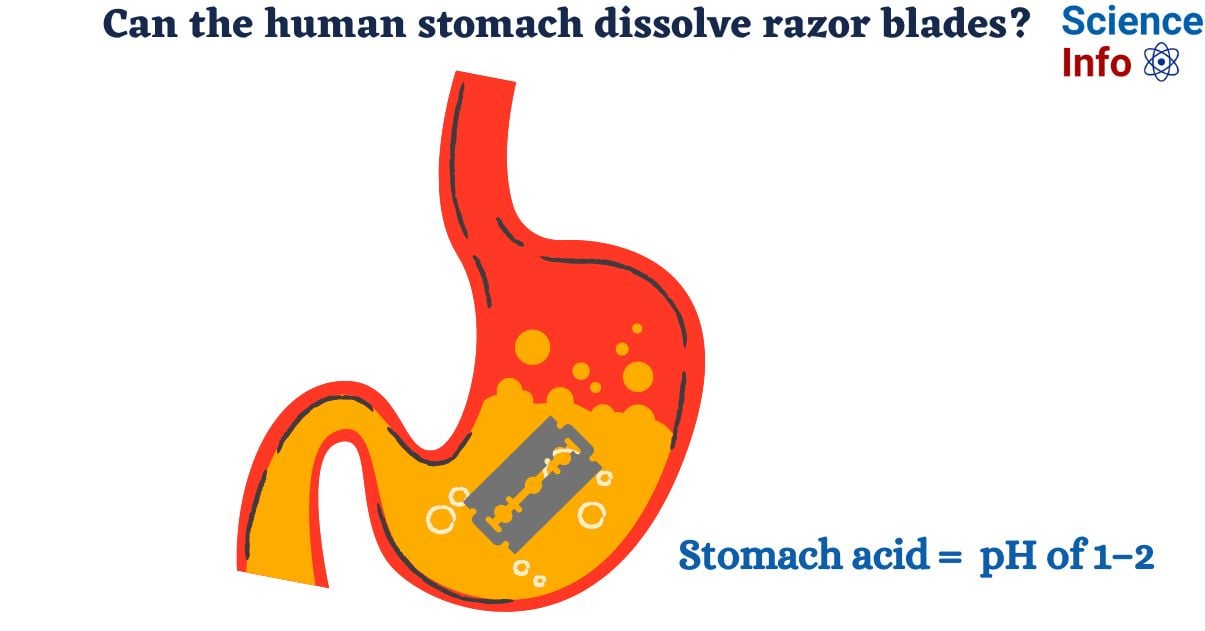
It is said that your stomach acid is so strong that it can dissolve a razor blade. The hydrochloric acid in your stomach is indeed quite strong. But is it sufficiently strong to melt the razor blades?
What is stomach acid composed of?
Hydrochloric acid (HCl) contributes significantly to the low pH of stomach acid. However, stomach acid contains very little HCl. Other ingredients include sodium chloride (NaCl) and potassium chloride (KCl).
The acidic trio is secreted by the cells that line your stomach wall. The cells also secrete enzymes and mucus. This mucus is essential to the procedure. It shields your stomach’s lining from acid and other gastric secretions, preventing harm to the sensitive organ.
How strong is stomach acid?
Stomach acid serves numerous functions for your body. It breaks down the meals you ingest into smaller, more digestible bits. It also serves as the initial line of defense against infections and microorganisms that might cause illness. These actions necessitate the use of highly acidic liquids. But how acidic is it?
To truly comprehend how strong stomach acid is, you must first understand how acid levels in liquids are measured. Acidity is evaluated using a pH scale that spans from 0 to 14. The fluid’s acidity increases as the pH decreases. Battery acid, for example, has a pH of zero, indicating that it is an extremely powerful acid. The least acidic fluids are at pH 14. Neutral fluids, such as clean water, are located in the middle, at 7.
Stomach acid has a pH of 1–2, making it very acidic. The least acidic fluids are at pH 14. Neutral fluids, such as clean water, are located in the middle, at 7. Stomach acid has a pH of 1–2, making it very acidic. Keep in mind that battery acid can dissolve metals and bones. Stomach acid, with a pH balance of only one or two points higher, can also harm highly strong objects such as bones and teeth.
Can the human stomach dissolve razor blades?
It is claimed that hydrochloric acid in the human stomach is strong enough to dissolve razor blades.
In one study, the effects of artificial stomach juice on metal objects frequently seen during endoscopic procedures were examined in vitro, and the resulting physical-chemical alterations were evaluated. What they discovered was that after 24 hours in the acid, the razor blades had lost approximately 37% of their weight. After 15 hours in the acid, double-edged razor blades weakened enough to break with a tool. In just 2 hours, the thicker back of a single-edged blade disintegrated completely.
But what needs to be understood is the researchers didn’t make anyone swallow a razor blade for the study. Instead, they conducted trials outside of the body to replicate what occurs inside the stomach. As a result, we cannot be certain of the outcomes because the situation inside the body may differ. Swallowing a razor blade can result in significant internal injuries such as digestive system wounds, perforations, and potentially fatal complications such as internal bleeding or infections. If someone has ingested a razor blade or any other sharp object, they should seek medical assistance immediately.
What happens if excess acid is produced in the stomach?
Stomach acid is necessary for digesting, however excessive acid production might be problematic. In rare cases, increased amounts of acid may be secreted. Certain stomach ailments may also cause an increase in acid secretions.
Excess acid production causes upper abdominal burning, and reflux symptoms, and can cause ulcers.
References
- https://www.healthline.com/health/how-strong-is-stomach-acid#components
- https://culinarylore.com/food-science:can-stomach-acid-dissolve-razor-blades/
- https://www.shortpedia.com/en-in/interesting-facts/interesting-facts-human-body/razor-blades-may-be-dissolved-in-the-human-stomach-1634021495
- https://forensicarticles.com/can-the-human-stomach-dissolve-the-razor-blade/
- https://indianexpress.com/article/lifestyle/health/know-your-body-can-stomach-acid-melt-metals-8654144/
- Li PK, Spittler C, Taylor CW 3rd, Sponseller D, Chung RS. In vitro effects of simulated gastric juice on swallowed metal objects: implications for practical management. Gastrointest Endosc. 1997 Aug;46(2):152-5. doi: 10.1016/s0016-5107(97)70064-6. PMID: 9283866.
