
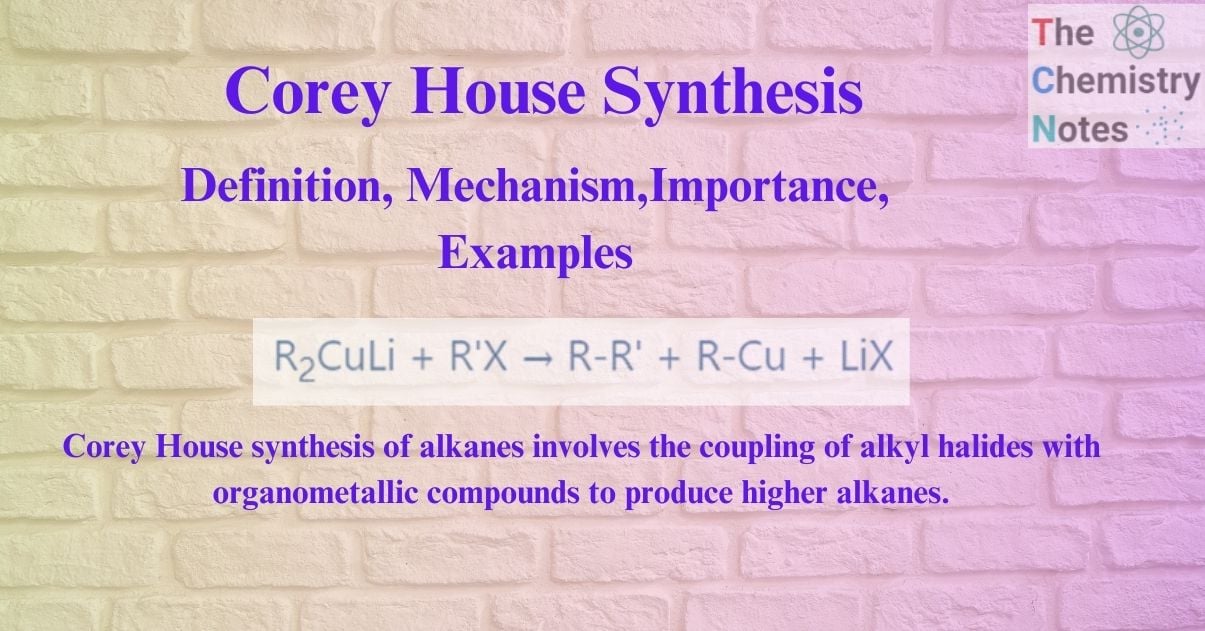
Corey House synthesis of alkanes involves the coupling of alkyl halides with organometallic compounds to produce higher alkanes. E.J. Corey and Herbert House developed this approach in the 1960s. As a result, it is frequently referred to as Corey House synthesis. It is a flexible approach for producing alkane.
Lithium dialkyl cuprate (R2CuLi), an organometallic compound, is utilized in this coupling. This reagent, also known as Gilman reagent, was developed for the first time by Herry Gilman.
Gilman reagent (R2CuLi) synthesis
Alkyl halide reacts with lithium in dry ether to from alkyl lithium.
RX + Li → RLi + LiX
The alkyl lithium reacts wih CuI to give dialkylmlithium cuprate known as Gilman reagent.
2 RLi + CuI → R2CuLi + Li I
Mechanism of Corey house synthesis
The dialkyl lithium cuprate reacts with alkyl halide to give higher alkane. This is known as Corey House synthesis.
R2CuLi + R’X → R-R’ + R-Cu + LiX
In this reaction R’ may be mehyl halide, primary alkyl halide, or secondary alkyl halide. The alkyl group in lithium dialkyl cuprate may be methyl, 1o , 2o , 3o . Additionally, it is not necessary for the two alkyl groups to be different.
Although the mechanism of Corey House’s alkane synthesis is unknown, it’s clear that the alkyl group R moved from the copper, taking a pair of electrons with it, and bonded to the alkyl group R’ in place of the halide ion. That substitution process is nucleophilic.
For example:
C2H5Cl + Li → C2H5Li
2 C2H5Li + CuI → 2C2H5– Cu Li + LiI
2C2H5– Cu Li + CH3Br → C2H5– CH3 + C2H5 – Cu + LiBr
Importance of Corey House synthesis
1. It is better method than Wurtz reaction. in this reaction alkyl halide reacts with lithium dialkyl cuprate to give higher hydrocarbon.
R2CuLi + R’X → R-R’ + R-Cu + LiX
2. The primary significance of this reaction is that it can be used to prepare symmetrical, asymmetrical (unsymmetrical), straight chain, and branched chain alkanes.
3. It is a powerful and practical tool for the synthesis of complex organic compounds.
References
- Smith M. & March J. (2001). March’s advanced organic chemistry : reactions mechanisms and structure (5th ed.). Wiley.
- https://chem.libretexts.org/Bookshelves/Organic_Chemistry/Supplemental_Modules_(Organic_Chemistry)/Alkanes/Synthesis_of_Alkanes/Corey-House_Reaction.
- https://www.vedantu.com/chemistry/corey-house-reaction.
