
Deoxyribose Sugar Definition
Deoxyribose is a five-carbon monosaccharide which is the sugar that forms the phosphate backbone of DNA molecules.
- As the name suggests, deoxyribose is formed by the loss of an oxygen atom from ribose sugar.
- The molecular formula of deoxyribose sugar is H-(C=O)-(CH2)-(CHOH)3-H, and it might exist in several isomeric forms. The hydroxyl groups present in all of those isomers are present on the same side of the structure.
- The deoxyribose sugar is also called 2-deoxyribose as it exists in two enantiomeric forms; D-2-deoxyribose, which is biologically important, and L-2-deoxyribose, which rarely occurs in the biological system.
- Deoxyribose is an aldopentose with five carbon atoms and a single aldehyde functional group.
- A single strand of DNA contains several individual molecules of deoxyribose, all of which together carry the genetic information of the animal.
- In DNA, deoxyribose exists as a five-membered ring where the 1’carbon is bonded to a nitrogenous base, and the 5’carbon is present on the opposite side of the ring.
- The 5’carbon is bonded to a phosphate group which then binds to the 3’carbon of the nucleotide above it.
- Deoxyribose sugar was first discovered by Phoebus Levene in 1929, and the discovery of deoxyribose sugar was made later than ribose sugar.
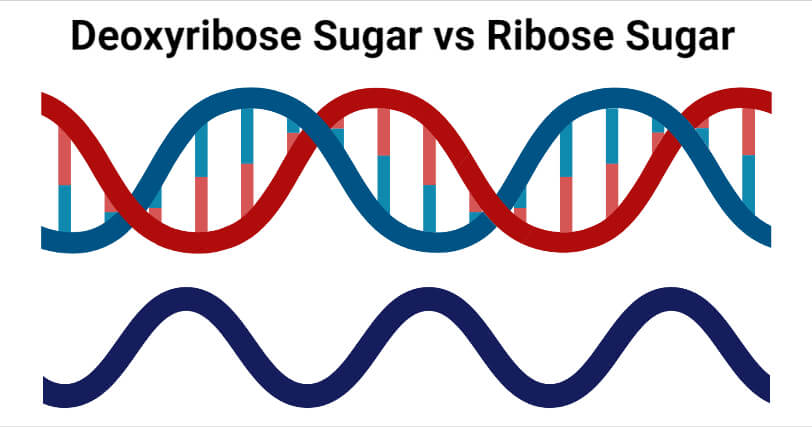
Ribose Sugar Definition
Ribose is a five-carbon monosaccharide present in RNA where it forms the backbone of the polymer.
- Ribose sugar in RNA alternates with phosphate groups and binds to nitrogenous bases.
- Ribose is also found in the form of ribose phosphates in the nucleotide coenzymes in various microorganisms and is also utilized by microorganisms for the synthesis of amino acids like histidine.
- Ribose is structurally similar to deoxyribose sugar, but deoxyribose sugar has one less hydroxyl group than ribose sugar.
- Ribose, like deoxyribose, exists in two enantiomeric forms; L-ribose, which rarely occurs in living systems, and D-ribose, which is the biologically important form.
- Ribose exists in both cyclic and linear forms in equilibrium, and the molecule can easily interconvert between the two forms.
- The hydroxyl group in ribose that is usually absent in deoxyribose is essential for RNA splicing.
- Ribose sugar in RNA forms the backbone of the nucleic acid as it binds to other chemical groups like phosphate and nucleotides.
- Besides being an essential component of nucleic acid, ribose is also present in ATP, which is the energy currency in living systems.
- Ribose can also be found in other molecules like cAMP, which is the secondary signaling molecule involved in various biochemical pathways.
8 Key Differences (Deoxyribose vs Ribose Sugar)
| Characteristics | Deoxyribose | Ribose |
| Definition | Deoxyribose is a five-carbon monosaccharide which is the sugar that forms the phosphate backbone of DNA molecules. | Ribose is a five-carbon monosaccharide present in RNA where it forms the backbone of the polymer. |
| Chemical Formula | The chemical formula of deoxyribose sugar is C5H10O4. | The chemical formula of ribose sugar is C5H10O5. |
| Hydroxyl group | Deoxyribose sugar contains one less hydroxyl group than ribose sugar. | Ribose sugar contains an additional hydroxyl group. |
| Derived from | Deoxyribose sugar is derived from ribose sugar. | Ribose sugar is synthesized from glucose via the pentose phosphate pathway. |
| Molecular mass | The molecular mass of deoxyribose sugar is 134.13 gm/mol. | The molecular mass of ribose sugar is 150.13 gm/mol. |
| Discovered by | Deoxyribose was discovered by Phoebus Levene in 1929. | Ribose was discovered earlier in 1891 by Emil Fisher. |
| Nucleic acid | Deoxyribose sugar occurs in the DNA. | Ribose sugar occurs in the RNA. |
| Nitrogenous bases | Deoxyribose combines with nitrogenous bases like adenine, guanine, cytosine, and thymine. | Ribose sugar combines with nitrogenous bases like adenine, guanine, cytosine, and uracil. |
References and Sources
- Jain JL, Jain S and Jain N (2005). Fundamentals of Biochemistry. S. Chand and Company.
- 3% – https://pediaa.com/difference-between-deoxyribose-and-ribose/
- 2% – https://vergeefsaker.com/faculty/reusch/VirtTxtJml/nucacidspv-z4274t30tg.html
- 2% – https://biologyreader.com/nucleotide.html
- 2% – https://biologydictionary.net/deoxyribose/
- 1% – https://www.sciencedirect.com/topics/chemistry/aldopentose
- 1% – https://www.easybiologyclass.com/nucleotide-biosynthesis-de-novo-salvage-purine-pyrimidine-nucleotides-cells/
- 1% – https://www.difference.wiki/deoxyribose-vs-ribose/
- 1% – https://www.coursehero.com/file/p2dekhp/The-sugar-in-DNA-is-deoxyribose-which-contains-one-less-hydroxyl-group-than/
- 1% – https://link.springer.com/referenceworkentry/10.1007/978-3-642-27833-4_1373-3
- 1% – https://chem.libretexts.org/Bookshelves/General_Chemistry/Exercises%3A_General_Chemistry/Exercises%3A_Oxtoby_et_al./14E%3A_Chemical_Equilibrium_(Exercises)
