
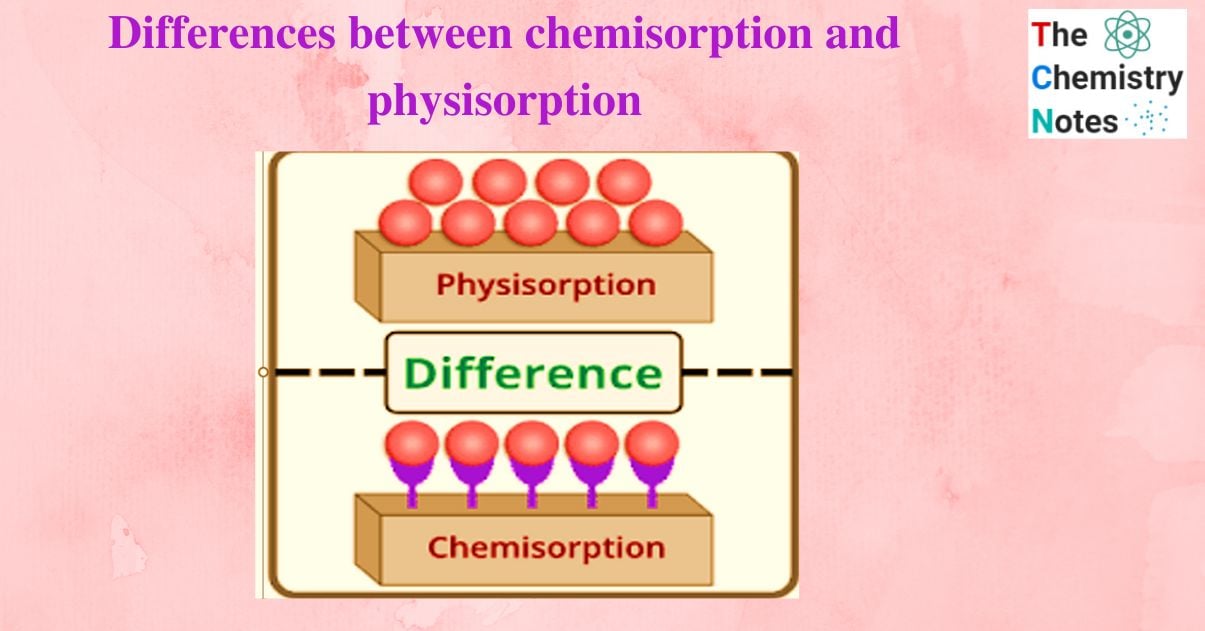
Physical adsorption, also known as physisorption, is a reversible phenomenon involving weak Van der Waals forces between adsorbate and adsorbent, whereas chemisorption is an irreversible phenomenon involving strong chemical interaction between adsorbate and adsorbent.
| S.N | Physisorption | Chemisorption |
| 1. | It is a reversible phenomenon. | It is an irreversible phenomenon. |
| 2. | Physisorption is caused by Van der Waals forces. | It is caused by chemical bond formation. |
| 3. | It is not specific in nature. | It is highly specific in nature. |
| 4. | Low temperature favors the physisorption process. It decreases as the temperature rises. | High temperature is favorable for adsorption. It increases as the temperature rises. |
| 5. | Easily liquefiable gases are readily adsorbed. | Gases that can react with the adsorbent show chemisorption |
| 6. | Enthalpy of adsorption is low (20– 40 kJ mol-1). | The enthalpy of chemisorption is high (80-240 kJ mol-1). |
| 7. | Physical adsorption has a lower activation energy. | Chemical adsorption has a higher activation energy. |
| 8. | Physisorption is a weak phenomenon. | It is a strong process. |
| 9. | It is a multi-layered process. | This type of adsorption is almost entirely a single-layered phenomenon. |
| 10. | For example: Adsorption of oxygen or hydrogen on the surface of charcoal | For example: Adsorption of oxygen on metal surfaces. |
References
- Hiemenz P. C. & Rajagopalan R. (1997). Principles of colloid and surface chemistry (3rd ed. rev. and expanded Paul C. Hiemenz Raj Rajagopalan). Marcel Dekker.
- https://nitsri.ac.in/Department/Chemical%20Engineering/Adsorption.pdf
- https://www.embibe.com/exams/application-of-adsorption/
- https://byjus.com/jee/adsorption/
- https://nitsri.ac.in/Department/Chemical%20Engineering/Adsorption.pdf
