
A dot and cross diagram can be used to illustrate how bonds are formed in small molecules. Diagrams called “dot and crosses” display how the outer-shell electrons of an ionic or covalent compound or element are arranged.
Dots and crosses are used to represent the electrons.
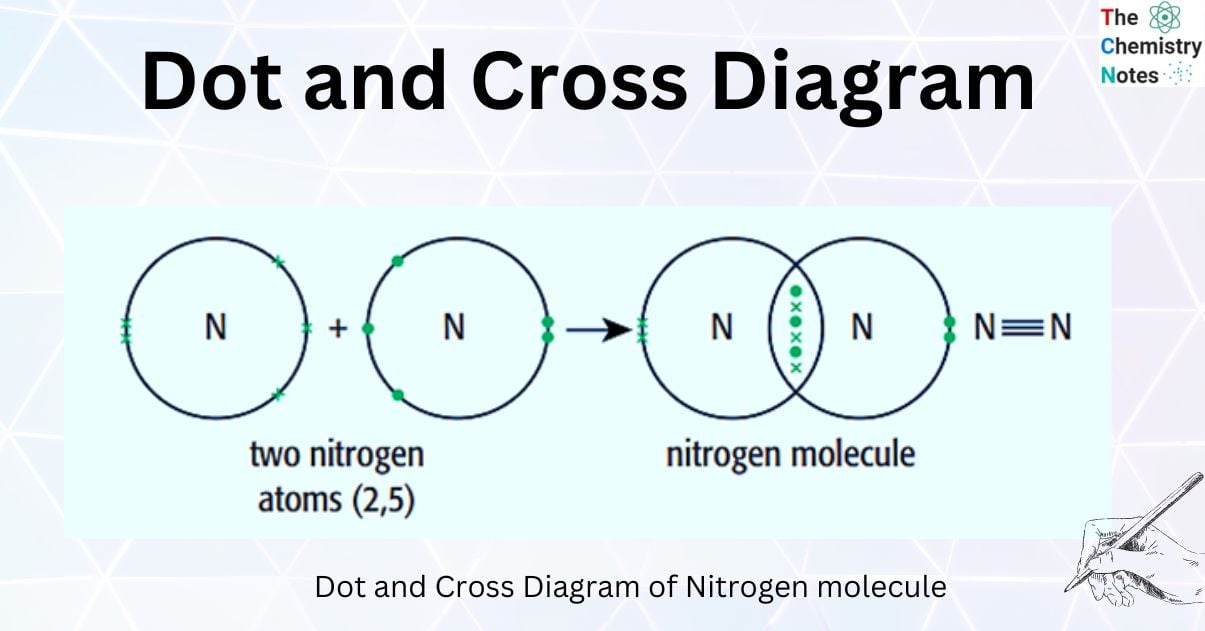
What is Dot and Cross Diagram?
A dot and cross diagram represents a visual representation of the sharing or transfer of electrons from atoms’ outer shells during a chemical bond. Dot-cross diagrams are a basic and necessary technique for determining the Lewis structure and shape of molecules and polyvalent ions.
Covalent bonds and ionic bonds can be represented with dot and cross diagrams.
This diagram shows:
- A circle is used to represent each atom’s outer shell.
- If there is a covalent bond, circles will overlap.
- Dots represent electrons from one atom, and crosses represent electrons from another atom.
Dot and Cross Diagram for Covalent Bond
Single Covalent Bond
One or more pairs of electrons are shared when two nonmetal atoms come together. A single covalent bond, also known as a bond pair, is a shared pair of electrons.
A single covalent bond is represented by a single line drawn between the atoms: for example, Cl-Cl.
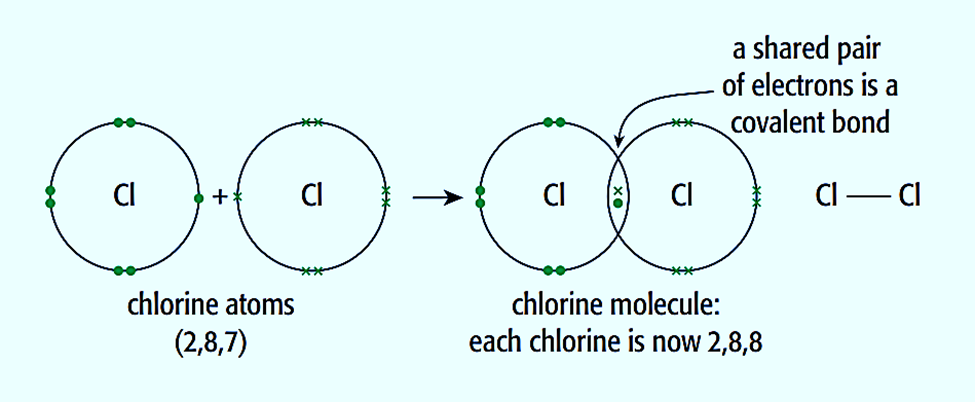
When chlorine atoms combine, not all of the electrons are used in bonding. Lone pairs are outer-shell electron pairs that are not used in bonding. Each atom in a chlorine molecule has three lone pairs of electrons and one bonding pair of electrons.
When drawing the arrangement of electrons in a molecule:
- use a ‘dot’ for electrons from one of the atoms and a ‘cross’ for electrons from the other atom;
- If there are more than two types of atoms, we can use additional symbols such as a small circle or a small triangle;
- The outer electrons are drawn in pairs to emphasize the number of bond pairs and lone pairs.
Examples of Dot and Cross Diagrams of Single Covalent Bond Compound
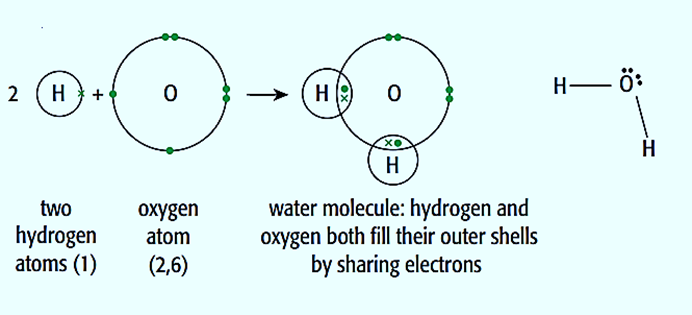
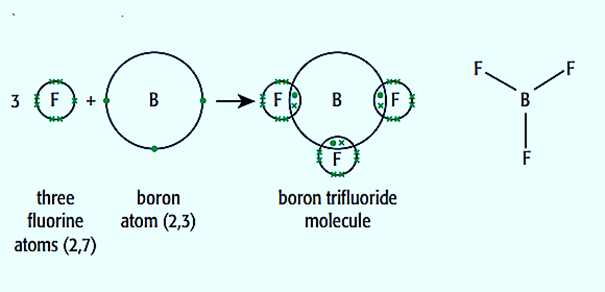
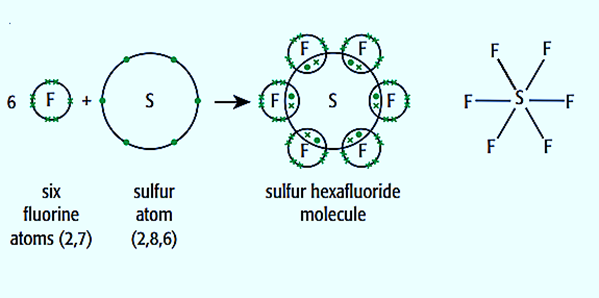
Multiple Covalent Bond
Some atoms can form bonds by sharing two pairs of electrons. This is referred to as a double covalent bond. A double covalent bond is represented by a double line drawn between the atoms, such as O=O.
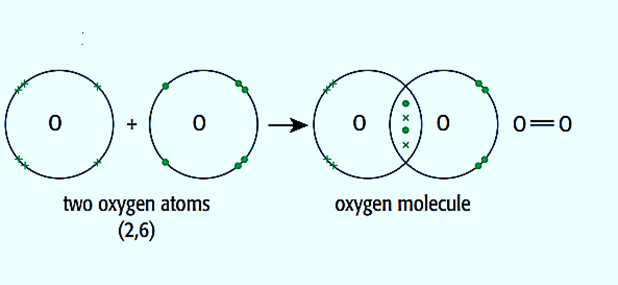
- Each oxygen atom must gain two electrons to complete its outer shell in order to form an oxygen molecule. As a result, two electron pairs are shared and two covalent bonds are formed.
- As with carbon dioxide, each oxygen atom must gain two electrons . However, the carbon atom requires four electrons to complete its outer shell. So two oxygen atoms form two bonds with carbon, giving the carbon atom eight electrons.
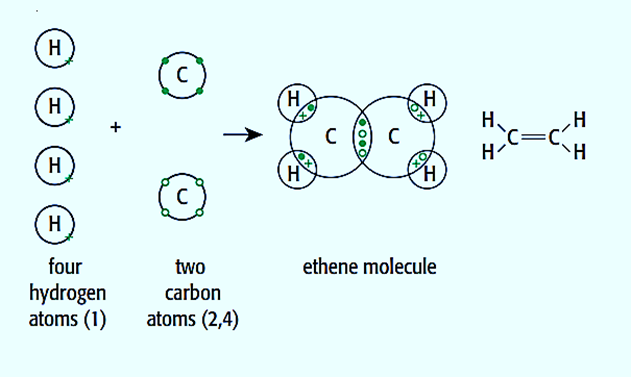
Ionic Bond: Dot and Cross Diagram
Ionic bonds are formed when a metal transfers electrons to a nonmetal to form a positively and negatively charged ion. The atoms achieve a noble gas configuration.
When drawing dot and cross representation for an ionic compound, it is usually acceptable to draw the metal ion’s outer electron shell without any electrons. This is due to the fact that it has transferred these electrons to the negative ion.
In ionic compounds;
- The use of square brackets ensures that the ion’s charge is distributed evenly.
- The charge on each ion, indicated by the writing in the upper-right square brackets.
Magnesium Dot and Cross Diagram
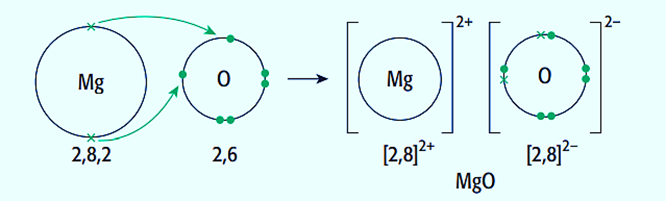
- The two electrons from each magnesium atom’s outer shell are transferred to the partially filled orbitals of an oxygen atom during the reaction between magnesium and oxygen to create magnesium oxide.
- Each magnesium atom obtains the electronic configuration [2,8] by losing two electrons.
- Each oxygen atom obtains the electronic configuration by gaining two electrons [2,8].
[2,8] is the electronic configuration of neon; thus it is a ‘noble-gas configuration’.
Calcium Fluoride Dot and Cross Diagram
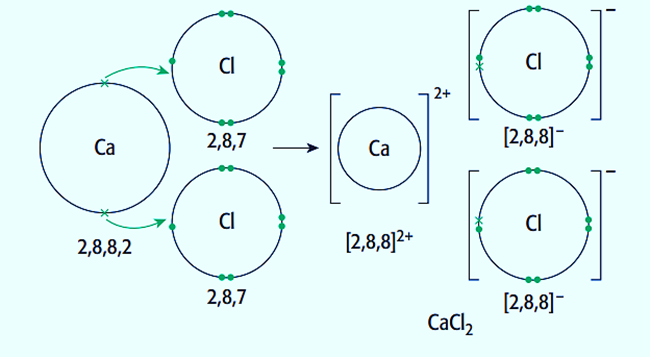
- In its outer shell, each calcium atom has two electrons that can be transferred to two chlorine atoms.
- Each calcium atom achieves the electronic configuration [2,8,8] by losing two electrons.
- To achieve the electronic configuration, the two chlorine atoms each gain one electron [2,8,8].
- The electronic configuration of argon is [2,8,8]; thus it is a ‘noble-gas configuration’.
Look the video on dot and cross representation
References
- https://edu.rsc.org/infographics/how-to-draw-dot-and-cross-diagrams/4014905.article
- https://chemistryguru.com.sg/drawing-dot-and-cross-diagrams
- https://keystagewiki.com/index.php/Dot_and_Cross_Diagram
- https://www.shalom-education.com/courses/gcsechemistry/lessons/structure-bonding-and-properties-of-matter/topic/dot-and-cross-diagrams/
