
Airplane flight was one of the most significant technological triumphs of the twentieth century. The introduction of the airplane has enabled people to travel from one side of the earth to the other in less than a day, as opposed to weeks of travel by boat and rail. We’ve all enjoyed technology for a long time, yet some of us have never considered the theory behind how do airplanes fly. This is an exciting topic to talk about .
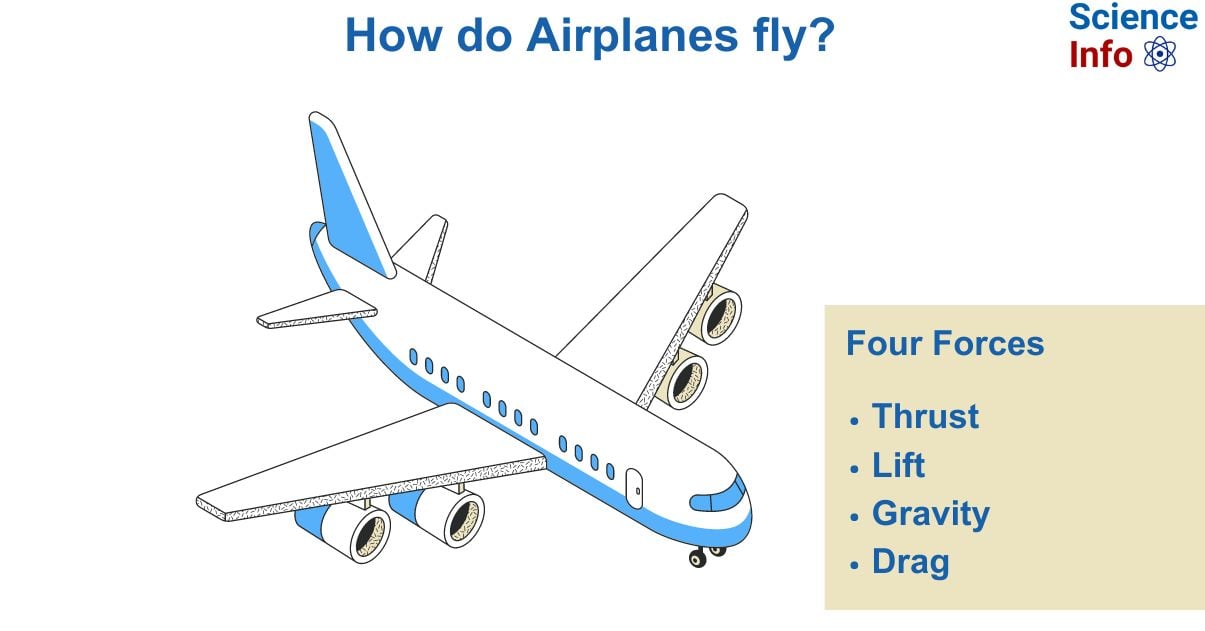
How do Airplanes fly?
Have you ever thought about what causes objects to move? What drives a massive, heavy aircraft through the air? Why do swings function if you pump your legs? Why do parachutes slow down items as they?
All of these questions have a single answer: forces. Engineers study forces through physics and then use what they learn to solve issues. Forces can cause things to accelerate, while balanced forces can cause them to remain stationary or move at a constant speed.
Four forces affect a plane’s flight: thrust, lift, gravity, and drag. Balancing all four forces allows planes to fly long and quickly. Lift is the force that propels the plane into the air, while thrust is the force that keeps it going forward. Drag slows it down, but gravity pulls it back to the ground. Thrust and lift keep an airplane flying, but drag and gravity shorten its flight.

Thrust
Thrust is the force that propels a plane forward. It is a mechanical force produced by the aircraft’s engine or propeller. In commercial and military aircraft, strong jet engines or turboprops produce the push required to propel the aircraft forward. The person throwing the paper airplane creates thrust. Without thrust, an airplane cannot reach the requisite speed for takeoff or maintain flight.
Lift
Lift is the force that pushes an airplane upward into the air. It is formed by the airplane’s specifically constructed wings, known as airfoils. These wings are designed to transport air over the top of the wing quicker than the air underneath it. This difference in airspeed causes a higher pressure beneath the wing and a lower pressure above it, resulting in an upward force known as lift. Lift is required to get the airplane off the ground and keep it in the air.
Gravity
Gravity is the force that pulls an airplane down to Earth. It is the same force that attracts all objects to the center of the Earth. The gravitational force is proportional to the object’s mass. In airplanes, gravity works against lift. Lighter aircraft require less pull to remain airborne, but heavier aircraft require more lift. Weight distribution in an airplane, such as increasing weight to the rear, can have an impact on its center of gravity and overall flying stability.
Drag
Drag is the force that opposes an airplane’s forward motion. It is caused by the air’s resistance as the plane passes through it. To reduce drag, airplanes are intended to be long and narrow, with a pointed nose, which reduces the quantity of air they must push out of the way. If an airplane had a larger surface, it would face higher air resistance, necessitating more energy to maintain forward speed. Reducing drag is critical for efficient flying since it allows the jet to travel faster and consume less fuel.
References
- Þ National Aeronautics and Space Administration: www.grc.nasa.gov/www/k-12/UEET/StudentSite/dynamicsofflight.html
- https://www.teachengineering.org/lessons/view/cub_mechanics_lesson01
- https://wonderopolis.org/wonder/how-do-airplanes-fly
