
Krebs cycle is the most common route for the complete oxidation of carbohydrates, proteins, and lipids. Krebs cycle was discovered by H.A. Kreb, who received the Nobel prize in 1953.
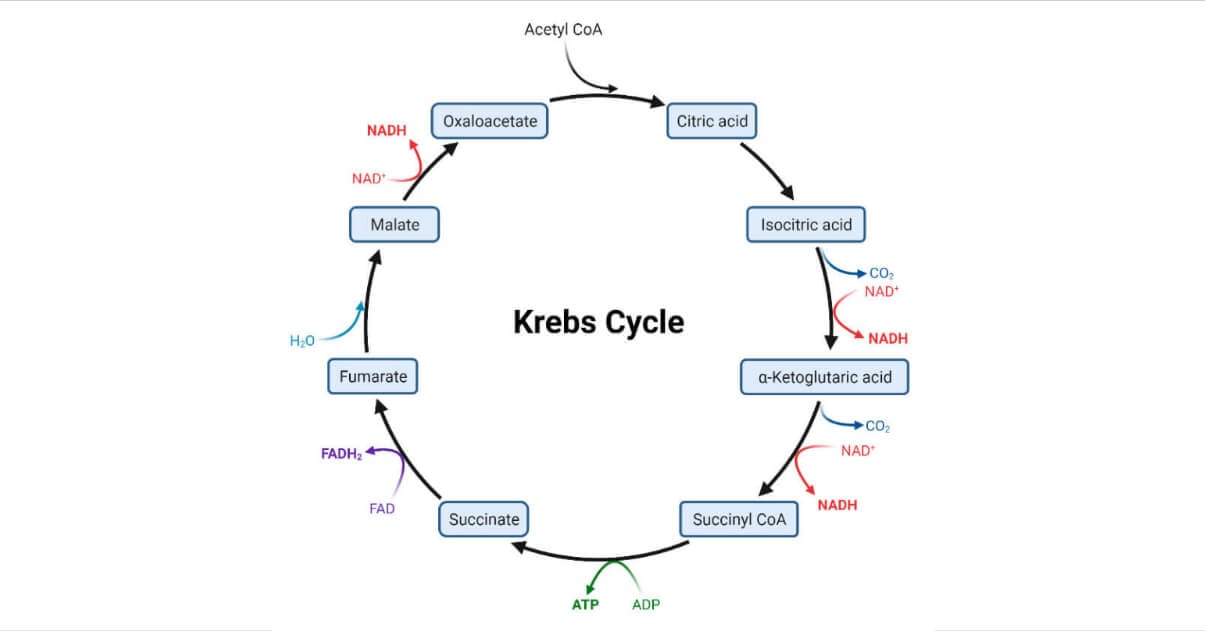
The Krebs cycle is also known as the TCA cycle (tricarboxylic acid cycle) or the Citric acid cycle. It is a series of enzyme-catalyzed reactions that occur in the mitochondrial matrix and involve the oxidation of acetyl-CoA to form carbon dioxide.
Reactions involve in Krebs cycle
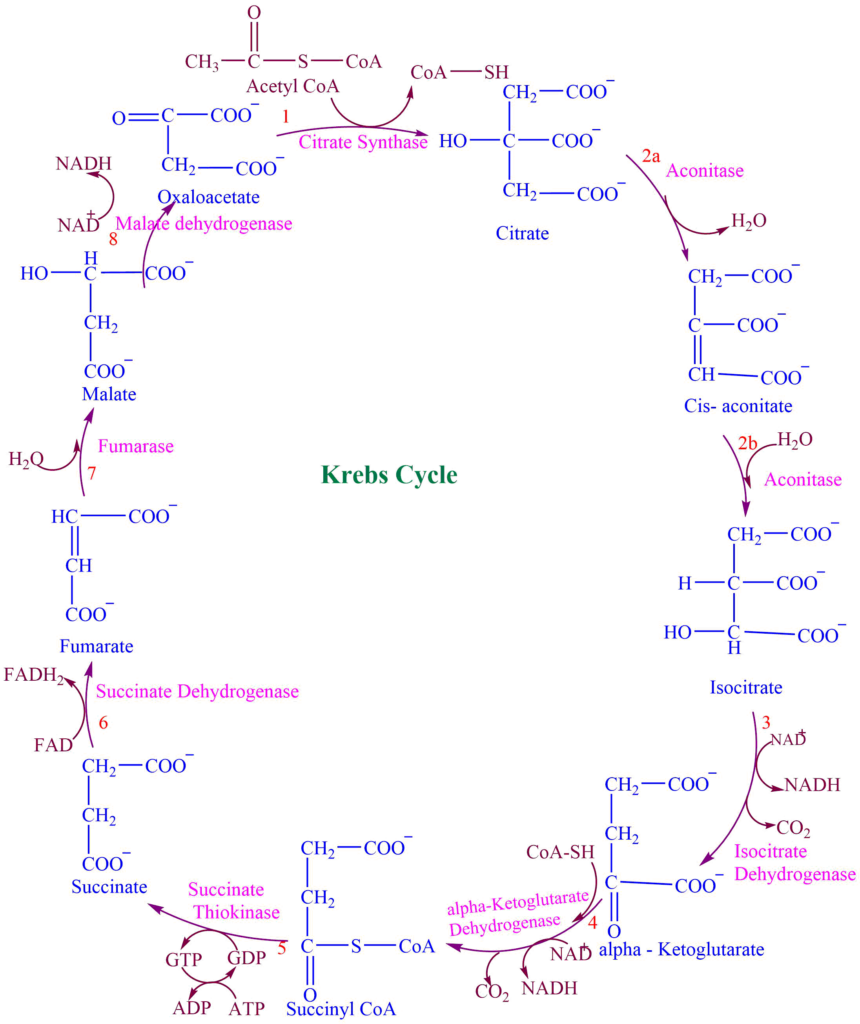
It is an eight-step enzymatic process that occurs in the matrix of mitochondria under aerobic conditions.
Step 1: Condensation reaction
The first step of the Krebs cycle involves the condensation reaction between the oxaloacetate (four carbon unit) and acetyl group of acetyl CoA (two carbon unit). Oxaloacetate reacts with acetyl CoA in presence of H2O to give citrate (6C) and CoA. This reaction involves the condensation process followed by hydrolysis and is catalyzed by the enzyme citrate synthase.
Steps 2a and 2b: Isomerization reaction
In this reaction, the water is removed from the citrate and added back. This moves the hydroxyl group from one carbon atom to its neighbor. So isocitrate is formed from citrate by isomerization. The enzyme aconitase catalyzes this reaction.
Step 3: Oxidative decarboxylation of isocitrate
Isocitrate is oxidized and decarboxylated to alpha-ketoglutarate (5C). In this step, the carbon-carrying hydroxyl group is converted into the carbonyl group. Thus, the formed immediate product is unstable and loses CO2to give the product. The enzyme isocitrate dehydrogenase catalyzes this reaction.
Step 4: Oxidative decarboxylation of alpha-ketoglutarate
Oxidative decarboxylation of alpha-ketoglutarate produces succinyl CoA (4C). The enzyme alpha-ketoglutarate dehydrogenase catalyzes this reaction to produce NADH, CO2, and high-energy thioester bond to coenzyme A.
Step 5: Substrate level phosphorylation
The enzyme succinate thiokinase catalyzes the conversion of succinyl CoA to succinate. This reaction yields a compound with high phosphoryl transfer potential through the substrate level phosphorylation.
Step 6: Oxidation
In this step, FAD removes two hydrogen atoms from the succinate to produce fumarate. The enzyme succinate dehydrogenase catalyzes this reaction.
Step 7: Hydration
The addition of water to fumarate places the hydroxyl group next to the carbonyl carbon to give malate.
Step 8: Oxidation
The carbon-containing hydroxyl group in malate is converted into a carbonyl group, regenerating oxaloacetate.
Net reaction of Kreb cycle
The oxidative decarboxylation of two pyruvates yields two molecules of Acetyl CoA, requiring two cycles per glucose molecule. In the Krebs cycle, complete oxidation of a glucose molecule yields four CO2, six NADH, two FADH2, and two ATPs.

References
- https://www.khanacademy.org/science/biology/cellular-respiration-and-fermentation/pyruvate-oxidation-and-the-citric-acid-cycle/a/the-citric-acid-cycle
- https://biologydictionary.net/krebs-cycle/
- https://byjus.com/neet/krebs-cycle/
- https://byjus.com/biology/tca-cycle/
- https://www.britannica.com/science/tricarboxylic-acid-cycle
- https://www.vedantu.com/biology/krebs-cycle
- https://microbiologyinfo.com/krebs-citric-acid-cycle-steps-by-steps-explanation/
