
Introduction to Plasticity
Plasticity is an important defining characteristic of a material. We find various kinds of materials around us. These materials can be studied under several properties and characteristics. Plasticity is the property of a material which explains the ability of that material to change its shape, size or dimension after applying and removing the external force. In physics, this external force responsible for changing the shape, size and dimension of any material is called the deforming force.
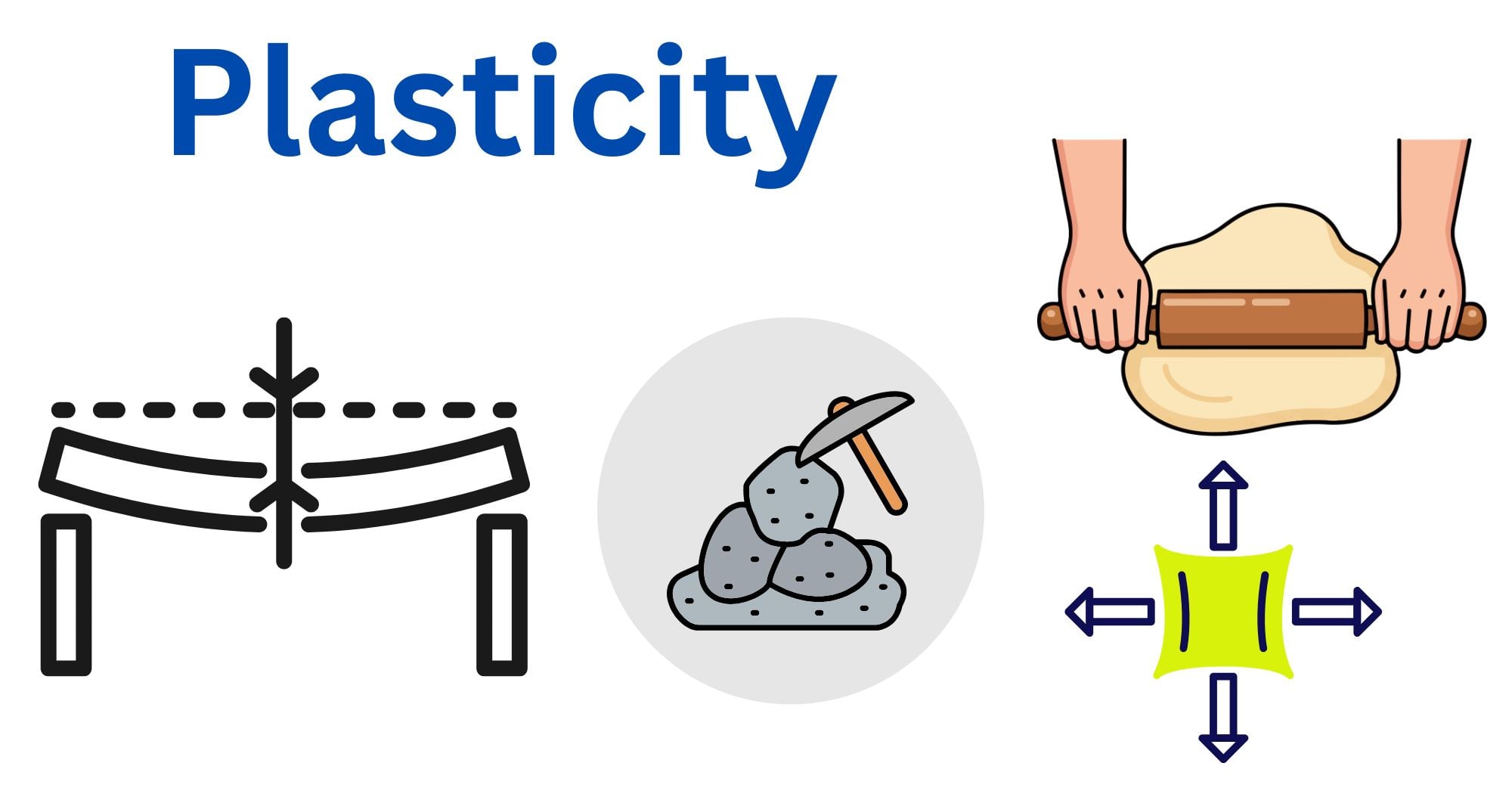
There are various circumstances common in our daily lives about deforming force. For example, when a dough is rolled, pressed or stretched, it permanently comes to a new shape. This is a simple illustration of plasticity. Opposite to plasticity is the elasticity which means an object can come to its original form after the removal of that deforming force. However, in real-life not any objects are perfectly elastic. A very strong deforming force can change any materials to plastic. Hence, this force plays an important role in attaining the elastic or plastic nature of that material.
The study of plasticity is very important in the fields like engineering, materials science, and industrial manufacturing. Many processes like pressing, rolling, stamping, and extrusion are performed by studying the plasticity of any object. The manufacturing process heavily relies on plasticity. It is also important in predicting the behavior of a material after applying stronger forces. Thus, plasticity has great importance in real practices.
Plastic Deformation and the Principle of Plasticity
Plastic deformation means the permanent deformation of objects after removing the deforming force. As the stress given to the object goes above the elastic limit of that object, deformation occurs. Therefore, once the limit is reached, there is no chance of that material to get back its original shape. The amount of stress and the strength of that material to withstand the stress determine the plasticity of any material.
Suppose we are stretching a metal rod. For a small force given, the rod stretches slightly and easily returns to its original length after removing the force. This stage represents elastic deformation. Now if the force is further increased and surpasses the elastic limit, the rod gets permanently elongated. This kind of deformation is called plastic deformation.
According to the principle of plasticity, once the stress reaches the yield point, the internal structure of the material begins to rearrange itself. The object at this point stops objecting the force and starts to change with the force.
While viewing the stress-strain curve, after yield point, the graph no longer becomes linear. Now, even a small increase in stress may give a larger strain to the object. Also, we can say, stress and strain do not follow Hooke’s law and are no longer directly proportional.
Mechanism of Plastic Deformation in Materials
Deformations are the result of intermolecular changes inside the material. They may be visible or invisible to the naked eyes. Thus, the internal structure of a material plays an important role to bring deformation to any object. Furthermore, the intermolecular structure is also responsible for providing the potential energy to any material for resisting the stress.
In many solid structures like metals, atoms are arranged in a regular pattern which is called a crystal lattice. When stress is applied to the materials, the atoms move slightly from their regular repeating patterns. If the stress is small, the atoms can return to their initial positions when the force is removed. But, when the stress becomes larger, the lattices can pile up over the other. This sliding or piling up can cause the plastic deformation.
This sliding movement is known as dislocation motion. Dislocations are small irregularities present in the crystal structure. When stress is applied, these irregularities move through the lattice. This dislocation causes shifting of atoms in the crystal. As a result, the material becomes plastic permanently.
Other two important mechanisms causing plastic deformation in crystal structures are slip and twinning. Slip occurs when one plane of atoms moves over another plane along specific directions called slip directions. This is the most common mechanism in metals. Twinning, on the other hand, involves a reorientation of a part of the crystal structure in a symmetrical manner.
In polymers, when stress is applied, the chain of molecules can come up another or they can get stretched. The long chain of molecules is disrupted and hence the plastic deformation occurs.
The most influencing factor for occurring plastic deformation is the temperature. At high temperature, the kinetic energy of molecules automatically increases and hence there is more certainty for microscopic deformations in the objects.
Types of Plastic Deformation
Plastic deformation particularly depends upon the force or the stress applied to a material. Some types of plastic deformation are given below:
Tensile Plastic Deformation
This occurs when a material is stretched by a pulling force. Mainly, one-dimensional change occurs in the objects and hence their length gets stretched. If the stress goes above the elastic limit, the material will have permanent change in its length.
Compressive Plastic Deformation
This occurs when a material is subjected to a pushing force. The material becomes shorter and thicker. Examples include crushing or pressing metals in manufacturing processes.
Shear Plastic Deformation
Shear deformation occurs when forces are applied to the layers of a particle. The forces on different layers are parallel to each other but opposite in directions. This makes the layers slide parallelly to one another.
Bending Deformation
Bending deformation occurs if a material is bent such that one side experiences tension while the other side experiences compression. Here too, if the force crosses the elastic limit, the object bends permanently.
Torsional Deformation
When a material is twisted, it also experiences a twisting force. This force gives rise to a shear stress, which may bring a permanent deformation if the deformation condition arises..
All these types of deformations are important in manufacturing processes where the strength of particles are important.
Stress-Strain Behavior and Plastic Deformation
The relationship between stress and strain is often represented by a stress–strain curve. This curve helps us understand how materials behave when subjected to increasing stress.
The curve usually consists of several regions:
Elastic Region
In this region, stress is directly proportional to strain. The material returns to its original shape after the load is removed.
Yield Point
The yield point marks the beginning of plastic deformation. Beyond this point, permanent deformation begins.
Plastic Region
In this region, strain increases rapidly while stress may increase slowly. The material undergoes permanent deformation.
Ultimate Strength
This is the maximum stress that the material can withstand before necking begins.
Fracture Point
Finally, the material breaks or fractures after excessive deformation.
Hence, by observing the curve one can easily visualize the elastic or plastic property of a material and use it in further applications.
Factors Affecting Plasticity of Materials
The factors affecting plasticity are:
Temperature
Higher temperatures increase plasticity because atoms can move more easily. Many metals become more ductile at high temperatures.
Crystal Structure
Materials with certain crystal structures allow easier movement of dislocations, leading to greater plasticity.
Grain Size
Materials of grain sizes are supposed to have greater strength. However, they also show different plastic behavior compared to larger grains.
Strain-rate
The rate at which stress is applied also affects plastic deformation. Applying stress rapidly can also reduce plasticity and increase brittleness.
Impurities and Alloying
The presence of impurities can also impact the plasticity of a material. Alloys can have either greater plasticity (or smaller). It depends on how they affect the crystal structure..
Plasticity in Metals, Polymers, and Other Materials
Metals
Metals have very high plasticity due to the dislocations in their crystal structures on applying force greater than their elastic limit. For example, gold, copper and aluminum are highly plastic but can be reshaped easily.
Polymers
Polymers are long chains of molecules. Under stress, these chains slide across each other and the chain is stretched. Plastics are the polymers which show this property.
Ceramics
Ceramics have very low plasticity. They are more likely to break rather than to deform. Their atomic bonds are strong and rigid.
Composite Materials
Composites materials are produced to achieve properties suitable to use. Some composites are designed to have controlled plastic behavior.
Applications of Plasticity
Metal Forming
Processes such as forging, rolling, extrusion, and drawing depend on plastic deformation to shape metals.
Manufacturing Machine Parts
Many mechanical components are manufactured using plastic deformation techniques.
Structural Engineering
Understanding plastic behavior helps engineers design structures by avoiding sudden fractures and collapses.
Automative Industry
Parts of a car are shaped using plastic deformation processes.
Aerospace Engineering
Plasticity is important in designing lighter but stronger components for aircraft and spacecraft.
Advantages of Plastic Deformation
Plastic deformation has several advantages in engineering and manufacturing.
- A material can be shaped into complex forms without breaking. This allows manufacturers to produce a wide variety of products.
- Another advantage is improved mechanical properties.
- Strain-hardening process is another method done to increase the strength of a material by plastic deformation.
- Plastic deformation also allows mass production of components using efficient manufacturing techniques.
- Additionally, plastic deformation processes often improve the surface finish and structural integrity of materials.
Limitations of Plastic Deformation
Despite its advantages, plastic deformation also has certain limitations.
One limitation is that excessive plastic deformation can lead to material failure. If deformation is excessive, there are chances of crackings and fractures.
Another limitation is that strain hardening can also cause an object less ductile because of repeated deformations.
Some materials such as ceramics and brittle have lesser elastic limit and hence they are easily fractured on applying smaller stress.
Also, as greater energy is required to attain plastic behavior, special equipment is required. This increases the cost of manufacturing.
Conclusion
Plasticity is a natural property of a material. It recognises the strength of a particle when certain forces are applied. Various manufacturing, engineering and structural designing processes rely on elasticity and plasticity.
The condition of plasticity comes after the elastic limit of a material. Once the object is unable to resist the deforming force, its elastic limit is reached. As a result, plastic deformation takes place. This is the act of molecules and their arrangement in the crystal lattice when stress is given to it.
The various types of deformations like tensile, compressive, shear, bending, and torsional etc. each of them have their own importance in the field of material science and manufacturing processes. The stress-strain curve shows a picture of the transition of any material from its elastic behavior to a plastic behavior. Furthermore, temperature, molecular structure and the stress applied are other important factors determining plasticity. However, it has its own limitations according to the scenario. These should be considered while building and manufacturing processes.
To sum up, it determines how an object behaves under forces and how it should be utilized in various manufacturing processes, giving rise to modern technologies.
References
- Oh, H. K. (2000). Physics of plasticity. Journal of materials processing technology, 97(1-3), 19-29.
- Kachanov, L. M. (2004). Fundamentals of the Theory of Plasticity. Courier Corporation.
- Lubliner, J. (2008). Plasticity theory. Courier Corporation.
- Dixit, P. M., & Dixit, U. S. (2025). Plasticity: fundamentals and applications. CRC press.
- Zuev, L. B., Barannikova, S. A., Danilov, V. I., & Gorbatenko, V. V. (2021). Plasticity: from crystal lattice to macroscopic phenomena. Progress in physics of metals, 22(1), 3-57.
- https://en.wikipedia.org/wiki/Plasticity_(physics)
- https://www.plasticity.xyz
