Urea is the primary form of waste product of amino groups derived from amino acids. Urea is made up of ammonia, CO2, and aspartate in a cyclic pathway referred to as Urea Cycle. The urea cycle was discovered by Kreb and Henseleit, so it is also called the Krebs-Henseleit cycle.
Reactions of the urea cycle
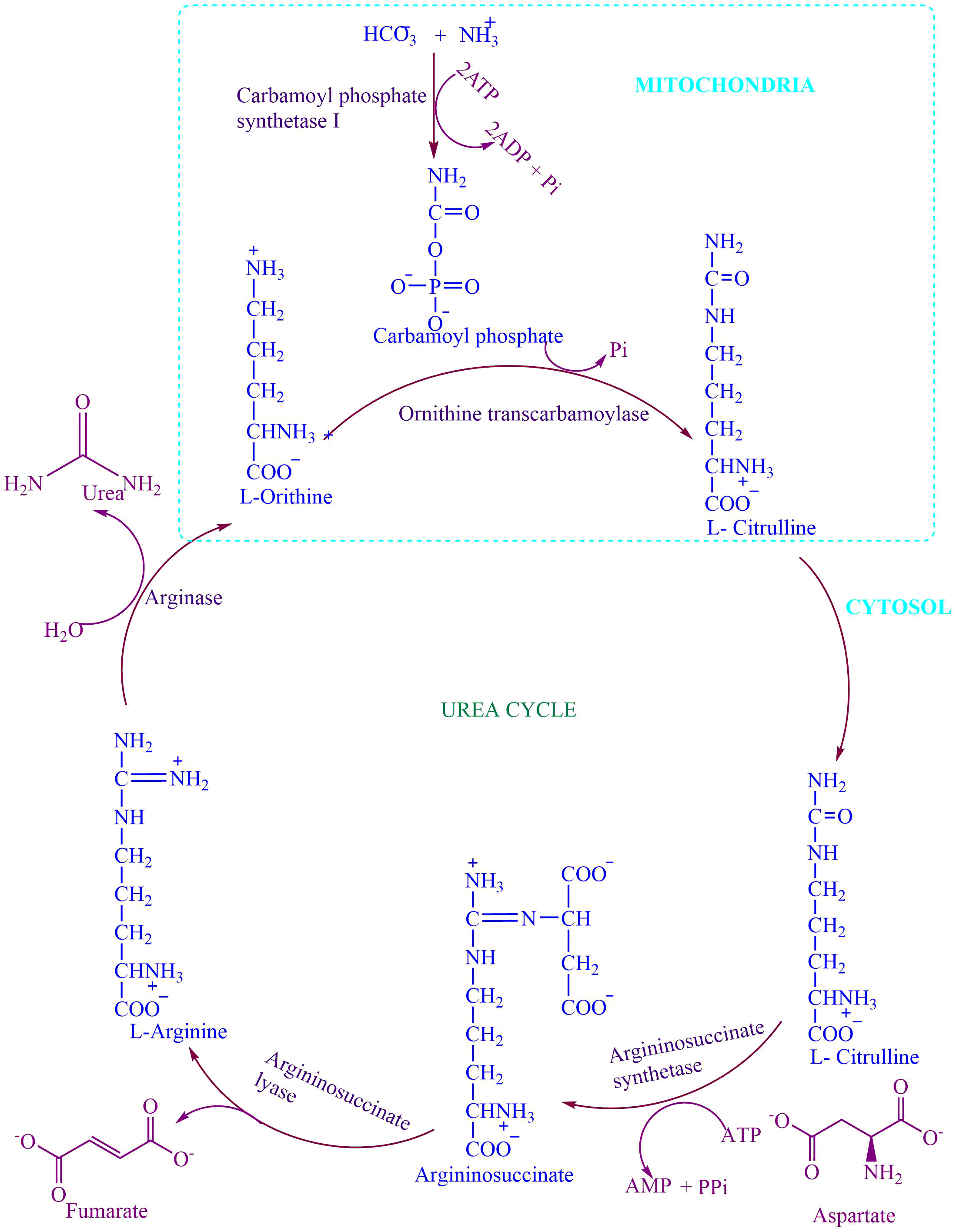
Urea synthesis is composed of five enzymatic reactions. The first two reactions take place in mitochondria, while the remaining three take place in the cytosol.
Step I: Formation of carbamoyl phosphate
The formation of carbamoyl phosphate is the primary step of the urea cycle. Carbamoyl phosphate is formed from ammonia and bicarbonate by carbamoyl phosphate synthetase I. The oxidative deamination of glutamate by mitochondrial glutamate dehydrogenase is the primary source of ammonia incorporated into carbamoyl phosphate.
Step II: Formation of citrulline
Ornithine transcarbamoylase transferred the carbamoyl portion of carbamoyl phosphate to the ornithine to produce citrulline. The citrulline then passes into the cytosol.
Step III: Synthesis of argininosuccinate
Argininosuccinate is formed by the combination of aspartate and citrulline. The reaction is catalyzed by the enzyme argininosuccinate synthetase. In this reaction, the alpha-amino group of aspartate provides the second nitrogen that is eventually incorporated into urea.
Step IV: Formation of arginine
The enzyme argininosuccinate lyase decomposes argininosuccinate to produce arginine and fumarate. This reaction produces arginine, which is an immediate precursor to urea. The reaction releases the fumarate which enters the citric acid cycle.
Step V: Hydrolysis of arginine
Arginine is hydrolyzed by the enzyme arginase to give ornithine and urea. The arginase is exclusively present in the liver, so only the liver can cleave arginine to produce urea.
Net reaction of urea cycle

Four high-energy phosphates are consumed in the synthesis of urea. The synthesis of urea is an irreversible reaction consisting of high negative ∆G. During the formation of urea, one nitrogen of the urea molecule is supplied by free NH3 while the other nitrogen is supplied by aspartate.
References
- https://www.news-medical.net/health/The-Urea-Cycle-Step-by-Step.aspx
- https://microbenotes.com/urea-cycle-enzymes-and-steps/
- https://www.pharmacy180.com/article/urea-cycle-1941/
- https://byjus.com/biology/ureotelism/
- https://chem.libretexts.org/Courses/Brevard_College/CHE_301_Biochemistry/10%3A_Metabolism_of_Amino_Acids/10.03%3A_Urea_Cycle
- https://www.britannica.com/science/urea-cycle
