Skip to content
Science Info
  • Home
  • Astronomy
  • Physics
  • Chemistry
    • Periodic Table
    • Analytical Chemistry
    • Basic Chemistry
    • Biochemistry
    • Computational Chemistry
    • Environmental Chemistry
    • Inorganic Chemistry
    • Nanochemistry
    • Organic Chemistry
    • Pharmaceutical Chemistry
    • Physical Chemistry
  • Biology
    • Plants
    • Animals
  • Science Facts
  • Top 10 in Science

Kabita Sharma

Kabita Sharma is a Ph.D. student in the Department of Chemistry at the University of North Texas, USA. Her research focuses on understanding protein degradation mediated by PROTAC (Proteolysis-Targeting Chimera) molecules and on exploring their potential for targeted protein degradation to treat diseases such as cancer. Through this work, she aims to advance drug discovery by targeting previously inaccessible or undruggable sites where PROTAC molecules can operate effectively. Additionally, she is analyzing how the buried surface area of proteins affects their binding and unbinding affinities. Using computational tools, she explores the challenges of removing one infected protein from another during treatment. Driven by a passion for solving complex scientific challenges, Kabita uses her knowledge in chemistry, chemical biology, and computational tools to advance her research. Beyond her academic pursuits, she aspires to inspire others toward science and its wonders through writing and sharing her knowledge.

X-ray Photoelectron Spectroscopy (XPS): Principle, Instrumentation, Applications, Advantages, Limitations
July 4, 2023 by Kabita Sharma
X-ray photoelectron spectroscopy

X-ray photoelectron spectroscopy is a surface-sensitive analytical technique that involves bombarding a material’s surface with X-rays and measuring the kinetic energy of the released electrons. The surface sensitivity and capacity to reveal chemical state information from the elements in the … Read more
Nitrobenzene: Preparation, Properties, Reactions, Uses

July 4, 2023 by Kabita Sharma
Nitrobenzene

Nitrobenzene is the most basic aromatic nitro compound, with the molecular formula C6H5NO2. Nitrobenzene was initially synthesized in 1834 by the German chemist Eilhardt Mitscherlich, who used fuming nitric acid to treat benzene. It is an oily, pale yellow, or … Read more

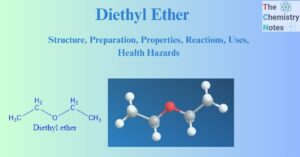
Diethyl Ether: Structure, Preparation, Properties, Reactions, Uses, Health Hazards

July 3, 2023 by Kabita Sharma
Diethyl ether

Diethyl ether, often known as ether, is an organic molecule composed of two ethyl groups connected by an oxygen atom as C2H5 – O – C2H5.  It is a well-known anesthetic and is also known as ethyl ether.  The IUPAC name … Read more

Chloroform: Structure, Preparation, Properties, Reactions, Uses, Health Hazards

July 3, 2023 by Kabita Sharma
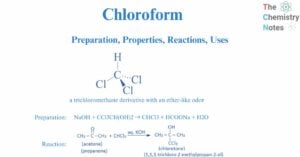
Chloroform

Chloroform is a colorless and volatile liquid. It is a trichloromethane derivative with an ether-like odor. It is represented by the chemical formula CHCl3. The hydrogen bonded to the carbon in chloroform contributes to hydrogen bonding. Many different types of … Read more

Ether: Preparation, Properties, Reactions, Uses

July 2, 2023 by Kabita Sharma
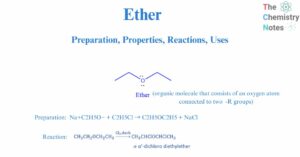
Ether

Ethers are a type of organic molecule that consists of an oxygen atom connected to two  -R groups. Alkyl, aryl, or vinyl groups can be used as R groups. They are also considered water derivatives in which both hydrogen atoms have … Read more

Acetone: Preparation, Properties, Reactions, Uses, Health Hazards, Safety Consideration

July 2, 2023July 2, 2023 by Kabita Sharma
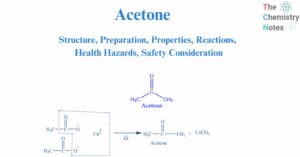
Acetone

Acetone is a colorless liquid ketone that is volatile and combustible. It is the simplest and most basic aliphatic ketone, with the formula CH3COCH3.  It is also known as 2-propanone, or dimethyl ketone ad acts as an organic solvent for … Read more

Alloys: Characteristics, Classification, Types, Benefits, Limitations

July 7, 2023July 1, 2023 by Kabita Sharma
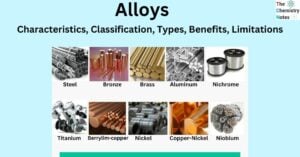
metal alloys

The term ‘alloy’ refers to a substance that is produced through the amalgamation of two or more metallic elements. Alloys may also be generated through the combination of metallic substances with non-metallic elements. The properties displayed by alloys frequently differ … Read more

Auger Electron Spectroscopy: Principle, Instrumentation, Applications, Advantages, Limitations

July 1, 2023 by Kabita Sharma
Auger electron spectroscopy

Auger electron spectroscopy (AES) is a type of electron spectroscopy that detects electrons produced by Auger relaxation processes. It is a non-destructive core-level electron spectroscopy used to determine the elemental composition of surfaces, thin films, and interfaces in a semi-quantitative … Read more

Aniline: Structures, Preparation, Reactions, Properties, Uses

June 29, 2023 by Kabita Sharma
Aniline

Aniline is an aromatic derivative in which a hydrogen atom of the benzene ring has been replaced by an amino group -NH2. Aniline is also known as aminobenzene or phenylamine. It has a chemical formula of C6H7N or C6H5NH2 that contains Six … Read more

Older posts
Newer posts
← Previous Page1 … Page26 Page27 Page28 … Page44 Next →

Topics

  • Analytical Chemistry (164)
  • Animals (2)
  • Astronomy (4)
  • Basic Chemistry (144)
  • Biochemistry (38)
  • Book Reviews (1)
  • Botany (2)
  • Computational Chemistry (4)
  • Differences Between (70)
  • Environmental Chemistry (31)
  • Events (2)
  • Inorganic Chemistry (183)
  • Journals (1)
  • Nanochemistry (17)
  • Organic Chemistry (177)
  • Periodic Table (130)
  • Pharmaceutical Chemistry (15)
  • Physical Chemistry (199)
  • Physics (115)
  • Plants (13)
  • Science Facts (12)
  • Syllabus (5)
  • Top 10 in Science (14)
  • Universities (4)
  • Zoology (1)
  • Redox Reactions (A Level Chemistry Revision Notes)
  • Oxidation Numbers (A Level Chemistry Revision Notes)
  • Electrochemistry (A Level Chemistry Revision Notes)
  • Hess’s Law (A Level Chemistry Revision Notes)
  • The Gaseous State: Ideal and Real gases (A Level Chemistry Revision Notes)
  • About
  • Our Team
  • Contact Us
  • Editorial Policy
  • Privacy Policy
  • Cookie Policy
  • Disclaimer (Terms and Conditions)
© 2026 Science Info. Made with ♡ by Sagar Aryal.