Skip to content
Science Info
  • Home
  • Science Facts
  • Top 10 in Science
  • Resources
    • Astronomy
    • Biology
    • Chemistry
    • Periodic Table
    • Physics
    • Syllabus
    • Universities

Chemistry

Chemistry is the study of elements (such as atoms, molecules, compounds, ions, and so on) and their chemical composition, properties, structure, and chemical reactions.

  • Chemistry is also concerned with the chemical interaction (bonding) of elements, atoms, and molecules. It investigates the causes and consequences of bonding.
  • Furthermore, chemistry is concerned with the energies emitted or absorbed by various molecules.
  • Chemistry is the science that studies the properties, content, and structure of substances (specified as elements and compounds), as well as the transformations they go through and the energy released or absorbed during these processes.
  • Chemistry is one of the most fundamental fields of science, involved with the in-depth investigation of matter, its properties, composition (chemical), and application.
  • Chemistry is further classified into the following groups based on the materials, processes, and system types under research.
  • Organic chemistry: Organic chemistry is the study of life’s chemistry and the reactions that occur in living organisms. It includes the study of organic processes in addition to the structure and characteristics of chemical molecules that are mainly made of carbon and hydrogen.
  • This discipline of chemistry is concerned with the in-depth study of the structure, characteristics, and synthesis of chemical substances having carbon and hydrogen along with minor/trace elements such as sulfur, oxygen, and nitrogen.
  • Inorganic chemistry: The study of the characteristics and behavior of inorganic compounds such as metals, minerals, ceramics, crystal formations, catalysts, and the majority of elements in the Periodic Table is known as inorganic chemistry. It encompasses all ‘non-organic’ chemical substances found in nature. This branch is concerned with the in-depth investigation of the characteristics, production, and behavior of inorganic substances. The creation and behavior of inorganic or organometallic chemical compounds present in the earth’s crust and non-living materials are covered in this subject.
  • Physical chemistry: This discipline of chemistry studies the effect of chemical structure on the physical qualities of a substance, the rate of chemical reactions, the calculation of properties and structures, and the interaction of molecules with radiation. Quantum chemistry, photochemistry, spectroscopy, chemical kinetics, and surface chemistry are all subfields of physical chemistry.
  • Physical Chemistry is concerned with the ‘physical attributes’ of chemical compounds through the application of law and other physics concepts such as motion, energy, force, time, statistical mechanics, quantum chemistry, and thermodynamics.
  • Analytical chemistry: Analytical chemistry is the qualitative and quantitative examination of the chemistry of substances. It is a branch of chemistry that analyses, utilizes tools, and employs various procedures to separate, identify, and quantify materials. So, analytical chemistry is concerned with identifying and quantifying specific molecules.
  • Biochemistry: Biochemistry is the scientific investigation of biological processes at the cellular and molecular levels using chemistry. In this field of chemistry of living cells, tissues, organs, and organisms is addressed. Its primary goal is to comprehend how biomolecules link to a specific process (metabolism) within a living cell. It seeks to understand the structures, functions, and interactions of proteins, nucleic acids, carbohydrates, and lipids to facilitate life.

Affinity chromatography: Principle, Procedure, Applications, Advantage

January 12, 2023January 10, 2023 by Kabita Sharma
Affinity chromatography

Affinity chromatography is a liquid chromatography technique that employs biospecific interactions to separate compounds. The molecule that needs to be purified is selectively and irreversibly adsorbed to a certain ligand. History of Affinity chromatography Immunochemists were the ones who created … Read more
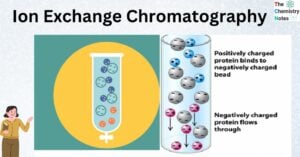
Ion Exchange Chromatography: Principle, Types, Procedure, Applications

January 12, 2023January 10, 2023 by Jyoti Bashyal
Ion Exchange Chromatography

Ion exchange chromatography (IEC), along with ion-partition/interaction and ion-exclusion chromatography, is an important analytical technique for the separation and determination of ionic compounds. This separation is based on ionic (or electrostatic) interactions between ionic and polar analytes, ions in the eluent, … Read more

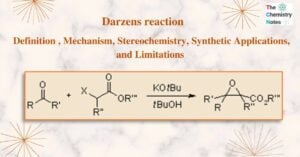
Darzens reaction: Definition, Mechanism, Stereochemistry, Synthetic Applications

January 11, 2023January 9, 2023 by Kabita Sharma
Darzens reaction

Darzens reaction is a condensation reaction that involves the reaction of ketone or aldehyde with an α-haloester in the presence of a base to form an α,β-epoxy ester i.e., glycidic ester. It is commonly known as Darzens condensation or glycidic … Read more

Size Exclusion Chromatography: Principle, Instrumentation, Applications

January 11, 2023January 9, 2023 by Jyoti Bashyal
Size Exclusion Chromatography

The size-exclusion chromatography (SEC) method, also known as gel-filtration chromatography, separates biological molecules based on their molecular size. It  is not an adsorption technique in comparison to other chromatographic techniques. Size exclusion chromatography is a technique that separates compounds based … Read more

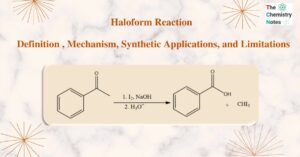
Haloform Reaction: Definition , Mechanism, Synthetic Applications, Limitations

January 9, 2023January 8, 2023 by Kabita Sharma
 Haloform reaction

 Haloform reaction involves an exhaustive halogenation of a methyl ketone (RCOCH3) in the presence of a base to give a haloform (CHX3).  Where R can be either a hydrogen atom, an alkyl, or an aryl group, and X is a … Read more

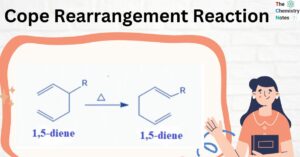
Cope Rearrangement Reaction: Reaction Mechanism, Stereochemistry, Application

January 6, 2023 by Jyoti Bashyal
Cope Rearrangement Reaction

Cope rearrangement of 1,5-dienes is one of the most fundamental C-C bonds-formation reactions available to synthetic chemists today. It is exceptional in the formation of highly stereospecific and predictable C-C  σ -bonds between non functionalized carbon centers. Elizabeth Hardy and Arthur … Read more

Paper Chromatography: Principle, Types, Application, Advantages, Disadvantages

January 4, 2023 by Jyoti Bashyal
Paper Chromatography

Paper chromatography is a simple yet effective detective tool for separating and analyzing the constituents of a mixture. Because paper chromatography is so similar to thin-layer chromatography (TLC), it is often used to teach TLC and other chromatography techniques. It … Read more

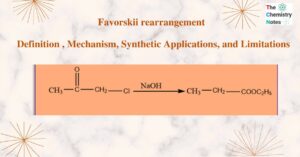
Favorskii rearrangement: Definition , Mechanism, Synthetic Applications

January 11, 2023January 4, 2023 by Kabita Sharma
Favorskii rearrangement

Favorskii rearrangement involves the conversion of cyclopropanones or α -halo ketones to carboxylic acids or their derivatives in presence of the base. Acidic “‘ α -hydrogens” must be present in the halo ketones. This reaction is named after the Russian … Read more

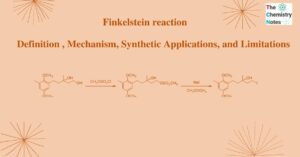
Finkelstein reaction: Definition , Mechanism, Synthetic Applications, Limitations

January 9, 2023January 3, 2023 by Kabita Sharma
Finkelstein Reaction

 Finkelstein reaction is an organic process in which an alkyl halide reacts with a metal halide salt to form another alkyl halide. This reaction’s name is given after the German chemist Hans Finkelstein. It is a nucleophilic bimolecular substitution reaction in which … Read more

Older posts
Newer posts
← Previous Page1 … Page68 Page69 Page70 … Page84 Next →

Topics

  • Astronomy (4)
  • Biology (18)
  • Book Reviews (1)
  • Chemistry (756)
  • Differences Between (70)
  • Events (2)
  • Journals (1)
  • Periodic Table (130)
  • Physics (125)
  • Science Facts (12)
  • Syllabus (5)
  • Top 10 in Science (14)
  • Universities (4)
  • Density and Pressure (A-Level Physics Revision Notes)
  • Equilibrium of Forces (A-Level Physics Revision Notes)
  • Turning Effects of Forces (A-Level Physics Revision Notes)
  • Linear Momentum and Its Conservation (A-Level Physics Revision Notes)
  • Non-uniform Motion (A-Level Physics Revision Notes)
  • About
  • Our Team
  • Contact Us
  • Editorial Policy
  • Privacy Policy
  • Cookie Policy
  • Disclaimer (Terms and Conditions)
© 2026 Science Info. Made with ♡ by Sagar Aryal.