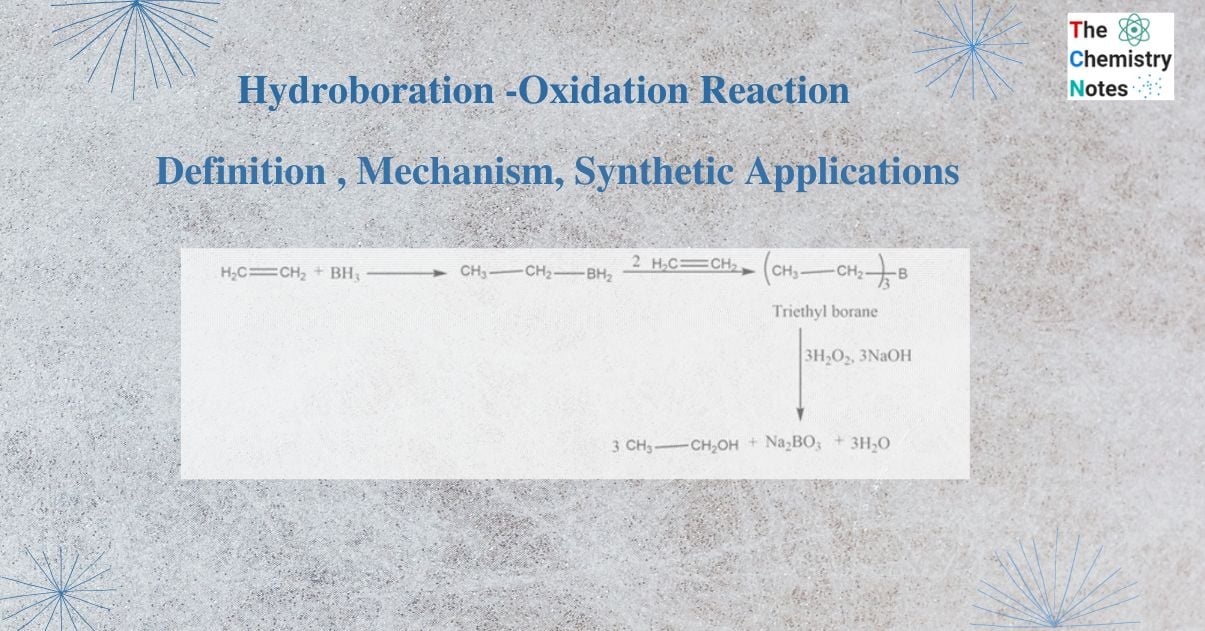
Hydroboration-oxidation reaction is two-step chemical reaction process, in which an alkene is transformed into alcohol.The addition of borane to the carbon-carbon double bond by the action of diborane to form alkyl borane is known as hydroboration. Further oxidation of alkyl borane gives alcohol. In the hydroboration-oxidation reaction process, the double bond is replaced by the simultaneous addition of hydrogen and a hydroxyl group. The typical solvent used in hydroboration is tetrahydrofuran (THF).
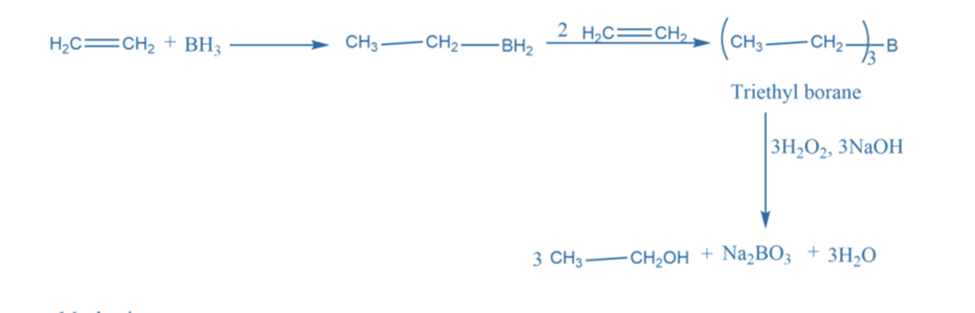
The hydroboration-oxidation reaction, in which the hydroxyl group attaches to the less-substituted carbon, is an anti-Markovnikov reaction. Herbert C. Brown reported the reaction for the first time in the late 1950s. He was also awarded the Nobel Prize in Chemistry for his discovery in 1979.
Hydroboration is highly regioselective and stereospecific. Borane addition involves steric and electronic effects, which favor the attack over the less substituted carbon. The less substituted carbon is chosen by boron in order to prevent steric hindrance when adding the second and third alkene residues. As boron reacts with alkenes up until the completion of the hydride substitution in BH3 and their replacement by adding on three alkene molecules to give a trialkyl borane. Instead of using borane itself, some mono- or dialkylboranes like 9-BBN, can be used to increase regioselectivity. For example, the addition of BH3 to 2-methyl-1-propene, where the new B-C bond will be formed with preference for atom 1 over atom 2.

Reaction mechanism of Hydoboration-Oxidation reaction
Hydroboration step
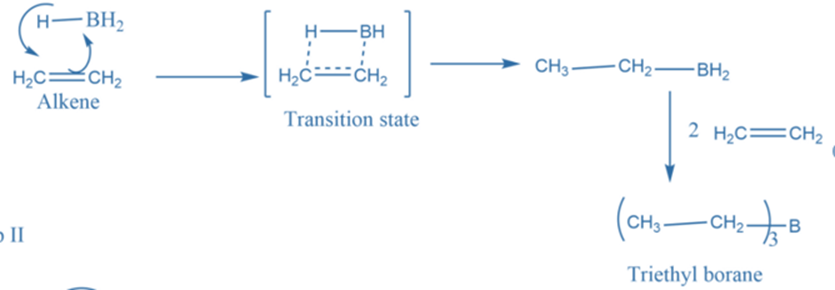
Hydroboration involves the simultaneous addition of hydrogen and boron to alkene through the Pi complex to form a four-centered transition state in which boron is attached to the least substituted carbon of the double bond.
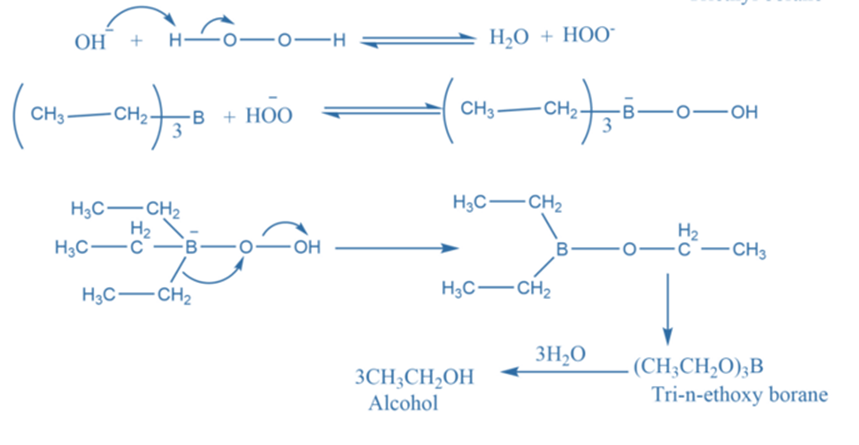
Oxidation step
The trialkyl borane formed from the hydroboration reaction is oxidized to the alcohols by hydrogen peroxide in aqueous sodium hydroxide. It involves an attack on the boron atom by the nucleophilic hydroperoxide anion. Alkyl borane with retained stereochemistry is produced by alkyl migration to oxygen.
Applications of Hydroboration-Oxidation Reaction
- Hydroboration-oxidation reaction mainly used for the alcohols from an alkene. It is stereoselective. Compared to other hydration reactions like acid-catalyzed addition and the oxymercuration-reduction process, the reaction offers a more stereospecific and complementary regiochemical alternative. Carbonyl Products from alkenes can be produced when other oxidants are used instead of hydrogen.
- It is also used for the preparation of arganoborane compounds.
References
- Morrison, R. T., & Boyd, R. N., Organic chemistry, Allyn and Bacon, Inc. 1987.
- March, J., Advanced Organic Chemistry, Wiley Eastern Limited, 1986.
- Skyes, P., A Guide Book to Mechanism in Organic Chemistry, Second edition, Orient Longman Ltd., 1988.
