Applications of Chelation Therapy

Applications of Chelation Therapy

Chelation therapy is a medical practice that involves the introduction of a chelating substance to eliminate heavy metals from the body. In chelation therapy, a variety of chelating compounds are employed as medications to treat heavy metal intoxication. The word … Read more

Reaming: Applications, Advantages

Reaming

Reaming is a cutting procedure that enlarges existing hole diameters more precisely while improving the surface finish of the hole walls. Reaming is a finishing technique for high-precision holes that uses a multi-edged tool. High penetration rates and shallow cuts … Read more

Flash Photolysis: Applications, Advantages, Disadvantages

Flash photolysis

Flash photolysis was created to investigate short-lived intermediates. In 1967, Manfred Eigen, Ronald George, George Porter, and Wreyford Norrish received the Nobel Prize in Chemistry for co-discovering Flash Photolysis in 1949. They invented this method to examine short-lived intermediates in photoinduced … Read more

Brittleness: Factors Affecting, Types

Brittleness

Brittleness refers to a material’s tendency to fracture or shatter when subjected to stress or impact. A brittle substance has no elasticity and shows little deformation before shattering. Glass and ceramics are common examples of brittle materials. Brittle behavior occurs when … Read more

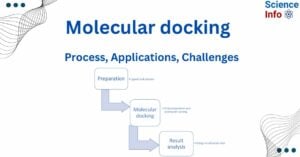
Molecular Docking: Process, Applications, Challenges

Molecular Docking

Molecular docking is an important method for structural molecular biology and computer-aided drug development. Molecular docking often occurs between a small molecule and a target macromolecule. This is commonly known as ligand-protein docking, although there is growing interest in protein-protein … Read more